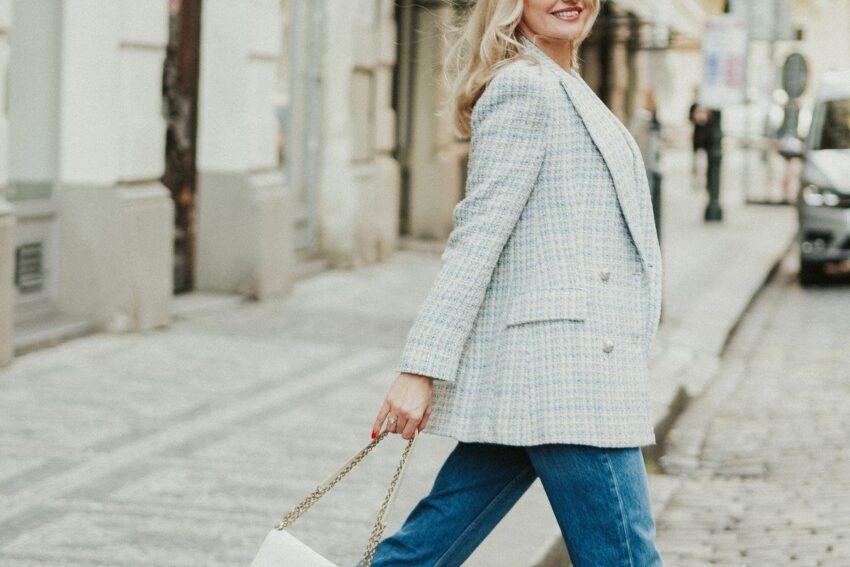
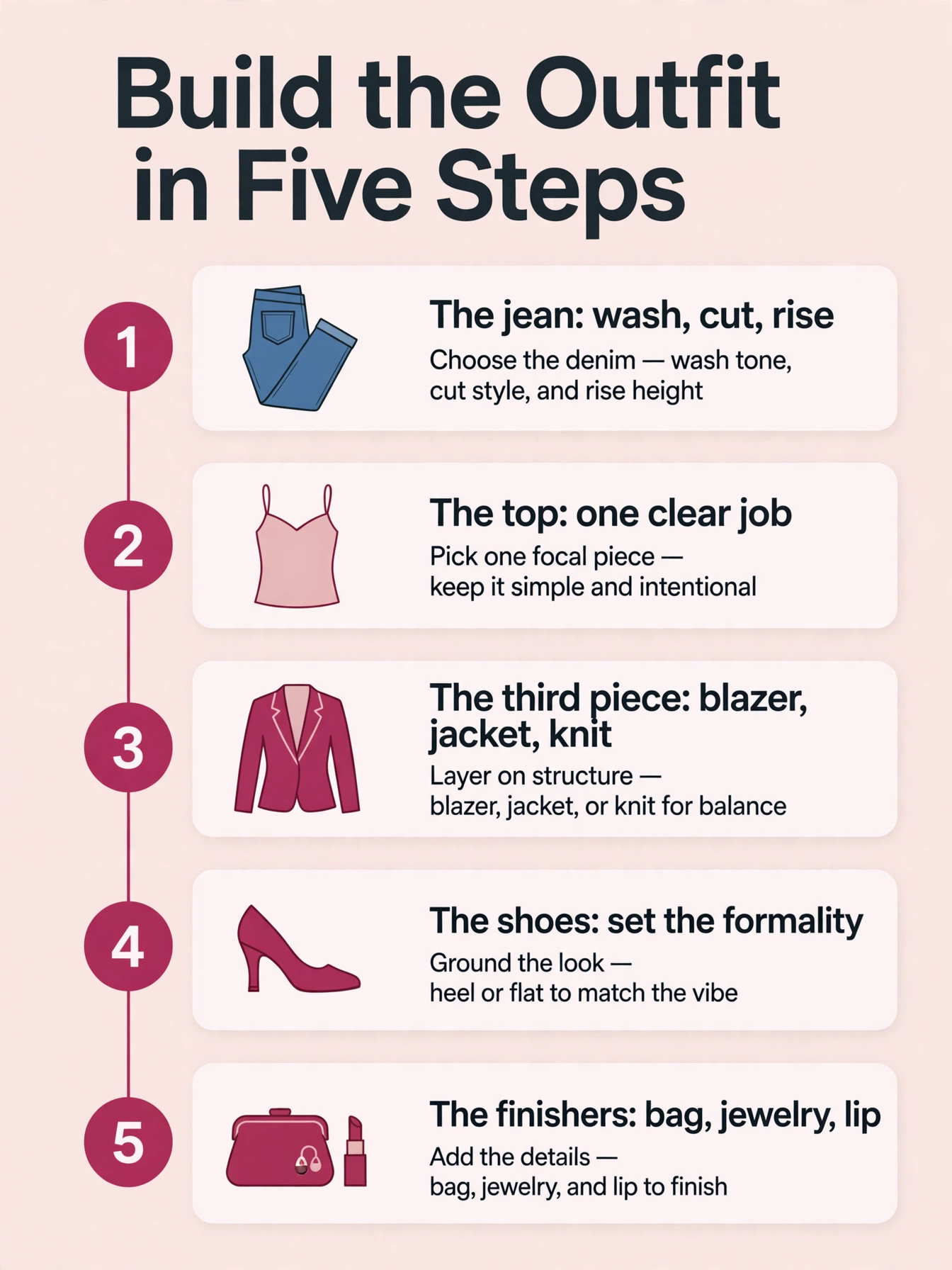
You reach for jeans because everything else feels like a decision you do not have energy for, then you walk in and feel underdressed next to friends in dresses while wearing the same plain top-and-jeans combination you wore last week. The jeans are not the problem. The missing piece is a build order. This guide gives you one: start with the jean itself, then add the top, the third piece, the shoes, and the finishers, in that order, every time.
Friday Night Style
Your Jeans Are Already Half the Outfit
Learn the five-step build that turns the pair you already own into a complete Friday night look for dinner, drinks, a date, or a concert.
Key Takeaways
- Choose the jean first, by wash, cut, and rise, because every later choice has to answer to it.
- Dark and black washes do the most evening work, while medium washes need stronger tops and shoes to catch up.
- Give the top one clear job, contrast, shine, structure, or skin, and let everything else stay quieter.
- Add a third piece whenever the top and jeans alone still read as daytime.
- Finish with shoes that set the formality and small details that prove the outfit was chosen, not grabbed.
Table of Contents
- Step 1: Pick the Jean — Wash, Cut, and Rise
- Step 2: Choose a Top That Does One Job Well
- Step 3: Add the Third Piece
- Step 4: Let Shoes Set the Formality
- Step 5: Finishers — Bag, Jewellery, Hair, and Makeup
- Four Worked Builds: Dinner, Drinks, Date, and Concert
- Fixes for the Two Ways Jeans Outfits Fall Flat
- Our view
- Frequently Asked Questions
- Sources
- Recommended
Step 1: Pick the Jean — Wash, Cut, and Rise
Most jeans outfits fail before a top is even chosen, because the base pair was picked by habit instead of by plan. You own several pairs, but they are not interchangeable. A faded, relaxed pair and a dark, tailored pair send opposite signals, and no top can fully reverse the signal the denim sends first. So start here, deliberately. Decide what the night needs, then pull the pair whose wash, cut, and rise already lean that way. If you want the broader starting point first, our guide to what to wear Friday night maps the options by plan, and this post then narrows the work to the jeans route specifically.
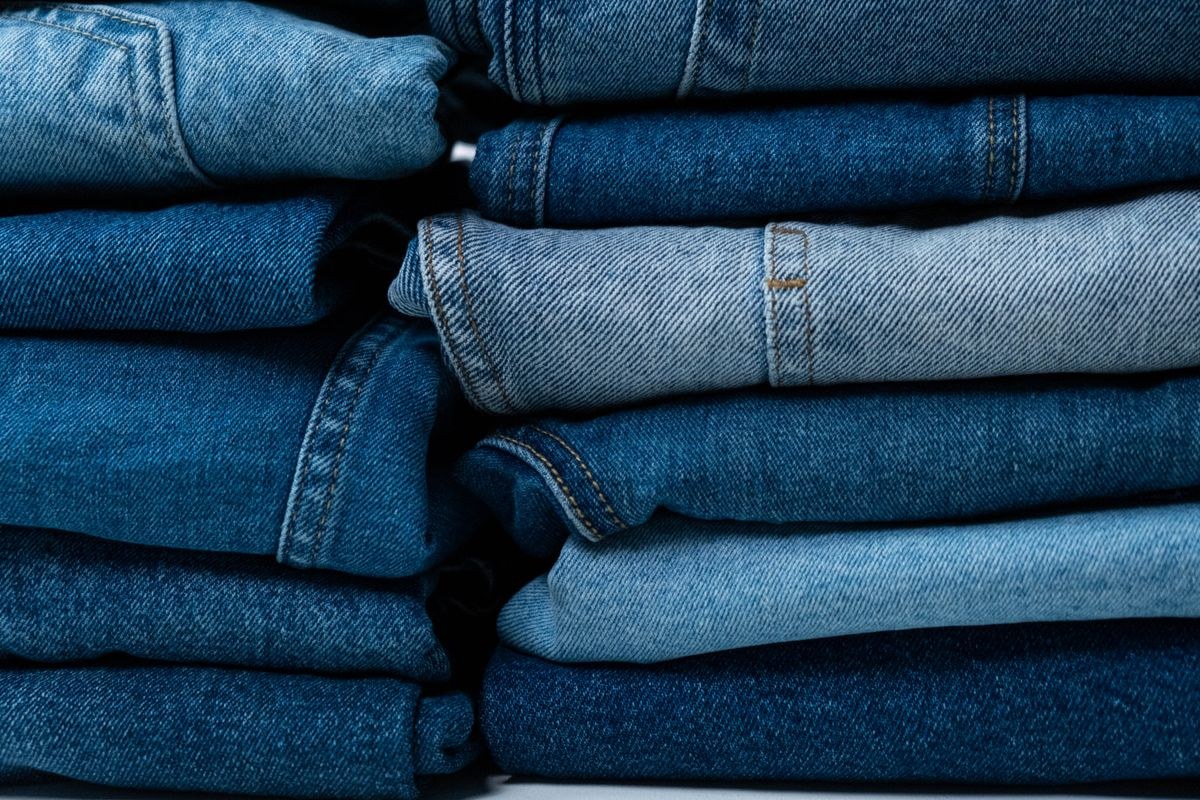
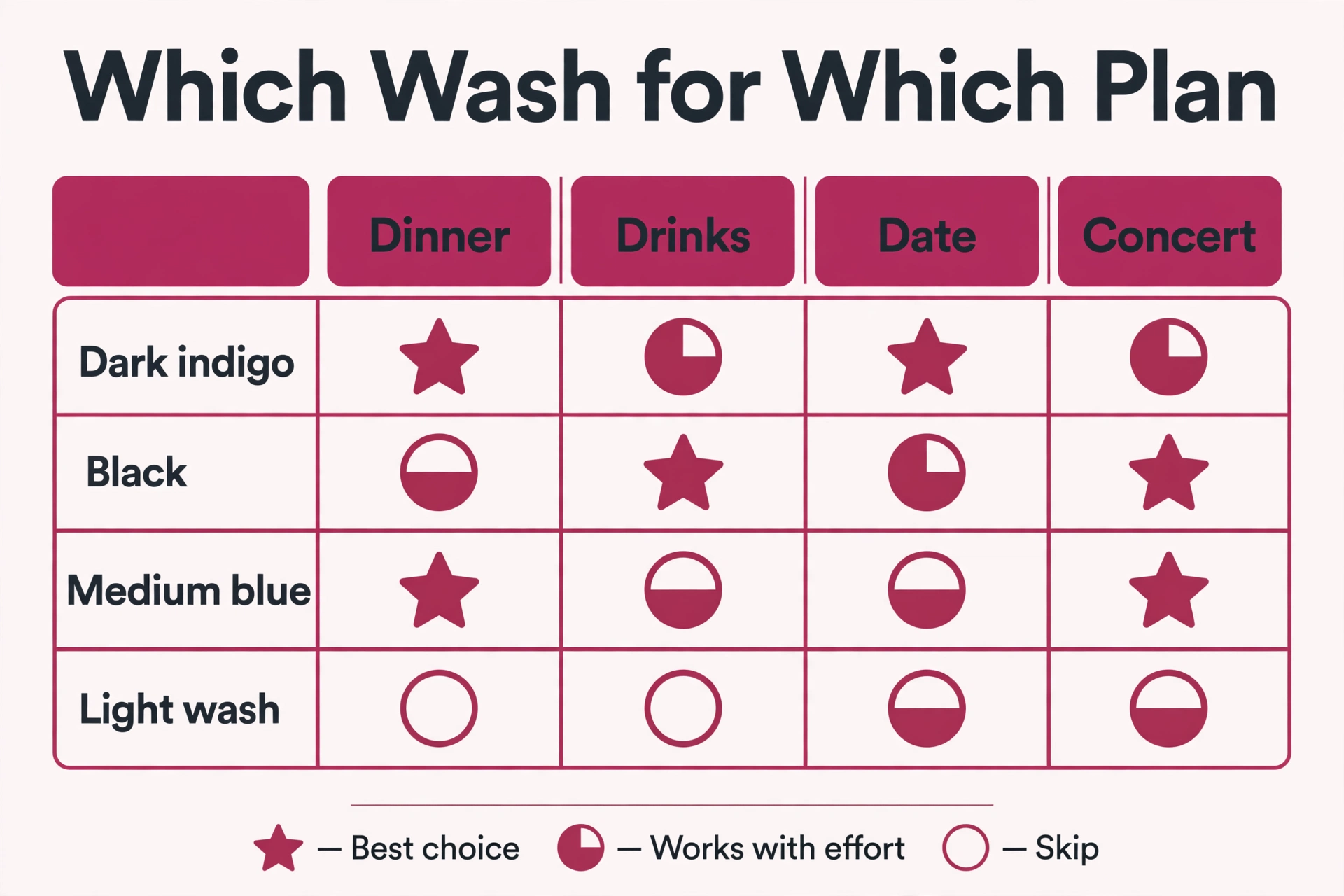
Wash is the fastest formality dial you own. Dark indigo and black read closest to trousers, which is why they carry dinner and date looks with the least help from everything else. The reason is in the dye itself: as CottonWorks explains in its denim basics, indigo sits on the surface of the yarn and fades with washing, so a deep, even wash still holds that saturated colour and reads polished, while a heavily faded wash has literally lost colour and reads relaxed. Medium blue sits in the middle and needs a dressier top or shoe to close the gap. Light wash can work at night, but only when the rest of the outfit is sharp enough to carry it, so treat it as the advanced option, not the default.
Reading cut and rise together
Cut decides the silhouette, and rise decides where the outfit breaks. A straight leg is the most forgiving evening base because it skims rather than clings and pairs with almost any shoe. The Levi’s size guide defines the core shapes plainly, from skinny, slim through the hip and thigh, to straight, the same width from hip to ankle, and bootcut, slim through the thigh with a slight flare at the ankle. Use those definitions when you shop or sort your own drawer, because brand names vary but the geometry does not. A wide leg needs a fitted or tucked top to keep a waist in the picture. A slim or skinny leg can carry a looser, draped top. A bootcut or flare needs a heel or a pointed shoe underneath, or the hem swallows the foot and the whole leg looks shorter.
Rise does quieter work. High rise gives you a defined waist to tuck into, belt, or crop against, which is why it anchors most going-out builds. Stylists quoted by InStyle point to that same waist definition and leg-lengthening effect, and note that a fitted evening top against a high waist creates a clean, unbroken line. Mid rise is the comfortable middle ground for long dinners where you will sit for hours. Low rise can work, but it demands a top that is chosen for it, not a top that happens to end wherever it ends, or the proportions drift. Whatever rise you choose, check the sit test before Friday: sit, cross your legs, and lean forward. A waistband that digs or gaps at home will not improve after two hours at a table.
| Cut and wash | What it does for the outfit | Best Friday plan for it |
|---|---|---|
| Dark indigo straight leg, high rise | Reads almost like a trouser; gives a clean line for tucked tops and blazers | Dinner, date, drinks somewhere polished |
| Black slim or skinny, high rise | Sharpest, most evening base; lets shine, lace, or colour on top stand out | Date, drinks, dance party afterwards |
| Medium blue wide leg, high rise | Relaxed volume that needs a fitted top and a defined waist to stay intentional | Casual dinner, gallery or drinks with friends |
| Dark bootcut or flare, mid or high rise | Lengthens the leg over a heel or pointed boot; balances the hip line | Dinner, date, live music seated venue |
| Light wash straight or relaxed, any rise | Most casual base; needs the strongest top, layer, and shoe to read as evening | Concert, casual drinks, outdoor plans |
Fabric, weight, and the baggy-knee problem
The pair that looks perfect at 7 p.m. and baggy by 10 p.m. is usually a fabric problem, not a fit problem. Denim weight and stretch content decide how long a jean holds its shape through sitting, standing, and dancing. CottonWorks sets out how denim construction, yarn size, weave, and weight work together, noting that jeans-weight fabrics run heavier than shirting denims and that the weave and yarn choices drive stiffness, drape, and strength. In practical terms, a heavier, low-stretch denim holds a cleaner line all night, while a very stretchy, lightweight pair trades that structure for comfort and may relax at the knee and waist as the evening goes on.
That trade-off is manageable once you name it. The Levi’s women’s jeans range sets stretch pairs against 100 percent cotton pairs side by side, and the care advice that protects either is the same: cold washing inside out and air drying, because high heat breaks elastic fibres down over time. So for a long night, reach for low to mid stretch in a cut that already fits without relying on stretch to close the waistband. Save the highest-stretch pair for shorter, more casual plans. And protect the pairs you love: wash them less often, inside out, and keep them out of a hot dryer, so the wash you bought them for stays the wash they keep.
Fit testing matters as much as fabric labels. In its tested roundup, Reader’s Digest describes trying a range of fits and budgets specifically to judge which pairs flatter and hold up in real wear, which is the right standard to apply at home too.
Step 2: Choose a Top That Does One Job Well
With the base fixed, the top has one decision to make: what single job will it do? The outfits that look thrown together usually have a top doing no clear job, a plain tee shape in a plain fabric with no contrast against the denim. The outfits that work give the top exactly one assignment. It can provide shine, in satin, silk, sequin, or a subtle metallic knit. It can provide structure, in a tailored vest, a corset-style bodice, or a crisp shirt with a real collar. It can provide contrast, in a colour or texture that clearly separates from the wash below it. Or it can provide shape, in a draped, wrapped, or off-the-shoulder neckline that changes the silhouette at the top half. Pick one. A top trying to do all four at once reads busy, and a top doing none of them reads daytime.
The classic jeans-and-a-nice-top combination gets dismissed as lazy, but done deliberately it is the opposite. In its evening edit, Who What Wear argues that the combination is a mastered skill rather than a shortcut, pointing to chic knitwear, statement jackets, sparkly pieces, and sleek heels as the elements that give blue jeans an after-dark upgrade. That is the standard to hold your own top to: could you name, in one phrase, what makes it an evening top?
Matching top volume to jean volume
Proportion is the second filter after the job. Wide and relaxed jeans need a top that ends at or above the waist, tucks cleanly, or fits close to the body, otherwise the whole outfit loses its middle and reads as two loose halves. Slim and straight jeans are more flexible: they take fitted tops for a sleek line and looser draped tops for contrast, as long as a tuck or a belt still marks the waist somewhere. The tested fit notes in the Who What Wear Levi’s guide make the same point from the denim side, describing how snug top blocks pair with straighter, more relaxed legs to keep the balance. Read that balance in your own mirror: if both halves are loose, fix the top first, because it is the faster change.
Tops to keep in a small going-out rotation
Step 3: Add the Third Piece
Jeans plus a top is an outfit. Jeans plus a top plus a third piece is a look. The third piece is the layer or structured addition that sits over or completes the top half: a blazer, a leather jacket, a tailored vest worn open, a cropped cardigan, or a statement belt treated as a structural element rather than an afterthought. Its job is to add the polish, edge, or coverage the first two pieces cannot supply on their own,
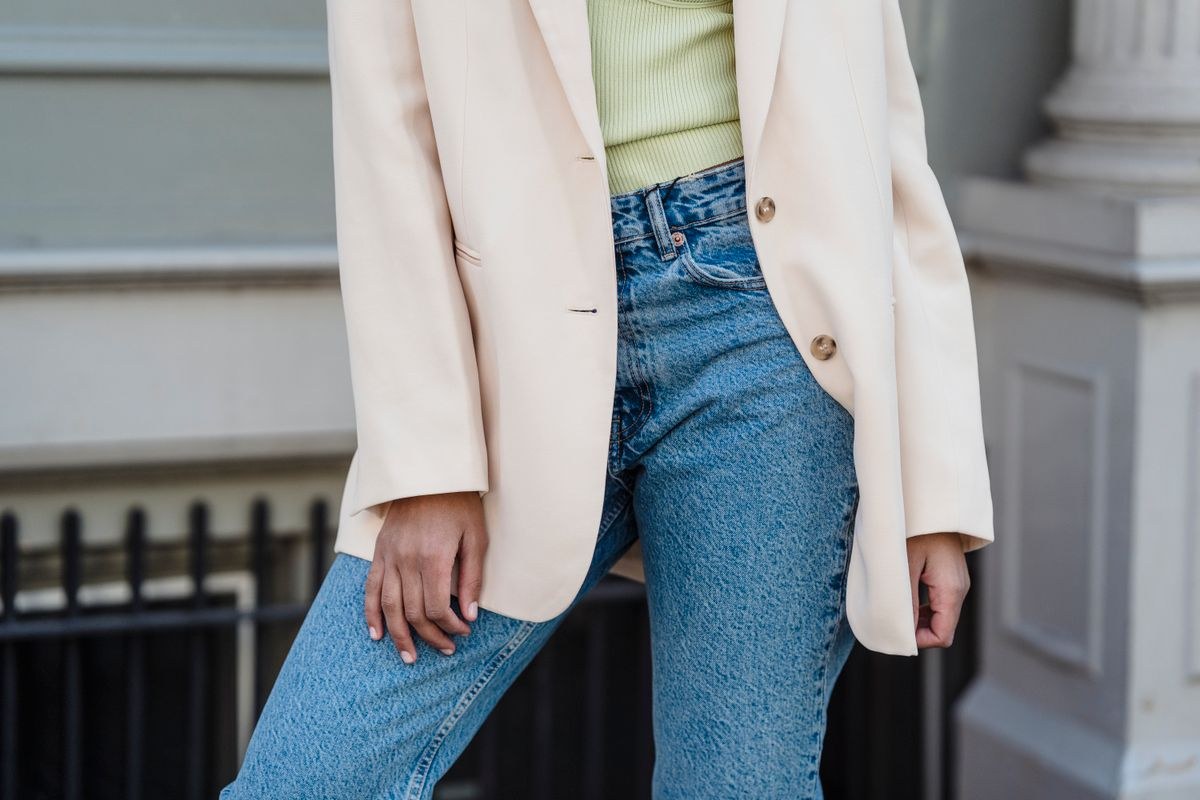
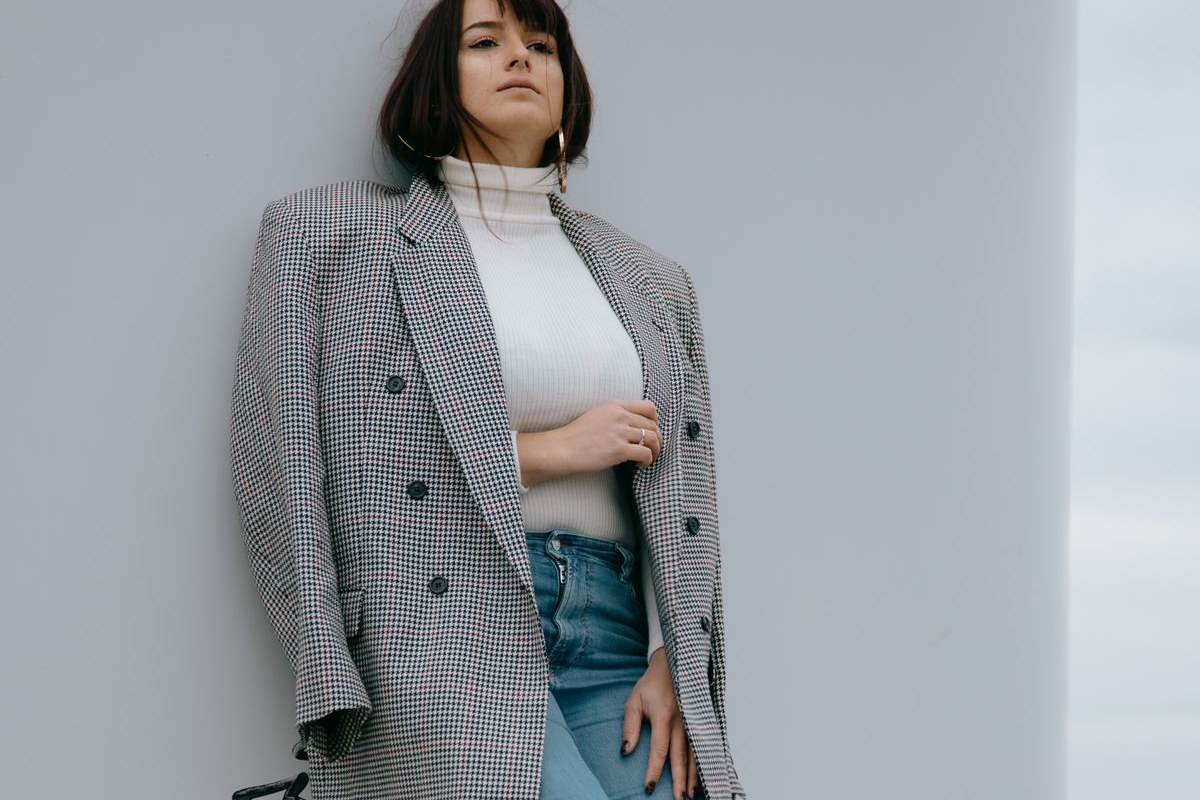
Start with the blazer if you are unsure, because it solves the widest range of problems. A tailored blazer over a camisole and dark straight jeans covers bare shoulders for dinner, sharpens a plain fitted top, and gives slim jeans the structure they lack. Our step-by-step on how to work a button-up style blazer into evening outfits covers the fit checks that matter, including shoulder line and sleeve length. The same logic appears across tested styling advice: InStyle notes that slipping on a blazer instantly gives even relaxed jeans a more tailored aesthetic, which is exactly the rescue a medium-wash pair needs on a smarter night.
Choosing the layer by the gap it fills
Diagnose the gap before you reach for a hanger. If the outfit reads too casual, add structure: blazer, tailored vest, or a belt with real hardware. If it reads too plain, add texture: leather, suede, tweed, or a knit with a visible stitch. If it reads too bare for the venue, add coverage that still shows the top beneath it, worn open or draped over the shoulders rather than closed over the feature you chose the top for. If it reads too soft for the plan, add edge: a leather jacket over lace or satin is the classic contrast, and it is the combination Who What Wear returns to in its dress-up edit, pairing lace bodysuits and wrap tops with denim and letting the tougher or more tailored layer set the evening tone.
When to skip the third piece
Skipping is allowed when the top already contains the third piece’s work. A top with built-in structure, strong sleeves, heavy embellishment, or a jacket-like cut does not need another layer competing with it, and adding one can bury the very feature you chose it for. In that case, treat the belt, the bag strap, or a strong earring as the completing element instead, and move on to shoes. The test is the mirror question again: does the outfit look finished, or does it look like the first two items from a three-item plan? Answer honestly and add or skip accordingly. Readers building a fully dark base can see the no-layer version handled in depth in our guide to the all-black outfit, where texture contrast does the finishing work that a layer would otherwise do.
Step 4: Let Shoes Set the Formality
Shoes are the last formality vote, and they vote loudly. The same dark straight jeans and satin camisole read as dinner with a pointed heel, as drinks with a sleek ankle boot, and as a concert with a clean low boot or a polished loafer. That range is useful only if you choose the vote on purpose. Decide how formal the night actually is, then pick the shoe that states that level, rather than defaulting to whichever pair is by the door. If you regularly feel overdressed or underdressed despite liking the clothes themselves, the shoe is the most likely culprit, because it is the piece most often chosen by habit.
Heel height is only part of the signal. Toe shape and finish matter just as much. A pointed toe lengthens the leg line, especially under bootcut, flare, and straight hems, while a rounded or heavy toe shortens and casualises the same pair. A glossy, metallic, or satin finish reads evening even at a low height, which is why a pointed flat or a kitten heel can out-dress a high but chunky daytime heel. The pairing logic in InStyle works through exactly these contrasts, matching sleek pointed pumps against relaxed denim to modernise it and pairing straight legs with boots for a timeless, edgier result. Borrow the principle even when you borrow none of the specific pairs: contrast the shoe’s polish against the denim’s ease, and the outfit lifts.
Hem and shoe, checked together
Never choose the shoe without the hem in view. A flare or bootcut needs enough heel, or a long enough inseam worn with a boot, for the hem to clear the ground and keep its line; dragging denim undoes every other careful choice in the build. A cropped or ankle straight leg is your shoe-display base, so use it when the shoe is a feature, a strappy sandal, a metallic heel, a statement boot. A wide leg needs a shoe with some presence underneath it, a pointed toe that extends the line or a boot with a defined shape, because a small, soft shoe disappears and leaves the leg looking unfinished. Stand, walk across the room, and sit once in the full combination before you commit. Friday floors include bar floors, pavement, and dance floors, and a shoe that only works standing still in your bedroom is not tonight’s shoe.
Step 5: Finishers — Bag, Jewellery, Hair, and Makeup
Finishers are small, which is exactly why they expose whether an outfit was built or merely assembled. A daytime tote, no jewellery, and hair left exactly as it was at noon tell the room the jeans outfit happened by default, even when every larger piece is right. Ten minutes of finishing tells the opposite story. Work through four checks in order: bag, jewellery, hair, and one makeup change. None of them needs to be dramatic. All of them need to be deliberate, and together they are what stop a good build from reading as an unfinished one.
Swap the bag first, because it is the fastest single change. An evening bag is smaller, more structured, or more finished than your day bag: a clutch, a small shoulder bag, or a mini bag with hardware that catches light. It does not need to match your shoes, a rule that dates an outfit faster than almost anything else, but it does need to belong to the same formality level. A sparkly or metallic bag can also supply the shine a plain top did not, which is why evening styling edits repeatedly pair simple denim bases with a sparkly bag and a drop earring to finish the look. If your top already shines, let the bag go quiet and structured instead. One shine source at a time is enough.
Jewellery, hair, and the one-change rule
Jewellery works best layered with intention rather than added by handful. Our full method for how to layer jewellery like a pro covers necklace lengths and mixing, and the short version for a jeans build is this: choose one zone to emphasise, neck, ears, or wrist, and let the other zones support it quietly. A bare or open neckline takes a layered necklace well. A high neckline shifts the emphasis to earrings. A sleeveless top gives a bracelet or cuff room to be the feature. Gold against dark indigo and black denim warms the whole look, while silver and crystal sharpen it, so pick the metal that matches the temperature you want rather than mixing by accident.
Do a final full-length check before you leave, in this order: base, top job, third piece, shoe vote, finishers. It takes under a minute once the order is habit, and it catches the one forgotten swap, usually the bag or the earring, while you can still fix it. This closing check is the practical habit behind our broader friday night outfit formula, applied here specifically to a jeans base. Readers who want the age-specific version of these finishing choices, including comfort and coverage adjustments that keep the same build order, will find it in our guide to friday night outfits over 40, which uses this identical sequence with different piece choices.

Four Worked Builds: Dinner, Drinks, Date, and Concert
A system only proves itself in complete outfits, so here are four builds using the five steps in order. Each one starts from a different jean base, because the base is what changes the character of everything layered over it. Notice what stays constant: one job for the top, a deliberate third piece or a deliberate skip, a shoe chosen for the plan’s formality and movement, and finishers that take minutes. Swap any single piece to fit your own wardrobe, but keep the order, because the order is what makes the swaps safe.
Dinner. Start with dark indigo straight-leg jeans in a high rise, the trouser-like base that carries a seated, food-focused evening. Top job: quiet shine, a satin camisole or a fine-knit fitted top in a deep tone, tucked fully to keep the waist clean while you sit. Third piece: a tailored blazer, worn open, which covers shoulders in a restaurant and sharpens the camisole’s softness. Shoes: a pointed low heel or a sleek ankle boot, formal enough for the room and stable enough for the walk there. Finishers: a structured clutch, one layered necklace in the camisole’s neckline, hair loose or softly waved. For the table-specific details, dress codes, and what to avoid when food is the main event, our guide to what to wear to a Friday night dinner goes deeper on this exact build.
Drinks and date builds
Drinks. Start with black slim jeans, the sharpest base, because bar lighting and standing crowds reward a clean, dark leg line. Top job: texture or shine, a lace-trim camisole, a sequin knit, or a draped top that moves a little when you do. Third piece: skip the full layer if the top is strong, and let a belt with real hardware do the structural work, or drape a blazer over the shoulders for the walk between venues. Shoes: a block-heel sandal or a pointed boot, chosen for standing time rather than for height. Finishers: a small shoulder bag you can keep on your body, earrings as the emphasised zone, and the one makeup change pointed at the eyes or the lip, not both. This build tolerates a medium-wash straight leg instead of black, but only if the top’s shine increases to compensate for the more casual base. If the night continues to dancing, our guide to what to wear to a Friday night dance party covers the shoe and bag swaps that keep the same base working.
Date. Start with dark bootcut or straight jeans, whichever pair passed your sit test most comfortably, because a date punishes fidgeting with an uncomfortable waistband. Top job: shape, a wrapped, draped, or fitted top that defines the waist against the high rise and leaves one focal area, neckline or fabric, not both. Third piece: a soft structure, a cropped cardigan, a tailored vest, or a blazer you can remove, so the silhouette underneath was planned to be seen. Shoes: a pointed heel or boot at a height you can walk in without thinking about it, because confidence is visibly a styling element here. Finishers: warm metal jewellery against the dark wash, hair deliberately different from your daytime style, and a bag small enough to set aside. The aim is polished and at ease at once, which is why every choice in this build favours the comfortable version of elegant over the fragile version.
The concert build
Concert. Start with the pair you can move in for three hours: a medium or dark straight leg or a relaxed fit with low to mid stretch, checked for the baggy-knee problem in Step 1, because you will stand, climb, and possibly dance in them. Top job: security plus one feature, a bodysuit that cannot come untucked, with its feature in the neckline, back, or fabric. Third piece: a leather jacket or an open overshirt you can tie, carry, or check, chosen because venues run hot inside and cold on the way home. Shoes: a low boot, a block heel, or a polished flat with a closed toe, because concert floors are crowded and unforgiving. Finishers: a crossbody mini bag that stays hands-free, jewellery kept to one zone so nothing catches or swings loose, and hair in the style most likely to still look intentional at the encore. Distressed denim can appear here as a passing option for the most casual venues, and if that is your pair, our separate guide on how to style ripped jeans covers that single style in full, but for dinner, drinks, and dates the clean bases above will always work harder.
Keep those bases ready with simple care: the John Lewis Levi’s guide advises turning jeans inside out, washing cold on a gentle cycle with similar colours, and hang drying rather than tumble drying to preserve fit and colour, so your dark dinner pair stays dark and your black date pair stays black.
Fixes for the Two Ways Jeans Outfits Fall Flat
Even with the build order in hand, three failure patterns repeat often enough to name directly, because each one has a specific fix rather than a general plea to try harder. The first is the all-casual stack: a casual wash, a casual top fabric, a casual shoe, and a day bag, where no single piece is wrong but every piece votes the same way and the total reads as daytime. The fix is to change the two cheapest votes, not the whole outfit. Keep the jeans and top, swap the shoe up one formality level, swap the bag down one size, and add one piece of deliberate jewellery. Two changed votes out of five are usually enough to move the total.
The third pattern, and the Thursday habit that prevents all three
The third pattern is the single fancy piece: one sequin top or one statement heel carrying an otherwise entirely daytime outfit, so the piece looks borrowed rather than built in. The fix is to give the star piece one supporting player at its own level, a metallic bag echoing a sequin top, a blazer echoing a statement shoe’s polish, so the eye finds the formality level confirmed twice and accepts it as the outfit’s intent. Good dress-up styling follows this same pattern throughout, rarely letting one evening piece stand alone against denim, and instead backing it with a tailored layer, a sleek shoe, or a finished bag.
Our view
We believe jeans are not the casual shortcut in a Friday night wardrobe; they are the hardest-working base in it, and they only look like a shortcut when the build stops after step one. Pick the pair on purpose, give the top one job, finish the layers, shoes, and small details with the same care, and the outfit stops apologising for starting with denim. The women who look most at ease on a Friday night are rarely the ones in the most complicated clothes. They are the ones whose clothes were decided in the right order.
— Friday Night Style
Frequently Asked Questions
Can I wear light-wash jeans on a Friday night?
Yes, for casual plans such as concerts, outdoor drinks, and relaxed dinners, as long as the rest of the build works harder. Pair a light wash with a dressier top, a structured layer, and a polished shoe, and keep the denim clean and free of heavy distressing. For smarter dinners and dates, a dark or black wash will always reach the right level with less effort.
Which jeans are best if I will be sitting at dinner for a long time?
Choose a mid or high rise with low to mid stretch, in a straight or bootcut leg, and pass the sit test at home first. Very high-stretch, tight pairs tend to dig at the waist or relax unevenly over a long meal, while a structured pair with a small amount of give holds its line and stays comfortable.
How do I stop my jeans outfit looking the same every week?
Change the base, not just the top. Rotate between your dark straight, black slim, and wide or bootcut pairs, and attach one planned build to each pair, with its own top job, layer, and shoe. Three bases with two builds each give you six distinct Friday outfits before any new purchase.
Do my bag and shoes need to match?
No, and exact matching can make an outfit look dated. They need to agree on formality, not colour. A structured clutch works with almost any evening shoe, and a metallic bag or shoe can act as the outfit’s single shine source while the other stays quiet.
What is the fastest fix if my outfit still looks too casual at the door?
Swap the shoe up one level and swap the day bag for a small evening bag. Those two changes take two minutes, vote loudly on formality, and fix the most common version of the problem without rebuilding the whole outfit.
Questions About Building an Outfit From Jeans?
Tell us the plan, the dress code, and the part of the outfit that is not working — we read every message.
Sources
- Levi’s Product Size Guide
- Levi’s Women’s Jeans
- Who What Wear — Evening Outfits With Jeans
- Who What Wear — Ways to Dress Up Jeans
- Who What Wear — Levi’s Jeans Fits Guide
- InStyle — Best High-Waisted Jeans
- InStyle — Bootcut Jeans Outfits
- InStyle — Jeans and Shoe Pairings
- CottonWorks — Denim Basics
- CottonWorks — Denim Construction
- Reader’s Digest — Best Jeans for Women
- John Lewis — Levi’s Jeans Guide