
You love the dress, and then the doubt starts: will it read as confident on a date, easy with friends, right for the restaurant, and fine in photos, or will you spend the night tugging at it? Cover up too much and you feel unlike yourself; cover too little for the room and self-consciousness takes over. This guide gives you a calm reading system — three dials, one focal point, and a two-minute mirror check — so you can adjust the signal without abandoning the outfit you chose.
Friday Night Style
Read the outfit before the room does
A simple mirror system for balancing neckline, hemline, and fit — so the dress you love reads exactly the way you meant it to.
Key Takeaways
- Judge the outfit as a whole signal — neckline, hemline, and fit combine, and no single detail decides the read on its own.
- Give the outfit one clear focal point and let everything else support it quietly.
- Calibrate for the actual room: venue, plan, company, photos, and weather all shift what reads as balanced.
- Test in motion and on camera before you leave, because an outfit that shifts is an outfit you will monitor all night.
- Use small fixes — a liner, tape, a carried layer — to adjust the read instead of changing into something you like less.
Table of Contents
- The Three Dials That Set the Read
- The One-Focal-Point Rule
- Reading Neckline, Hemline and Fit Together
- Calibrating for the Room
- The Photo Test and the Movement Test
- Small Fixes That Change the Read Without Changing the Outfit
- The Mirror Self-Check, Step by Step
- Our view
- Frequently Asked Questions
- Sources
- Recommended
The Three Dials That Set the Read
“Too revealing” sounds like a line you either cross or do not, but an outfit does not work that way. What people actually register is a combined signal, and it forms fast. Research on thin slices of behavior shows that observers form detailed, durable impressions from very brief exposure, and work on first impressions confirms that those early readings are built from the whole presentation at once — face, posture, and clothing together — rather than from one item inspected in isolation. That is good news for you in the mirror: because the read is a sum, you can change the sum by adjusting any one part of it.
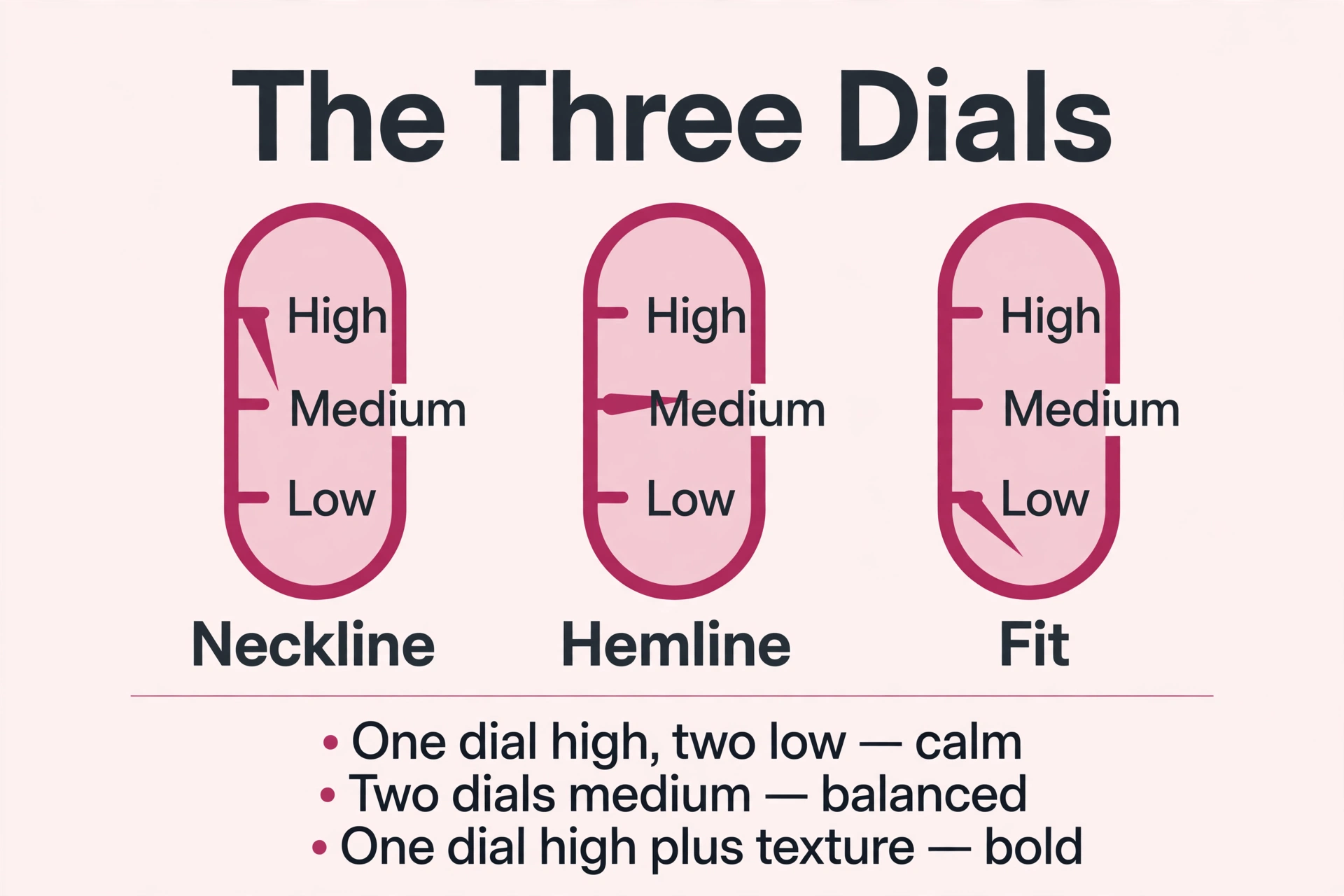
Think of the sum as three dials. The first dial is the neckline: how open the top of the outfit is, and where it directs the eye. The second is the hemline: how much leg the outfit shows, and how the length behaves when you sit and walk. The third is fit: how closely the fabric follows your body, and how much structure it holds as you move. Each dial can be turned up or down independently, and the outfit’s overall read is roughly the total of the three. A high total is not a problem in itself — plenty of rooms welcome it — but a high total reached by accident, in a room that expected less, is exactly what produces the tugging, checking, second-guessing feeling you are trying to avoid.
The dials at a glance
| Dial | Turns the read up when | Turns the read down when | Quick way to soften it |
|---|---|---|---|
| Neckline | It is deep, wide, sheer, or prone to gaping when you lean | It is higher, narrower, opaque, and stays put in motion | Add a liner or camisole, tape the edge, or layer over it |
| Hemline | It is short, slit high, or rides up when you sit | It falls longer, moves freely, and covers the same standing or seated | Add tights or boots, choose a lower heel, or carry a longer layer |
| Fit | It is body-close, thin or clingy, and shows every underlayer line | It skims, is structured or lined, and holds its shape as you move | Choose smoother underlayers, a slip, or one looser layer on top |
Read your outfit dial by dial and be honest about each one. A deep neckline on a long, fluid dress is one medium dial and two low ones. A short hem on a high-neck, long-sleeved dress is the same shape of outfit, with the emphasis moved. The outfits that tend to feel like “too much” in the mirror are usually the ones where all three dials are high at once — deep and short and body-close — because then there is no quiet area for the eye to rest, and no margin when the fabric moves. If you are building from scratch rather than checking a dress you already own, the friday night outfit formula gives you a balanced base to start from, and this check then fine-tunes it.

Why the total matters more than any single piece
It helps to know that this combining effect is not just stylist folklore. In research on attire and emotion, clothing consistently shaped how observers read status and confidence, yet it was always read alongside the wearer’s expression and bearing — the outfit was one cue in a chord, never a solo note. Studies of clothing style and first impressions found the same pattern from the other side: identical people were rated differently depending on the whole style they wore, and styles that were unusual for the setting drew the most extreme ratings. In plain terms, people read outfits in context and in combination. Your job in the mirror is simply to do deliberately what every observer will do automatically.
That is also why arguments about a single garment — “is this neckline too low,” “is this skirt too short” — so rarely settle anything. The honest answer is almost always “compared with what else the outfit is doing, and where?” A neckline that feels bold on a body-close mini can feel elegant on a flowing midi. A hem that feels daring with a strappy, fitted top can feel playful and relaxed with a soft, covered one. Once you stop grading pieces and start reading totals, the mirror gets much quieter, and decisions get much faster.
The One-Focal-Point Rule
If the three dials tell you how strong the signal is, the focal point tells you where it points. A balanced outfit has one place the eye lands first: the neckline, the legs, the back, the waist, a slit, a bare shoulder. Everything else supports that choice by being calmer — more covered, looser, longer, or simpler. This is not a rule about hiding. It is a rule about emphasis. One strong statement reads as intentional; three competing statements read as unresolved, and unresolved is what most people actually mean when they say an outfit looks like “too much.”
Try it as an experiment in your own closet. Take the dress you are unsure about and name its focal point out loud. If you cannot name one, the outfit probably has either no emphasis at all — which can read as shapeless rather than modest — or several emphases fighting each other. If you can name two or three, pick the one you love most and soften the others by one notch each. You are rarely changing the outfit; you are clarifying it. A short dress keeps its length and gains a higher neckline or a sleeve. A low neckline keeps its drama and gains length or ease below. The focal point survives; the noise around it drops.

Focal points in separates and in dresses
With separates, you hold the dials in different hands, which makes balancing easier: a more open top pairs naturally with a longer or looser bottom, and a shorter skirt pairs naturally with a covered, relaxed top. Guidance on pleated skirts makes the same trade in miniature, suggesting that a shorter skirt be balanced with an oversized top and flat or low-heeled shoes, while longer lengths can carry a closer fit up top. With a one-piece dress, the designer has already set the dials, so your levers are the styling around it: shoes, layers, hair, and underlayers. Lower, simpler shoes turn the hemline dial down. A layer worn or carried turns the neckline dial down when you want it to. Hair worn up exposes a neckline fully; hair worn down softens it. None of these change the dress. All of them change the read.
This is also the kindest way to think about advice you may have heard as a warning. Where an older conversation about promiscuous clothing dealt in labels for whole looks, the focal-point rule deals in emphasis, which is something you control garment by garment. And where the art of dressing sexy without trying too hard is about ease of styling, this check is about placement: one clear emphasis, chosen by you, on purpose. The two skills stack — ease in how you put it together, clarity in where it lands.
When you want a bolder total
Sometimes you genuinely want two dials high: a celebration, a dance floor, a night where dressing up is the point. The system does not forbid that; it asks you to choose it knowingly and support it — if two dials run high, make the third work harder, with structure, lining, and secure fit, because the outfit has no slack left for a strap that slips or a hem that climbs. Bold and secure reads as confident; bold and precarious reads as a wardrobe problem in progress. Choose bold if you want it — just pay for it in fit and security, not in worry.
Reading Neckline, Hemline and Fit Together
The dials are easy to learn separately and more useful in combination, because certain pairings amplify each other. Depth plus closeness is the strongest amplifier at the top of an outfit: a neckline that is both low and body-hugging reads considerably bolder than the same depth in a soft, draped fabric that moves independently of you. Length plus closeness amplifies at the bottom: a short, fitted hem reads bolder than the same length in a flared or fluid skirt, because the fluid skirt gives the eye movement and coverage in motion even while the measurement is short. Sheerness amplifies everything it touches, since it raises the effective openness of whatever dial it sits on while adding a second layer of visual information.
Neckline: depth, width, and behavior
Read a neckline on three points. Depth is where it ends. Width is how much shoulder and chest it spans. Behavior is what it does when you lean forward, sit, reach, and laugh — the moments a static mirror check misses. A deep but narrow neckline in a structured bodice can be the most secure thing you own, while a modest-looking scoop in a loose knit can gape every time you lean over a table. Museum costume collections make the long view visible: the Costume Institute evening dress notes how an era’s glamour was built from a daring low bodice paired with an elaborately worked, substantial skirt — emphasis up top, weight and coverage below. Designers have been balancing dials against each other for as long as there have been evening dresses; you are using the same instinct with a shorter checklist.
For date dressing in particular, behavior matters more than depth. Our guide to what to wear on a friday night date assumes a lot of leaning in, sitting across a small table, and walking side by side — all movements that test a neckline. Tape or a liner that keeps the edge where you placed it converts a daring neckline into a settled one, and settled is what lets you forget about it.
Hemline: length, slit, and the seated test
Read a hemline seated, not standing. Stand in front of the mirror and the measurement looks fine; sit in a chair like the one at dinner and a short hem rides, a slit opens further, and a fitted skirt shortens itself by inches. The seated test is the honest one for almost every Friday plan, from the booth seating covered in our friday night dinner guide to a friend’s sofa. Check three things seated: where the hem lands, whether the slit stays where it was, and whether you can cross and uncross your legs without a hand hovering. If all three pass, the length is fine for that plan, whatever the tape measure says. If one fails, the fix is usually underlayers or footwear, not a different dress — a slip short under a short hem, tights under a slit, or a lower heel that changes how a fitted skirt sits.
Height of heel belongs in this reading too, because heels change both proportion and posture: the same hem reads shorter and the whole silhouette reads dressier on a high heel than on a flat. That is a lever, not a trap. If the hem feels borderline, dropping the heel is often enough to bring the total back into the range you wanted, with the dress untouched.

Fit: the dial that decides how the night feels
Fit is the dial you feel from the inside, and it may be the most important of the three. Research on enclothed cognition describes how the symbolic meaning of clothing and the physical experience of wearing it combine to shape how the wearer herself thinks and feels — what you wear acts on you, not only on observers. The classic swimsuit study on PubMed found that clothing which heightened women’s self-consciousness about how they looked consumed real attention, leaving less for everything else. Translate that to a Friday night: an outfit that needs monitoring — a strap checked, a hem smoothed, a neckline adjusted every few minutes — taxes the exact attention you wanted to spend on the people you came to see. A slightly less bold outfit that needs nothing from you will almost always produce a better night, and, not coincidentally, a more confident impression.
So grade fit by monitoring cost. Zero-cost fit holds its shape standing, seated, and in motion, and lets you forget it entirely. High-cost fit looks wonderful for the photograph at the door and then bills you all evening. If a piece is high-cost, either fix the cost — sizing, tailoring, underlayers, tape — or accept that its read includes the adjusting, because observers see the tugging as part of the outfit. Work on clothing and perceptions of intent is a useful reminder here that observers read clothing cues quickly and sometimes unfairly, and they read the whole presentation, fidgeting included. You cannot control every reading, but you can remove the avoidable noise from yours. For close fits generally, our bodycon outfits guide covers choosing structure and fabric weight that keep the fit dial deliberate rather than accidental.
Calibrating for the Room
The same outfit reads differently in different rooms, and calibration is simply matching your total to the room you are actually entering. Start with the stated code if there is one. The Emily Post attire guide places a short cocktail dress and dressy separates under semi-formal, and advises erring toward formality for evening events — a reminder that most codes regulate formality, not coverage, so a bold-but-polished outfit usually satisfies a code better than a covered-but-casual one. When there is no code, read the venue instead: lighting, seating, how much you will be standing among strangers versus sitting among friends, and what the occasion celebrates. A birthday dinner centers a friend; an engagement celebration, like the ones in our engagement party guide, centers a couple. In rooms that center someone else, the gracious calibration is a notch below your boldest, not because your outfit is wrong, but because emphasis is a finite resource in a room and sharing it is part of dressing well for other people.
Company, plan, and photos
Company recalibrates as much as venue. Friends who know you read your outfit against everything they know about you, which softens almost any signal. New company — a date’s friends, colleagues after hours, a partner’s family — reads the outfit alone, at full strength, which is why the same dress can feel effortless in one group and exposed in another. Neither reading is the true one; they are different audiences applying different context. Choose for the audience you will actually have. If you are meeting new people and want the outfit’s full effect available but not mandatory, carry the adjustment with you: the layer in your bag is a dial you can turn mid-evening, in either direction.
The plan matters in practical ways. Dancing raises every dial — hems travel, necklines shift, fit is tested at speed. A seated dinner lowers them. A walking-heavy night argues for footwear that keeps your posture natural, because posture is part of the read: research on attire and posture — a study of how even small changes to clothing altered judgments — underlines how readily observers fold body language into their impression of an outfit. Photos deserve their own sentence in the calibration: cameras flatten layers, flash makes thin fabrics more transparent than they look in a mirror, and a seated group photo shows hems at their shortest. If the night will be photographed, run the photo test below before you leave, and let the camera, not the mirror, have the last word.

Weather and the carried layer
Weather is the dial-turner nobody plans for. Heat makes fabrics cling and liners feel unbearable; cold makes a bare outfit read bolder simply because everyone else is bundled, and it tempts you into a mismatched cover-up grabbed at the door. Plan the layer as part of the outfit: a blazer, a cropped jacket, a soft wrap, or a long coat chosen to work with the dress rather than hide it. Mixing a hard-edged layer over a soft dress is a styling move in its own right — see how to mix soft and hard — and it doubles as your calibration tool: worn open it frames the focal point, worn closed it turns the total down, carried it costs nothing. Color plays into the room read as well; if you are choosing between two versions of an outfit, what color to wear on friday night can help you pick the one whose signal matches the room’s mood.
The Photo Test and the Movement Test
Two tests, five minutes, and most mirror doubt is settled with evidence instead of mood. The movement test comes first. In the outfit, with the shoes and underlayers you will actually wear, do the evening in miniature: sit down and stand up three times, lean forward as if across a table, reach up as if for a shelf or a hug, walk a short flight of stairs if you have one, and sit cross-legged or with legs crossed if that is your habit. Note every place a hand went to adjust something. Each adjustment point is a fix to make now — tape, a liner, a different underlayer, a safety pin placed invisibly — or a dial to turn down deliberately. An outfit that passes the movement test untouched has earned your trust; wear it and stop re-checking.
What the camera sees that the mirror does not
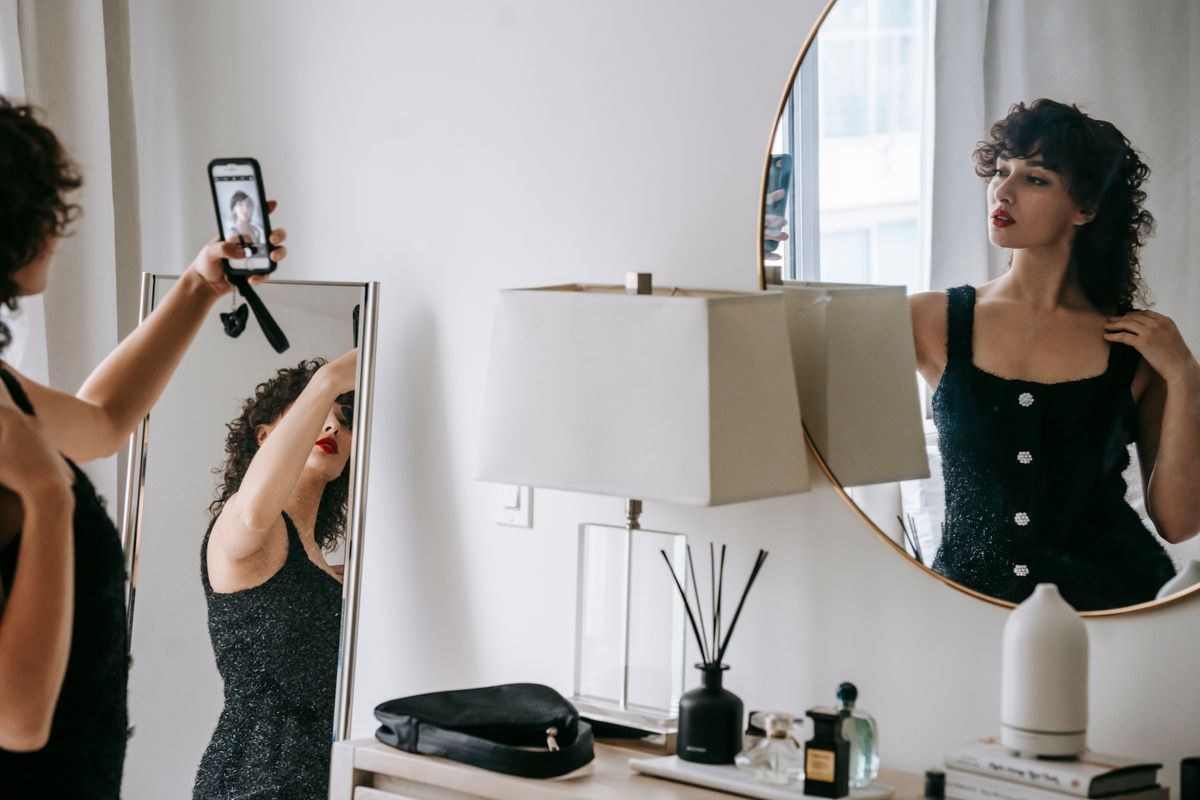
Then take three photos, or a short video, in the brightest light you have: one standing, one seated, one mid-movement. Check them for the camera-specific effects — flash transparency, a hem that reads shorter at a seated angle, a neckline that opens from above, underlayer lines that the mirror’s softer light hid. The point is not to scrutinize yourself; it is to see the outfit the way the room’s phones will. If a photo shows something you did not intend, you have found a cheap fix at home instead of a surprise in a tagged picture tomorrow. If the photos match your intention, you have proof, and proof is the best antidote to the mid-evening urge to keep checking.
A note on other people’s opinions
At some point, someone else’s voice usually joins the mirror — a friend who loves it, a friend who would never. Weigh those voices by what they know: the room, the plan, and how you feel in the dress are evidence; a general preference for how women should dress is not. For options rather than verdicts, browse our friday night outfit ideas for ladies and the broader what to wear friday night guide. Your calibration is a practical judgment about a specific night, and you are the only one holding all the information it requires.
Small Fixes That Change the Read Without Changing the Outfit
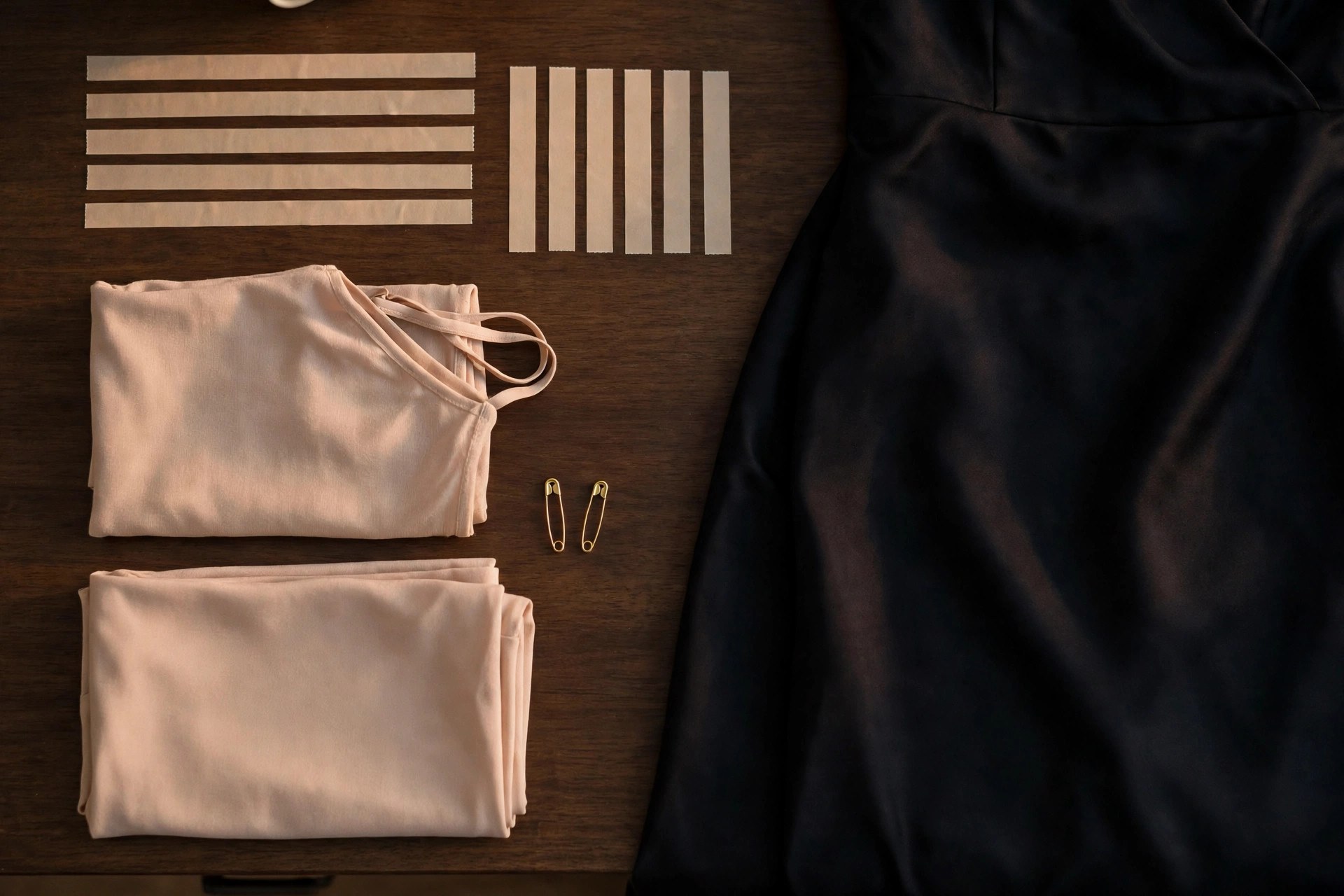
Most calibration is done with small, reversible tools, not with a different dress. Keep the kit in mind as dial-turners. A nude or tonal liner under a sheer panel turns the sheerness dial down while keeping the design. A camisole with a neckline that echoes the dress turns depth down without a visible “modesty panel” effect — match the line, not just the color. Slip shorts under a short or slit hem buy you seated freedom without adding visible coverage standing. Tights or tall boots shorten the amount of leg on display while keeping the hem exactly where the designer put it. Each of these preserves the outfit you chose and changes only its total.
Tape, pins, and secure edges
For necklines and straps, the professional standby is double-sided fashion tape, and the Hollywood Fashion Secrets guide lays out the method: start with clean, dry skin, press the tape along the inside edge of the neckline, and hold the fabric firmly for several seconds, then test by moving your arms and shoulders. Applied that way, tape converts a neckline you would have guarded all night into one that stays where you placed it — the read softens not because there is less neckline, but because there is no gaping, slipping, or adjusting attached to it. Carry two spare strips in your bag; heat and dancing loosen adhesive, and a thirty-second bathroom refresh restores the morning’s calibration completely. A small safety pin placed on the inside at a wrap dress’s crossover or a slit’s apex does the same job where tape cannot grip, and an invisible stitch taken in advance does it permanently for a dress you wear often.
The layer as a dial, and the exit check
Treat your layer as equipment, not apology. A tailored blazer over a slip dress, a cropped jacket over a fitted one, a long coat over everything: each lowers the total while adding polish, and each can come off when the room turns out warmer, later, or more relaxed than expected. This is the easiest calibration to reverse mid-evening, which makes it the right first move whenever you are genuinely unsure between two reads — arrive at the more covered version, read the room with your own eyes, and adjust. Uncertainty is not a failure of judgment; it is information arriving late, and a carried layer is how you dress for information that arrives late.
Finally, run the exit check at the door, in this order: focal point named, dials totaled honestly, movement test passed, photo test passed, layer and tape in the bag. If all five are done, the question “how revealing is too revealing” has been answered for tonight, by evidence, in about five minutes. Walk out and spend the night on the night.
The Mirror Self-Check, Step by Step
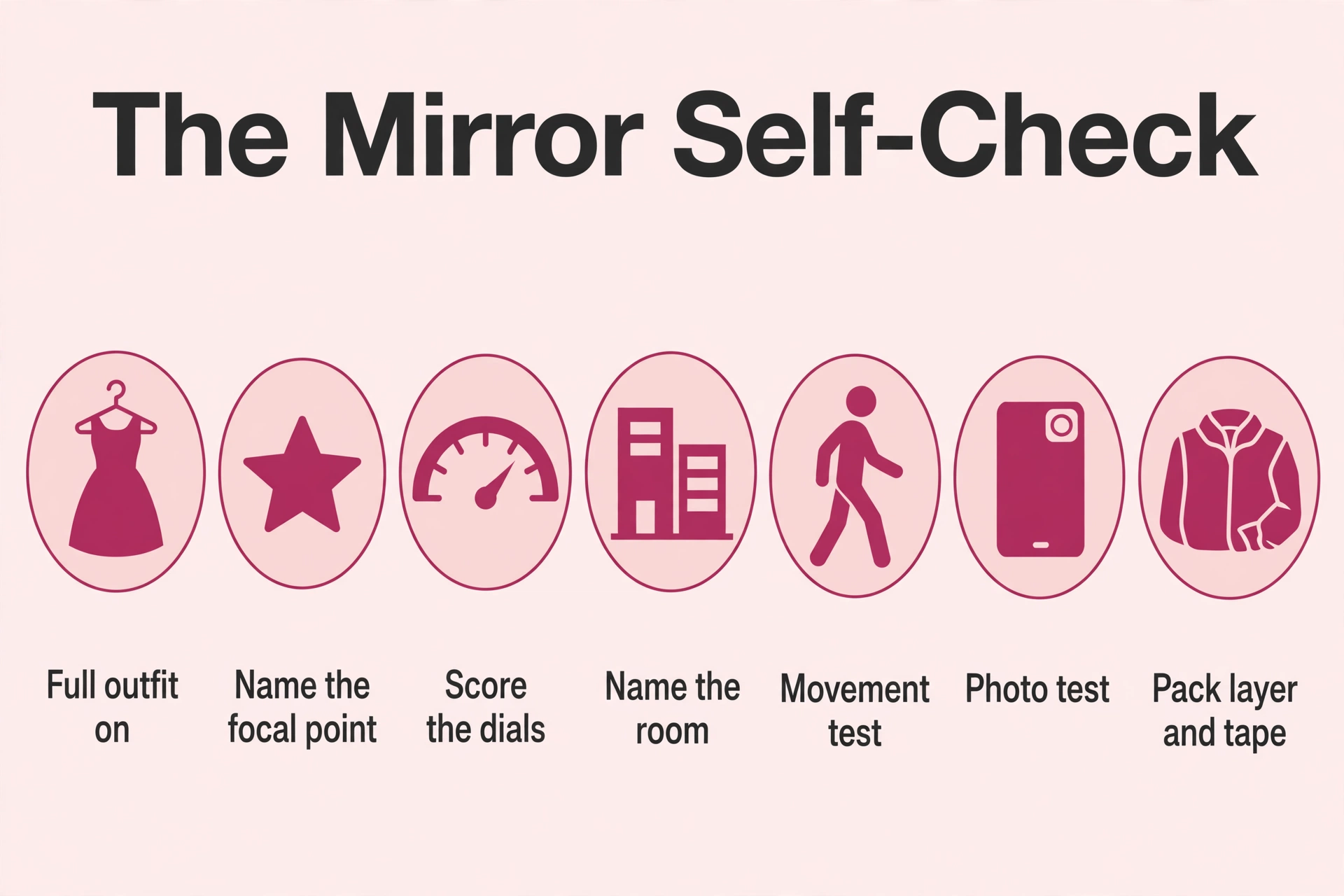
Here is the whole system as one sequence, the way to actually run it. Step one: put on the complete outfit — shoes, underlayers, jewelry — because partial outfits give partial readings. Step two: name the focal point. If you cannot, add or subtract emphasis until you can. Step three: score the three dials, low, medium, or high, and say the total plainly. Step four: name the room — venue, company, plan, photos, weather — and ask whether the total fits it, adjusting one dial if it does not. Step five: run the movement test and fix every adjustment point. Step six: run the photo test, seated and standing. Step seven: pack the layer and the tape. Seven steps, five minutes, and the mirror goes back to being a mirror instead of a judge.
When the answer is still “I’m not sure”
Occasionally the check ends in genuine uncertainty — usually when the room itself is unknown, like a first visit to a new place with new people. In that case, default to the version of the outfit you can forget about. Between two totals, choose the one with the lower monitoring cost, carry the layer, and remember that confidence is itself part of the signal: an outfit worn without adjusting reads as intentional at almost any total, while an outfit worn with constant checking reads as uncertain at almost any total. You are not choosing the “right” amount of coverage in the abstract. You are choosing the outfit tonight’s version of you can wear all the way through the night.
Our view
We do not believe there is a line, drawn once, that separates the outfits you may wear from the outfits you may not — and we think the women who dress best on a Friday night are not the ones who found that line, but the ones who stopped looking for it. What there is, instead, is a read: a total made of neckline, hemline, and fit, landing in a particular room, on a particular night, on a particular woman who either has to think about her dress all evening or gets to forget it entirely. Learn to take that read yourself — quickly, kindly, with a mirror, a chair, and a camera — and the question in this post’s title mostly answers itself. Wear the dress you love. Set its dials on purpose. Fix what moves. Then go and be a person at the party, not a person managing an outfit. That ease, far more than any measurement, is what people remember as confidence.
— Friday Night Style
Frequently Asked Questions
Is there a fingertip rule for hemlines that actually works?
As a rough seated-comfort check it has some use, but as a rule it ignores fit, slit, fabric, and the room, which are most of the read. The seated test in this guide — sit, cross your legs, stand — tells you more about tonight than any measurement, because it tests the outfit in the positions the evening will actually put it in.
My dress is both short and low-cut. Do I have to change it?
No. You have a high total, which is a choice, not an error. Support it: make sure the fit is secure, tape the neckline, add slip shorts if the hem travels, and carry a layer so you hold a way to turn the total down if the room reads differently than expected. If the monitoring cost still feels high, soften one dial — tights, a liner, a lower heel — and keep the dress.
How do I dress for a date when I do not know the venue yet?
Dress to the plan you do know — the neighborhood, the hour, whether you will walk — and build in one reversible adjustment. A carried blazer or wrap plus a mid-range total covers almost every surprise, and you can turn the read up or down in the first five minutes once you see the room. Asking where you are going is also completely allowed, and a specific answer makes calibration easy.
What if my friends and I read the same outfit very differently?
That is normal, because readers bring different context and different habits of judgment, and research on first impressions shows setting alone shifts ratings. Weigh comments by knowledge of tonight’s room and plan, decide by your own mirror check, and remember that the wearer’s comfort is data too — an outfit only you find distracting will still read as distracting, through the adjusting it causes.
Can a layer really change the read that much?
Yes, because it changes two dials at once: it covers part of the neckline or arms, and it adds structure that lowers the fit dial. Worn open, it frames the focal point and reads as styling; worn closed, it presents a different, calmer outfit over the same dress. No other single item gives you that range in both directions.
What should I do if I get there and still feel over- or under-done?
Adjust once, early, with what you carried — layer on or off, tape refreshed, shoes swapped if you brought them — and then stop. Rooms contain a wider range of outfits than the mirror at home suggests, and after the first few minutes people are reading your company, not your hemline. One early adjustment is calibration; a night of adjustments is the thing you were trying to avoid.
Questions About Reading a Friday Night Outfit?
Tell us the plan, the dress code, and the part of the outfit that is not working — we read every message.
Sources
- Dressed Emotions: How Attire and Emotion Expressions Influence First Impressions — Journal of Nonverbal Behavior
- First Impression (Psychology) — EBSCO Research Starters
- Half a Minute: Predicting Teacher Evaluations From Thin Slices of Nonverbal Behavior — Ambady and Rosenthal
- Clothing Style and Formation of First Impressions — APA PsycNet
- Enclothed Cognition — University of Bath Research Portal
- That Swimsuit Becomes You — PubMed
- The Effects of Clothing and Dyad Sex Composition on Perceptions of Sexual Intent — Wiley
- Unbuttoned: Provocativeness of Female Work Attire and Occupational Status — University of Hertfordshire
- Attire Guide: Dress Codes From Casual to White Tie — Emily Post Institute
- Evening Dress — The Met Costume Institute
- The Best Pleated Skirts — InStyle
- How to Use Fashion Tape — Hollywood Fashion Secrets