
You loved it in the mirror. The fit was right, the color was right, and you left the house feeling finished. Then the photos came back: your dress looked shiny in the wrong places, your black top had no shape at all, your skin went orange in one picture and grey in the next, and one close-up quietly rearranged your face. Nothing was wrong with the outfit. It was dressed for a mirror, and the night was lit for cameras. This guide closes that gap.
Friday Night Style
Look Right in the Photo, Not Just the Mirror
Camera-first Friday night outfits chosen for flash, mixed venue lighting, and the phone lens that will actually take the picture.
Key Takeaways
- Choose matte or softly textured fabric first, because shine is the single biggest reason a good outfit photographs badly.
- Wear mid-tone and jewel colors when you can, since phone cameras keep their detail and read their color most honestly.
- Give a black outfit visible texture, a defined neckline, or a contrasting layer, so the camera keeps the detail your eye can see.
- Skip tiny, tight, regular patterns on photo-heavy nights, because fine repeats can ripple into moiré on a phone sensor.
- Take one test photo at home, flash on and flash off, before you leave, and change the one thing the test exposes.
Table of Contents
- Start With the Finish: How Fabric Surface Reads on Camera
- Why Flash Flattens, Shines, and Erases Detail
- Mixed Venue Lighting: Why Your Color Changes Room to Room
- Color on a Phone Sensor Is Not Color in the Mirror
- The Black Outfit Problem: Detail Loss and How to Keep It
- Patterns, Pinstripes, and the Moiré Trap
- Fit, Neckline, and How the Frame Crops You
- The Phone Lens Is Closer Than You Think
- The Outfit System That Survives Cameras
- Our view
- Frequently Asked Questions
- Sources
- Recommended
Start With the Finish: How Fabric Surface Reads on Camera
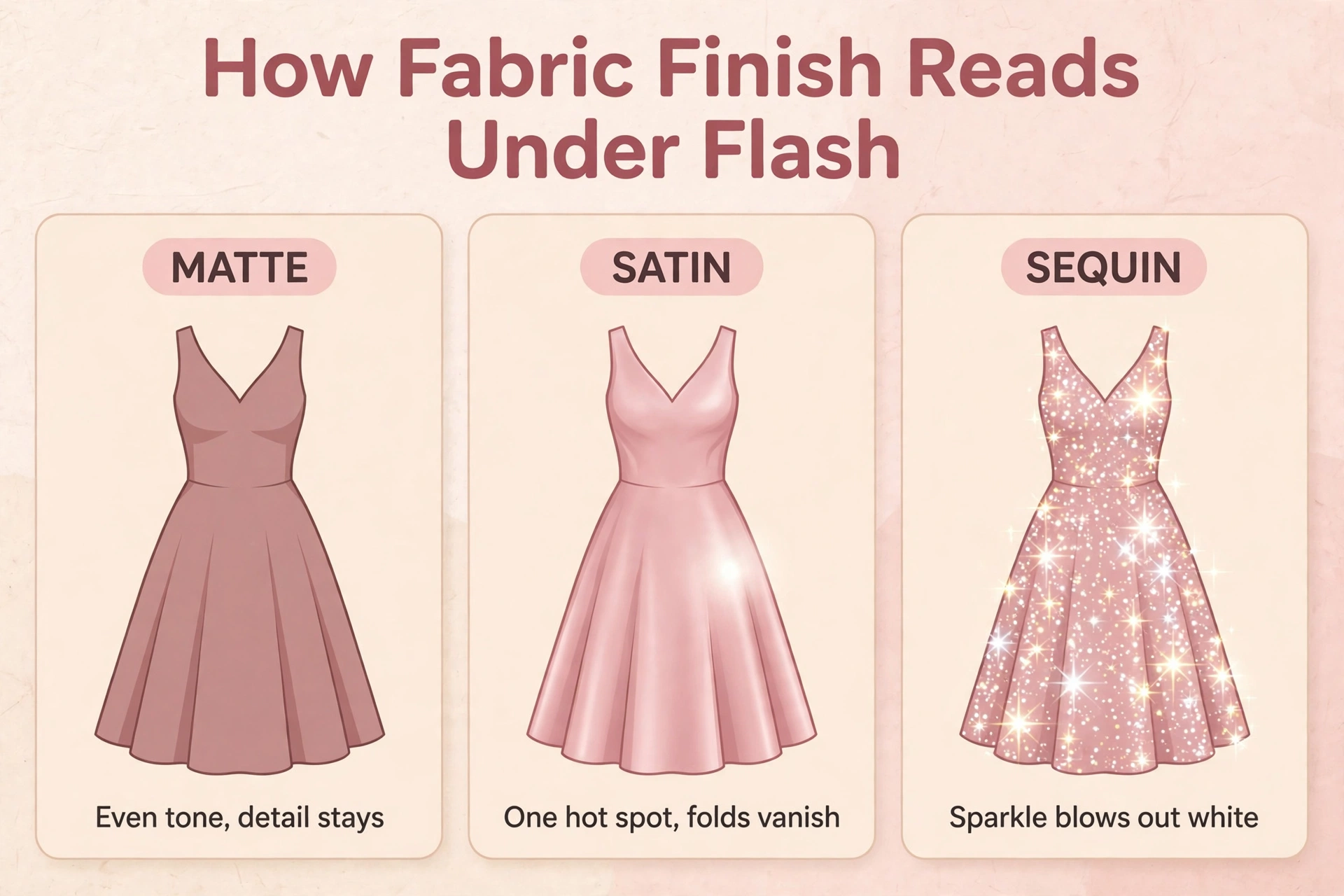
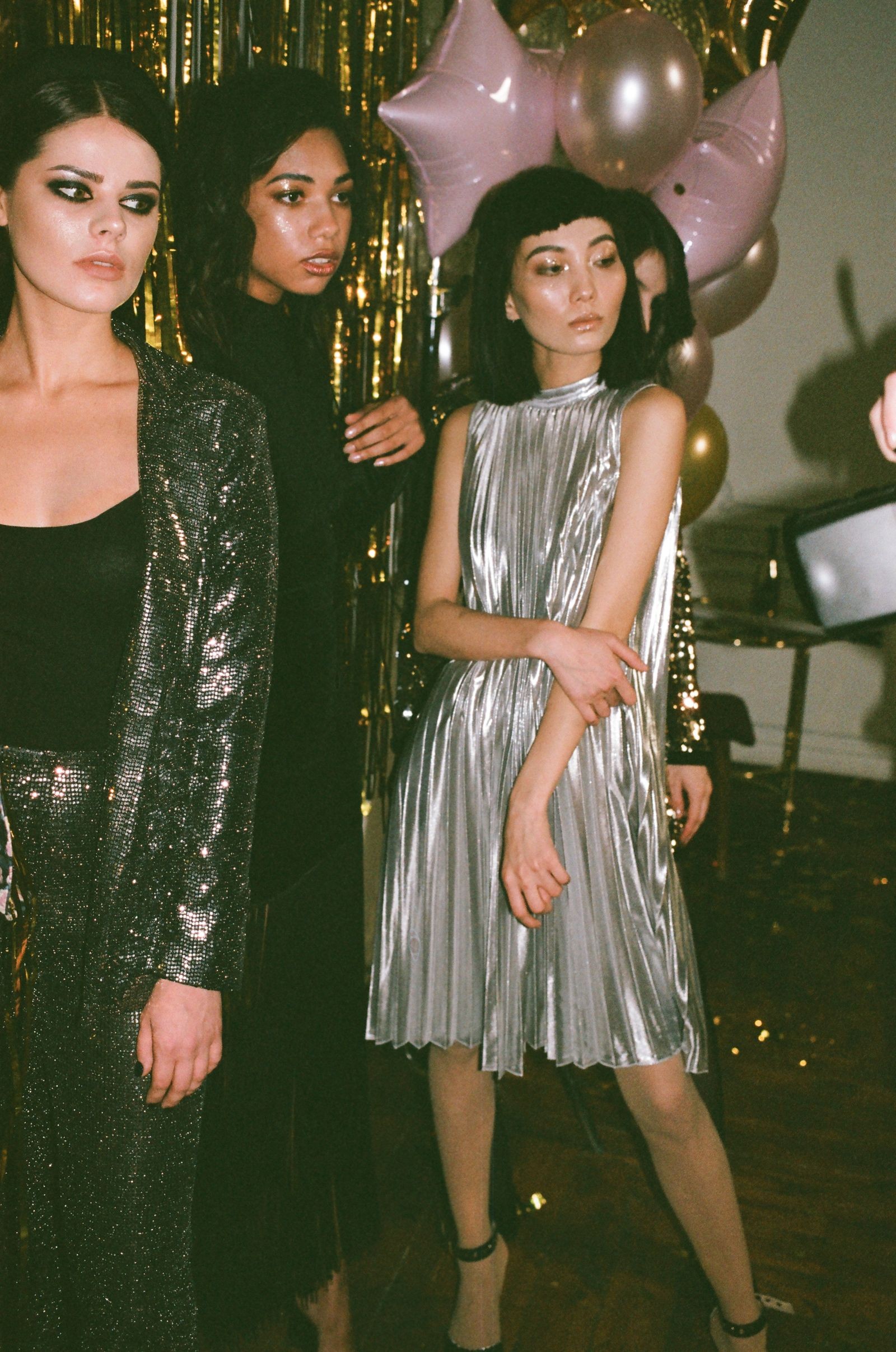
Most outfit advice starts with color or silhouette. For photographs, start one level earlier, with the surface of the fabric itself. Your eye adjusts constantly, softening glare and filling in shadow. A phone sensor takes one exposure, from one angle, and whatever that surface does with light in that instant is the photograph. Matte fabric scatters light in many directions, so the camera records an even tone and keeps seams, folds, and texture. Shiny fabric throws light back in one direction, so the camera records one bright patch and loses everything around it.
That is why the same dress can look expensive in person and cheap in a photo. In person, satin moves and the shine moves with it, which reads as fluid. In a still frame, only the frozen hotspot remains, usually parked on the hip, the bust, or the stomach, exactly where you least want a spotlight. The reliable base of a camera-friendly wardrobe is the same base as a good friday night outfit formula: a silhouette you trust, in a finish that behaves. Build the finish rule into the formula and most photo problems never start.
| Finish | How it reads on camera | Best use on a Friday night | Watch out for |
|---|---|---|---|
| Matte crepe, jersey, ponte | Even tone under flash; seams and shape stay visible | Your default for dresses and tops on photo-heavy nights | Very dark matte shades can merge into one flat shape |
| Satin and silk-look | One bright hotspot where light hits; folds can vanish | Bias cuts and draped pieces in soft, ambient light | Direct flash on pale satin can blow out to white |
| Sequin and metallic | Hundreds of tiny highlights; some clip white, some go black | One sequin piece per outfit, balanced by matte pieces | All-over sequin under flash can look noisy, not glamorous |
| Velvet | Deep, rich color that drinks light; reads darker than it looks | Jewel-tone velvet in warm venue light | Black velvet in a dark room can disappear entirely |
| Lace and open texture | Pattern and shadow give the sensor detail to hold | Black outfits that need visible detail to keep shape | Very fine lace over a contrasting lining can shimmer at a distance |
Matte is the default, shine is the accent
The working rule is simple: let matte fabric carry the large areas, and let shine appear in smaller, chosen places. A matte dress with a metallic clutch photographs as an outfit with a highlight; a fully metallic dress photographs as a highlight with an outfit somewhere underneath it. The same logic sits behind how to dress sexy without trying too hard: one strong element reads as confidence, while everything shouting at once reads as noise.
Texture is detail the camera can keep
When light is low, smooth surfaces give the sensor little information. Texture gives it plenty: ribbed knit, lace, embroidery, and jacquard create tiny shifts of light and shadow that still read as a garment rather than a silhouette. If you love the jeans-and-a-nice-top route, the textured version of that top is doing quiet camera work for you, a point worth borrowing from our guide to a friday night outfit with jeans: the top is the photograph, so its surface matters most.
Why Flash Flattens, Shines, and Erases Detail
The phone flash is a small, hard light source sitting almost exactly on the lens axis, and nearly every photo problem at a party starts there. Because the light comes from the camera itself, it hits the front of you evenly and throws your shadow directly behind you, removing the gentle side-shadowing your eye uses to read shape. Faces look flatter, waists look wider, and a fitted dress can read as a tube. A flash diffuser exists precisely because direct flash creates harsh shadows, strong reflections, and overly bright highlights; spreading the light softens all three. You cannot diffuse a friend’s phone, but you can choose fabric that does not amplify the problem.
Shine is where flash does its worst work. The diffuser guidance makes the mechanism plain: direct flash produces bright specular highlights on shiny surfaces, and those highlights can hide the detail underneath them. On satin, the fold pattern you loved becomes one white glare patch. On sequins, hundreds of tiny mirrors fire back at once, so the dress reads as static. On skin, forehead and cheekbones flare while everything else goes dull, which is why the same makeup looks polished in the bathroom mirror and greasy in the group shot.
Distance is your only flash control
You do control one variable: how far the phone is from you. Flash falls off fast with distance, so a photo from across a table is lit far more gently than one at arm’s length, and the hotspot on satin shrinks as the light spreads. When someone raises a phone close to your face, ask for the wider shot instead. The outfits in our friday night outfit ideas for ladies all pass this test: nothing in them depends on the camera being kind at close range.
Flash on, flash off: take both
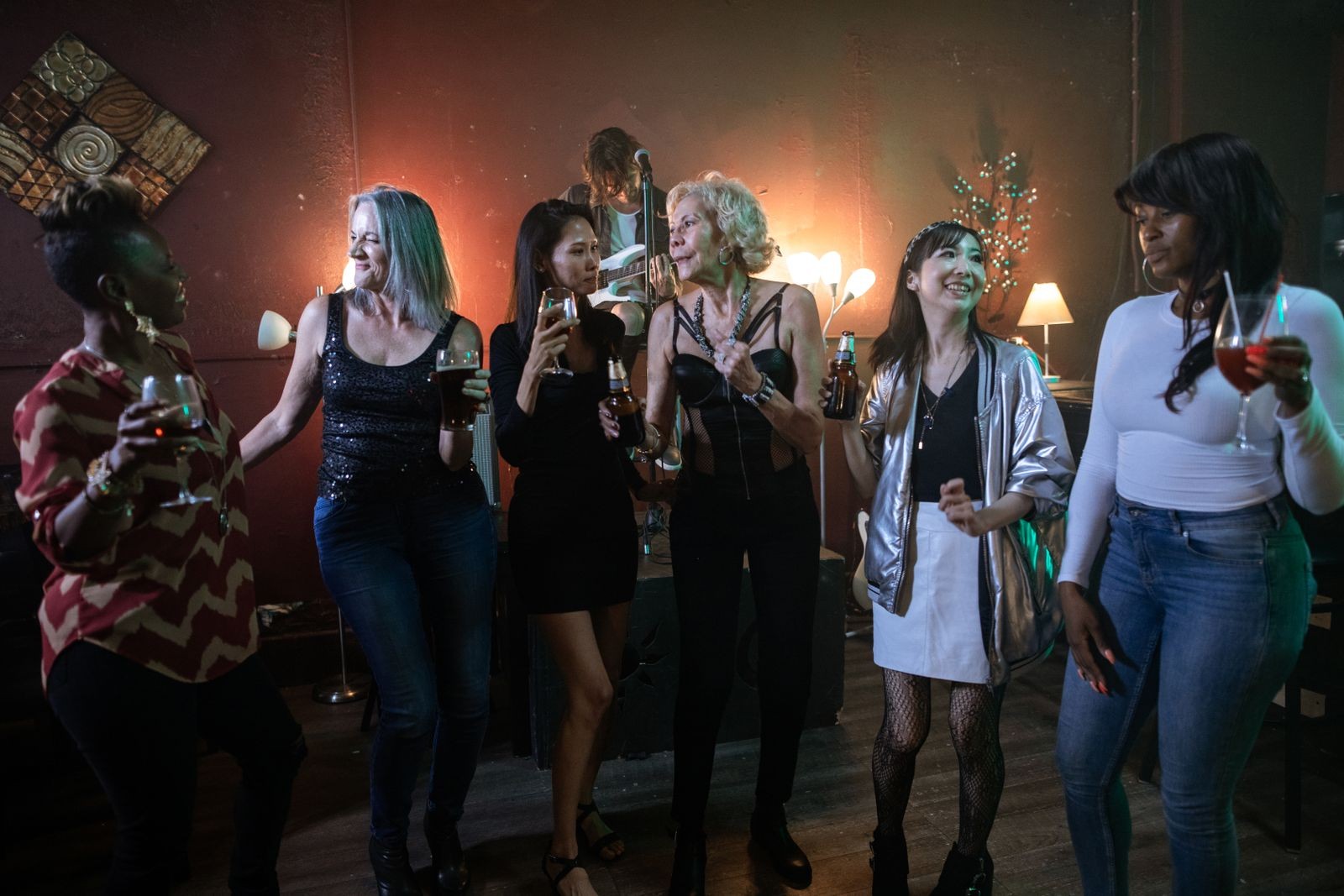
Modern phones offer a real alternative to flash in the dark. Apple explains that Night mode turns on automatically in low light and takes a longer capture, which is why it asks you to hold the phone steady until the shot completes. Google’s guidance for Pixel is similar: Night Sight is built to take photos in low light without the flash when the device is held still. Both modes trade the hard flash look for softer ambient light, usually kinder to fabric and skin. The catch is movement: a long capture blurs anything that moves, so a dancing shot still wants flash, while a posed group shot almost always looks better without it. Ask for one of each and choose later. That habit alone rescues more outfits than any purchase, including the seated looks in friday night outfits for fall, where the light is low and nobody is moving fast.
Mixed Venue Lighting: Why Your Color Changes Room to Room
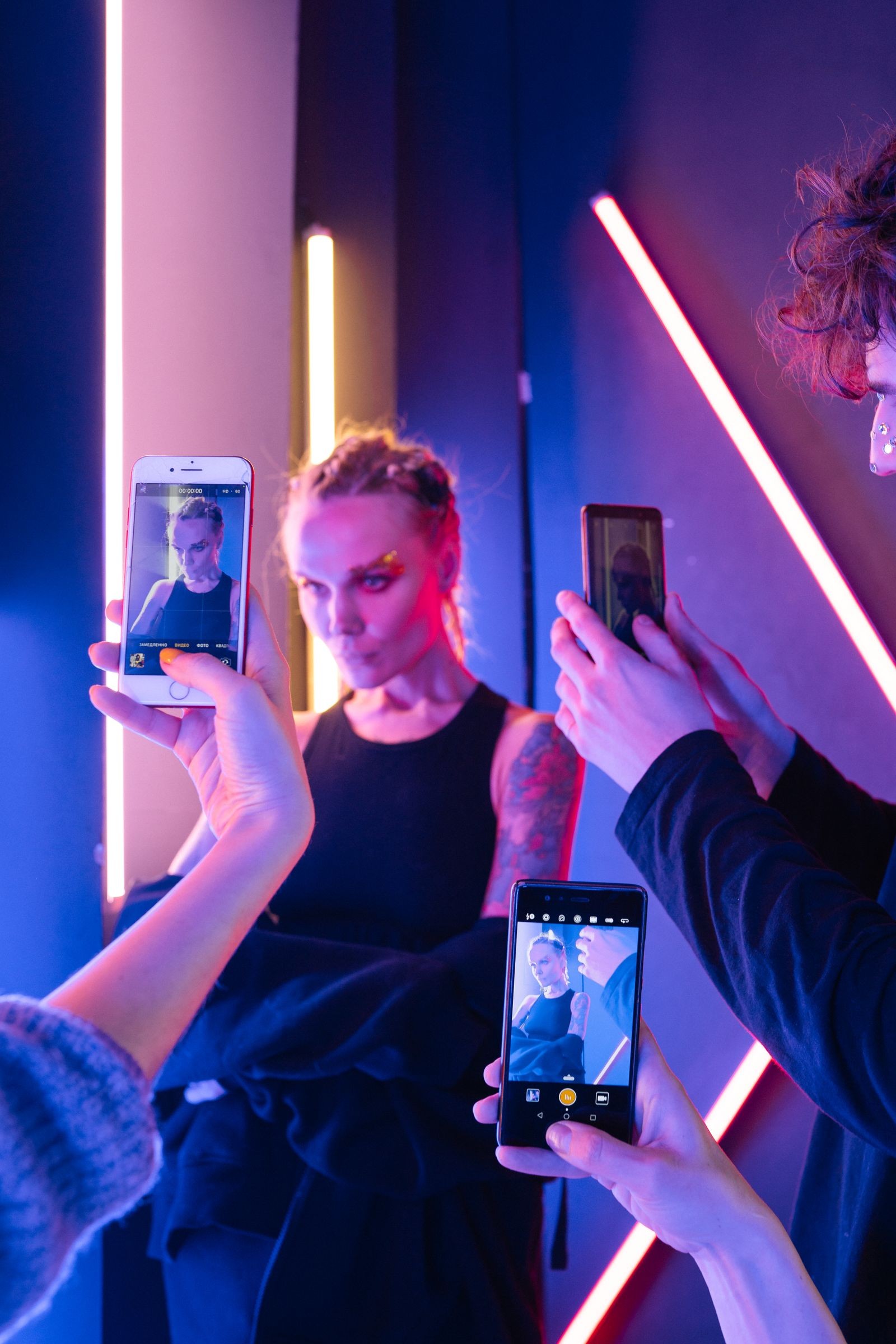
A Friday night rarely happens under one light: warm lamp glow at dinner, cooler light at the bar, a colored wash near the music, and white flash cutting through all of it. Your eyes re-balance constantly, so a dress reads as the same dress in every room. A camera balances once per photo, for the whole frame, and when the frame contains two colors of light, something has to lose. Adobe’s guide to white balance explains that different lighting creates different color temperatures: incandescent light casts warm yellow-orange, fluorescent light can add a green tint, and overcast daylight runs cool and blue. It also warns that mismatched light sources in one frame are the hardest case to fix later, because one half of the photo goes warm while the other goes cold.
That split is the story of most disappointing party photos. You stand between a warm lamp and a colored sign, and the camera picks one truth: your dress keeps its color on one side and shifts on the other. The outfit-level defense is to avoid colors that sit close to the venue lights themselves: warm tones under warm light merge into the room, and pale cool tones pick colored light up like a sponge.
Choose the room before the photo chooses it
You cannot relight a restaurant, but you can pick your spot inside it. Stand where one light dominates: fully in the warm zone for dinner photos, fully out of the colored wash for the group shot. Adobe’s editing guidance underlines why this matters after the fact: the Temp and Tint sliders adjust one global balance for the whole image. A single slider cannot fix a photo that is warm on the left and green on the right, so the fix has to happen while you are still standing there.
Warm light flatters jewel tones, cool light tests pastels
Saturated mid and jewel tones hold their identity across the widest range of venue lighting, which is one reason they anchor our guide to what color to wear on Friday night. Pastels are the most fragile: under warm light they go muddy, under colored light they can change family, and under flash they wash toward white. If a pastel is the outfit, give it structure and texture so the photo still has something to read when the color softens. On a date, where the light is usually one warm source, the softer palette in what to wear on a Friday night date works as written.
Color on a Phone Sensor Is Not Color in the Mirror
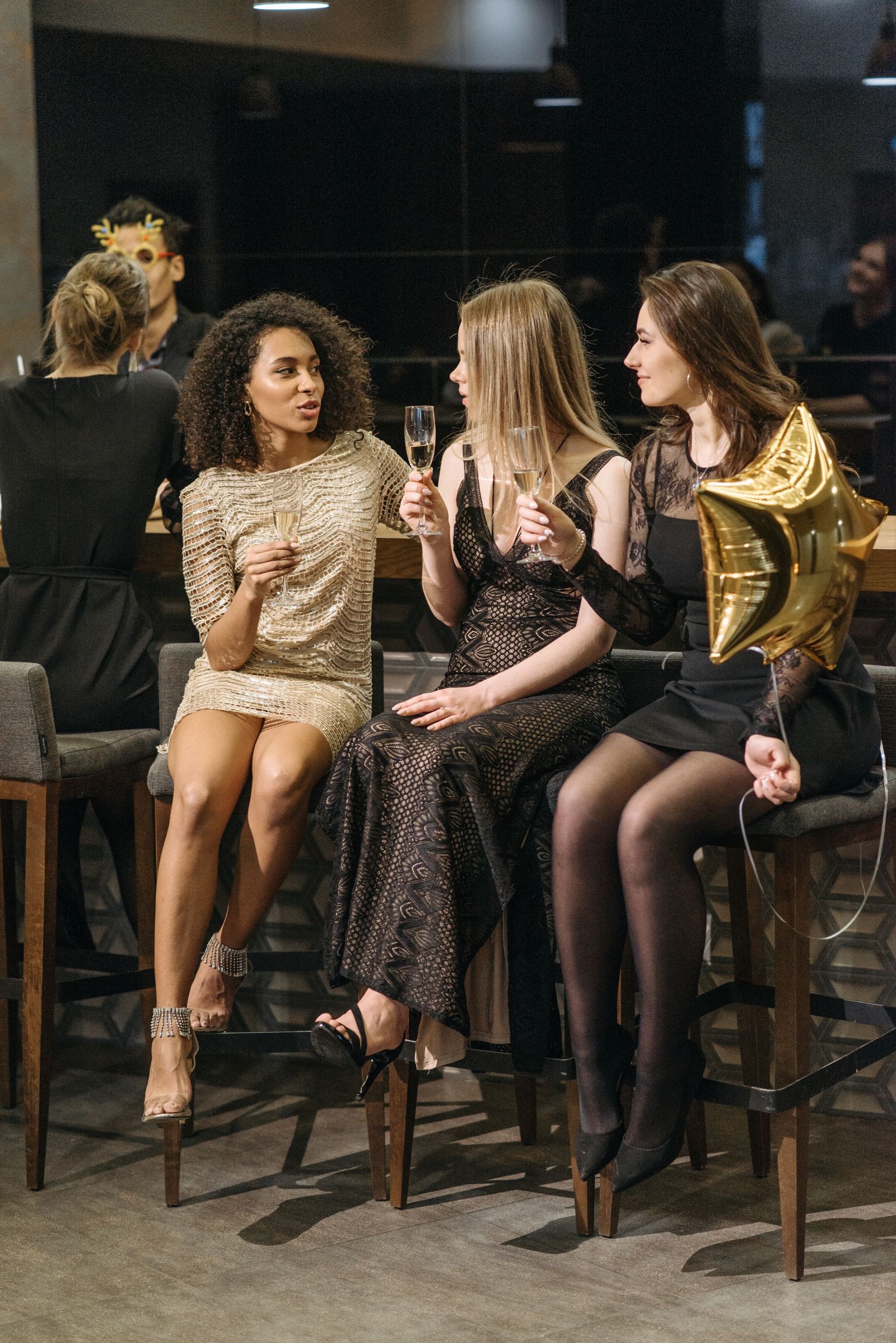
Even in one clean light, the color in the photo is not guaranteed to be the color you chose. Light itself varies in how faithfully it renders the colors it falls on. The ENERGY STAR criteria define the color rendering index as the degree of color shift objects undergo under a light source compared with a reference source, and set a minimum rendering quality for certified fixtures for exactly this reason. Under a light that renders reds poorly, a red dress and red lipstick both go dull at once. Favor colors with enough saturation to survive a mediocre light, and treat very subtle shades, the almost-black navy, the barely blush pink, as daylight colors rather than venue colors.
Phone processing adds a second shift. Faced with a dark scene, the camera brightens, boosts contrast, and pushes saturation toward what its software thinks a night photo should look like. Deep colors can oversaturate, pale colors can bleach, and two similar shades can merge into one. Checking the actual photo, not the mirror, is the only reliable color test, a habit that matters even more for the softer palettes in friday night outfits over 40, where a soft shade needs texture to survive processing.
The safest color families for cameras
Emerald, sapphire, ruby, deep teal, rich plum, and true red are the reliable performers: saturated enough to survive weak rendering, dark enough to keep detail, light enough to separate from a dark room. At the risky ends sit pure white, which clips under flash, and near-black shades, which merge in shadow. If your heart is set on a risky end, borrow safety from the other elements: white with texture, black with sheen contrast or jewelry. The complete outfit thinking in what to wear Friday night still applies; this section simply re-ranks its colors by how a sensor will judge them.
The Black Outfit Problem: Detail Loss and How to Keep It
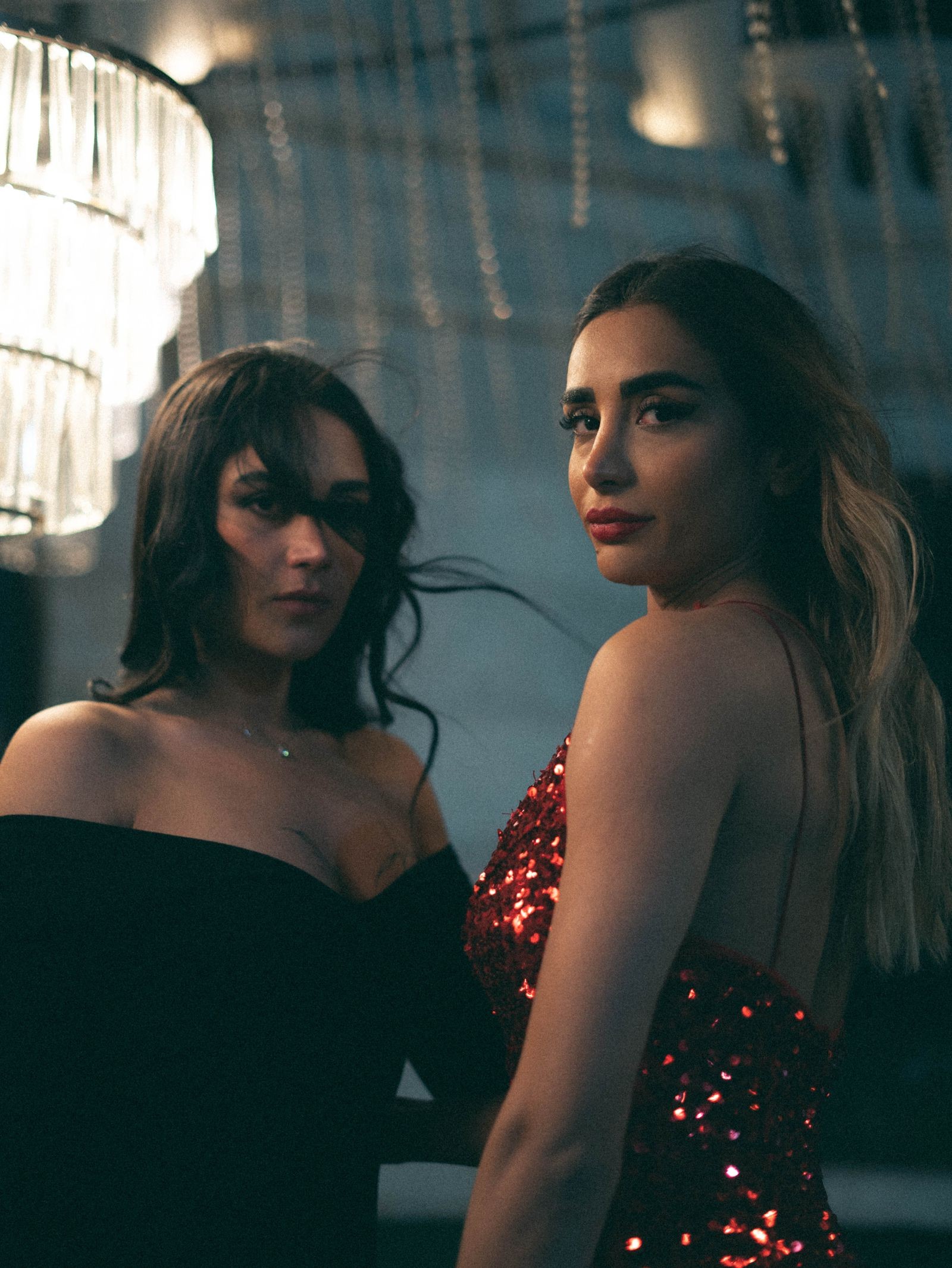
Black is the most loved Friday night color and the most betrayed by cameras. The problem is range. Adobe’s guide to dynamic range describes it as the ratio between the brightest highlights and the darkest shadows in a scene, and notes that cameras differ in how much of that range they can hold. A night venue is an extreme scene: bright signs and faces at one end, your black dress at the other. The phone exposes for the faces and the lights, and the dress falls below what the sensor can separate. Seams, ruching, lace, and the waist you styled all collapse into one black shape.
The editing vocabulary for the failure is shadow clipping: an image so underexposed in its dark areas that no detail remains there at all, only black. Once detail is clipped at capture, brightening the photo later reveals noise, not your neckline. So the work has to be done by the outfit itself, before the photo exists. Black survives on camera when it is not one flat surface: lace over lining, velvet beside satin, ribbing, embroidery, or a neckline that lets skin draw the shape the fabric cannot.
Build black in layers of finish
Treat an all-black outfit as a study in finishes rather than a single color. A matte crepe dress with a patent shoe and a satin clutch gives the camera three different blacks, and the differences are what read as an outfit. Skin is the other contrast you own: a neckline that places skin beside the black restores the outline. This is the same judgment behind reading how revealing a Friday night outfit is: the question is where the visual breaks fall. A well-placed break keeps black elegant instead of invisible. The close-fit versions in our guide to the best bodycon outfits for every body type make the point from the other side: in black, a bodycon needs texture or paneling, because the silhouette alone will not survive a dark room.
Stand black against a lighter ground
Background choice finishes the job. A black outfit against a black banquette is a lost cause; the same outfit against a lit wall separates cleanly. When the group lines up, take the end nearest the light. It is the difference between a dress and a shadow with a face.
Patterns, Pinstripes, and the Moiré Trap
Some patterns photograph falsely, producing ripples that were never on the garment. Canon’s support library explains the moiré effect plainly: when a subject carries a fine, regular pattern such as stripes or plaids, a ripple that does not exist on the subject can appear in the image, and it changes with distance, zoom, and angle. The cause is a clash between the pattern’s fine repeat and the sensor’s own grid. The tighter and more regular the repeat, the higher the risk: narrow pinstripes, tiny houndstooth, small dense checks, and micro-dots are the classic offenders, especially in black and white, where contrast is at its maximum. Phones make it more likely, not less: their sharpening exaggerates fine detail, and a pattern that looked fine in the test shot at the door can ripple in the closer shot at the table. Video is worse again, since the pattern moves against the grid continuously.
Patterns that are safe, and how to wear the risky ones
Scale is the whole game. Large-scale prints, wide stripes, bold florals, and irregular patterns photograph cleanly because their repeats are far too big to fight the sensor. If you love a fine pattern, wear it in a smaller area, a pinstripe trouser under a plain top rather than a full pinstripe suit, and keep its contrast moderate: navy and cream ripples less than black and white. Texture-based pattern, like lace or jacquard, is safest of all, because its repeat is irregular by nature. When in doubt, photograph the garment at two distances at home and zoom in. Moiré announces itself immediately.
Fit, Neckline, and How the Frame Crops You
A photograph is not a full-length mirror; it is a crop, and most Friday night photos are cropped at the waist or the knee by a table, a bar, or the photographer’s framing. An outfit whose design sits below the waist will spend the night effectively unworn. That is why neckline and shoulder do such heavy lifting: they are almost always in frame, and a defined neckline gives the camera a clean edge between skin and fabric, the contrast it uses to keep your shape legible in low light. Very high, closed necklines in dark fabric can merge face, neck, and dress into one column; very deep necklines can dominate a close crop. The middle options, a clean V, a square neck, an off-shoulder line with structure, frame reliably at almost any crop.
Fit reads differently on camera too. Flash flattens, and flattening widens, so a garment that skims reads as tailored while a garment that clings reads every shadow as a contour. On a photo-heavy night, choose the fit you would choose from friday night outfits when you feel bloated: drape and a defined line at the ribs or under the bust, rather than compression at the waist. It is about giving a two-dimensional image the clean lines it needs to describe a three-dimensional outfit.
Details that survive the crop
Place one deliberate detail where the camera actually looks: an earring with presence, a neckline with an edge, a sleeve with shape. Waist and hem details are for the room; face-level details are for the record. If the night will be photographed mostly seated, style the outfit from the waist up first and let the rest be simple.
The Phone Lens Is Closer Than You Think
The last distortion is geometric. Phone lenses are wide, and wide lenses exaggerate whatever is nearest: a face shot from a foot away gains a larger nose and a stretched forehead, while the person at the edge of a group shot can be widened sideways. Google and MIT researchers built an entire correction method around this, because as their wide-angle portrait research describes, wider fields of view introduce stronger perspective distortion, most visibly in faces. Their paper shows the effect at its starkest in group selfies, where faces at the periphery are, in their words, stretched, twisted, and squished compared with real life.
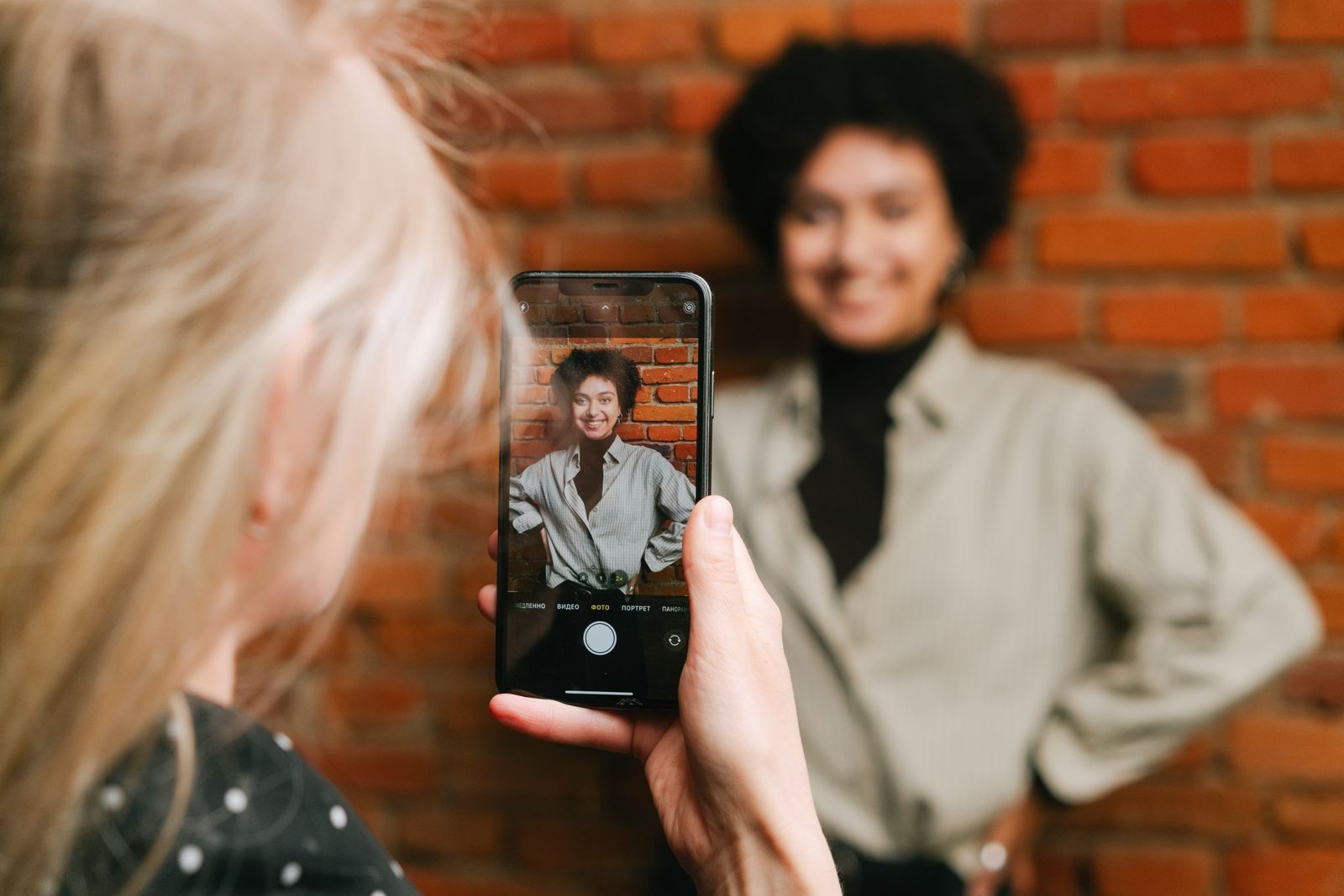
The team’s fix is a content-aware warping mesh that restores face shapes while leaving backgrounds alone, and phones increasingly apply corrections like it automatically. But correction is a rescue, not a plan. Your plan is distance and position: a step back with a slight zoom changes the geometry itself. In group photos, take the centre rather than the edge when you can, keep in the same plane as everyone else, and never be the one leaning in closest to the phone.
Selfies obey the same physics
Everything above doubles for selfies, where the lens is closest of all. Hold the phone a little higher and farther than instinct says, use the longer lens if your phone offers one, and keep the neckline inside the smaller selfie frame. Google’s own troubleshooting guidance adds a mundane factor: if you notice a halo or glare in your photos, turn the flash off and retake under natural or indirect light, and keep the lens clean, since smears scatter light into the haze that makes a good outfit look foggy. A two-second lens wipe before the group shot is the cheapest photo upgrade of the night.
The Outfit System That Survives Cameras
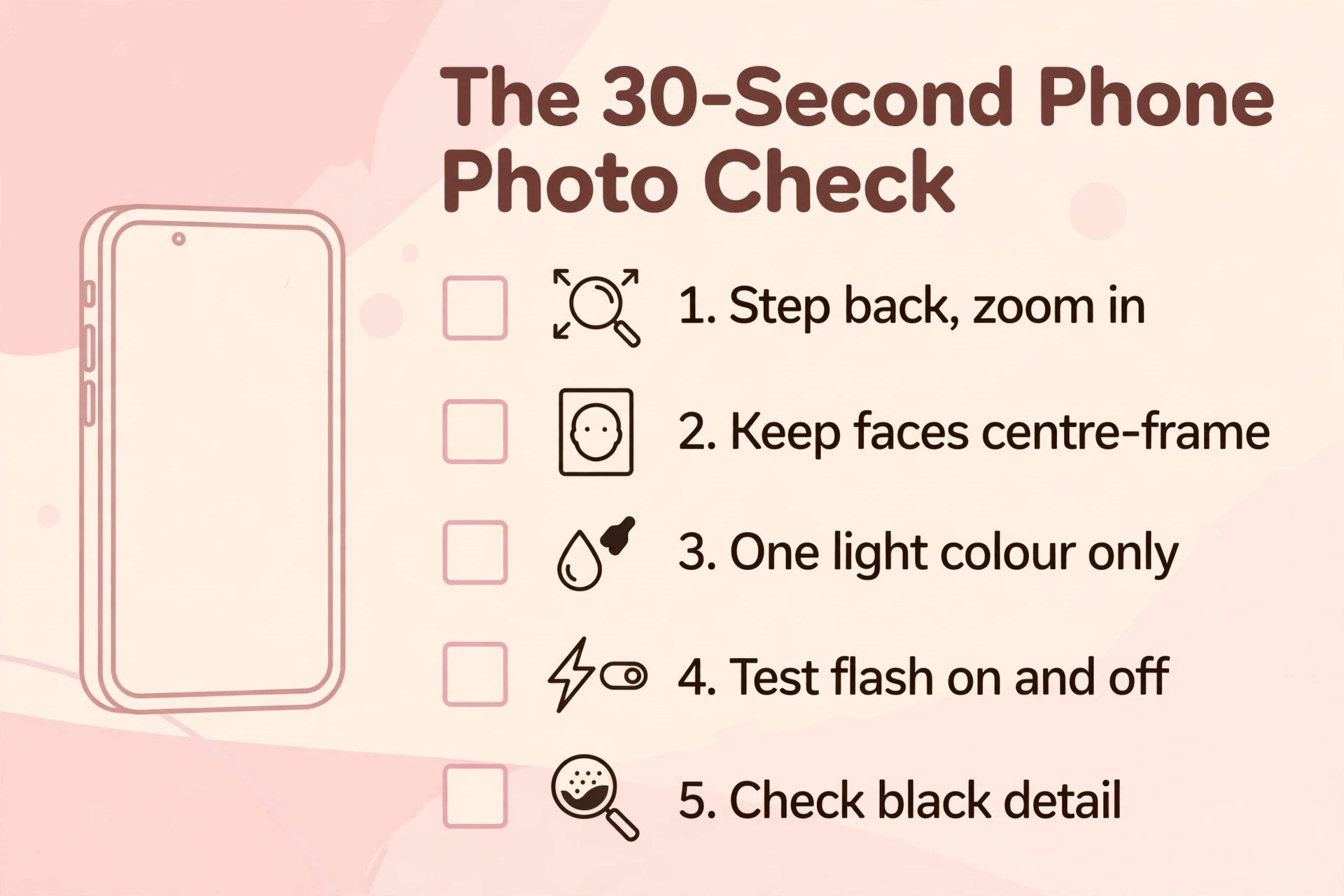
Put the pieces together and the system is short enough to run while you get dressed. Start with finish: matte or textured fabric carrying the large areas, shine as an accent. Choose color from the camera-safe middle: saturated, mid-to-deep tones, with black rebuilt in layered finishes and white given texture. Check the pattern scale: large or irregular, never fine and tight. Set the frame: a defined neckline, one face-level detail, a fit that skims. Then run the test that replaces all guessing.
The two-photo test before you leave
Stand anywhere with ordinary indoor light and take two photos: one with flash, one without. Look at four things only. Does a hotspot sit somewhere you dislike? Does the color still read as the color you chose? Can you still see detail in the darkest part of the outfit? Does the pattern stay calm when you zoom in? Each failure has a one-item fix: swap the shiny piece, add the contrasting layer, choose the textured version. Two minutes at home replaces a night of untagging.
Ask for the photo you want
The final skill is direction, delivered lightly. Party photographers are usually friends holding phones, and they respond well to specifics: step back a little, use the zoom, take one with flash and one without, hold still for the night mode shot. Night modes reward stillness, since both Apple and Google build them around longer captures. Everyone in the photo benefits from the same physics.
Our view
A mirror is a kind judge and a camera is an honest one, and the difference between them is not your face or your body. It is physics: a hard little flash, three colors of room light, a sensor with limits, and a lens held too close. Once you know the physics, the fix stops being luck. Matte where the area is large, color with depth, black built from texture, pattern at a safe scale, and one test photo before you leave. Dress for the camera that will actually be there.
— Friday Night Style
Frequently Asked Questions
Why do I look shiny in photos when my outfit is not shiny in person?
Because direct flash returns bright specular highlights from any surface with a sheen, including satin and skin itself. In person the shine moves as you move; in a still photo it freezes in one place. Matte and textured fabrics scatter the light instead, which is why they photograph calmer.
What is the most photograph-friendly color to wear at night?
A saturated mid-to-deep tone: emerald, sapphire, ruby, deep teal, or rich plum. They keep their identity under mixed lighting and separate from a dark room without clipping. Pure white risks blowing out under flash, and black risks losing detail in shadow, so both need texture or contrast to help them.
How do I stop a black outfit disappearing in photos?
Build it from more than one finish, such as lace over lining or a matte dress with a glossy shoe, add a defined neckline so skin draws the outline, and stand against a lighter background. Detail the camera can see at capture is the only detail an edit can recover later.
Why do stripes and small checks ripple in phone photos?
That ripple is moiré: a false pattern created when a fine, regular repeat in the fabric clashes with the grid of the camera sensor. It is worst with tight, high-contrast patterns like black-and-white pinstripes and micro-checks. Large-scale or irregular patterns, and textured weaves like lace, avoid it.
Is flash or night mode better for outfit photos?
For a posed photo, night mode is usually kinder, because it uses the room’s softer ambient light instead of a hard flash. For anything moving, flash wins, because a long capture blurs motion. Take one of each and keep the better frame.
How far should the phone be for a flattering photo?
Farther than feels natural. Wide phone lenses exaggerate whatever is closest, distorting faces at close range and stretching people at the edges of group shots. A step back with a slight zoom, faces near the centre of the frame and in the same plane, removes most of the effect.
Questions About Friday Night Outfits That Photograph Well?
Tell us the plan, the dress code, and the part of the outfit that is not working — we read every message.
Sources
- Adobe — Understanding White Balance in Digital Photography
- Adobe Lightroom Classic Help — Set White Balance With Temp and Tint
- Adobe — Shadows and Highlights in Photography
- Adobe Blog — The Exposure Triangle and Shadow Clipping
- Canon Support — Tips on Preventing the Moiré Effect
- Apple Support — Use Night Mode on Your iPhone
- Google Pixel Camera Help — Take Photos in Low Light With Night Sight
- Google Pixel Camera Help — Fix Photo or Video Quality Issues
- Google Research — Distortion-Free Wide-Angle Portrait on Camera Phone
- Shih, Lai and Liang — Distortion-Free Wide-Angle Portraits on Camera Phones (paper)
- ENERGY STAR — Downlights Key Product Criteria and Color Rendering Index
- Neewer — What Is a Flash Diffuser and How Does It Work?