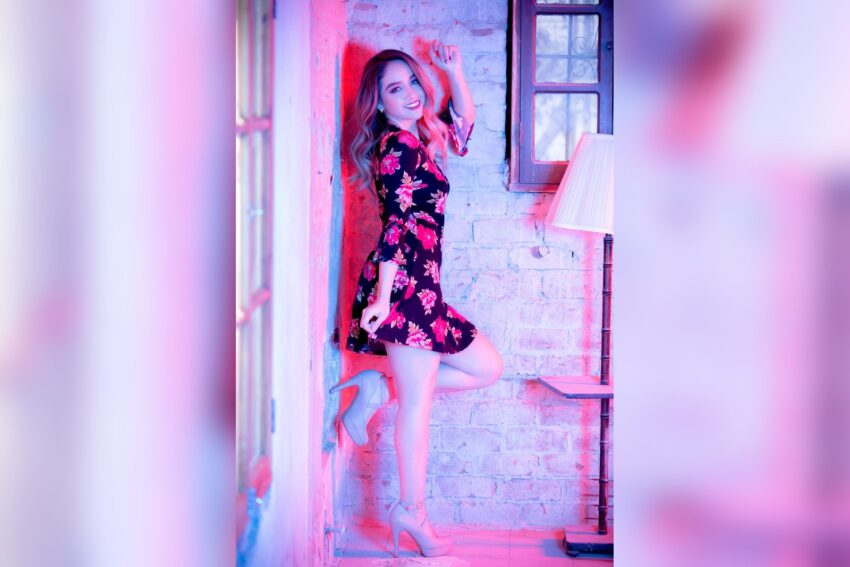
The dress looked right on the hanger and wrong on you: the waist seam sits two inches low, the hem pools past the point the photo promised, the print is suddenly the size of your head, and the jacket sleeves swallow your hands. Nothing about the outfit is badly made. It was simply patterned for a taller frame, and on a petite frame every landmark lands in the wrong place. The fix is not shopping smaller. It is proportion engineering: raise the waist, shorten the third piece, place the hemline on purpose, scale the print, and let the shoe finish the leg line.
Friday Night Style
Same Night Out, Cut for Your Frame
Complete Friday night outfits built on petite proportion rules — high rises, cropped layers, placed hemlines, and prints scaled to a smaller frame.
Key Takeaways
- Petite is a proportion, not a size: rises, waist seams, knee placement, sleeves, and hems all sit higher and shorter, so shop the petite cut before you reach for a tailor.
- Build every outfit in thirds — a short top third over a long bottom two-thirds — by raising the waistline with high rises, tucks, and cropped layers.
- Place hemlines deliberately: above the knee, at the ankle bone, or full length skimming the shoe, never pooling or cutting mid-calf by accident.
- Dress in one colour or close tones when you want length, and keep prints, bags, and belts scaled smaller than your palm and your frame.
- Finish the leg line with the shoe: pointed toes, low vamps, and shoes matched to your trousers, tights, or skin keep the line running to the floor.
Table of Contents
- Petite Is a Proportion, Not Just a Hem
- The Proportion Rules Every Outfit Here Uses
- Seven Friday Night Outfits, Engineered for a Petite Frame
- Third Pieces at Petite Length
- Print, Bag, and Belt: Getting the Scale Right
- The Shoe Line: Where the Leg Actually Ends
- What to Skip on a Petite Frame
- Our view
- Frequently Asked Questions
- Sources
- Recommended
Petite Is a Proportion, Not Just a Hem
Start with the definition, because it changes how you shop. Retailers draw the petite line by height, but they cut it by proportion. Talbots size charts proportion their petite range for women 4’11” to 5’4″, against 5’4″ to 5’8″ for misses, and the ASOS petite size guide designs its petite clothes for heights up to 5’3″, cut proportionally shorter, with petite jeans and trousers built around a 29-inch leg. The Nordstrom petite size guide for JS Collections likewise labels its petite range “5’4″ and under.” The height bands differ slightly by brand; the cutting principle does not.
What changes inside a petite pattern is the part most shoppers never see. Anthropologie’s petite guide spells it out: petite sizes carry shorter rises and leg lengths in trousers, higher knee placement, shorter sleeves and higher armholes in tops and jackets, and higher waistlines with shorter hems in dresses and skirts. The Apparel Search petite guide makes the same point: petite clothing is cut for women 5’4″ and under, of every size, with shorter torsos, rises, sleeves and hems, narrower shoulders, and details scaled down throughout. Petite is about where the garment’s landmarks sit, not about being a smaller person. So shop by measurements rather than by the label: LOFT’s petite Parker pants, for example, publish a rise of 10 7/8 inches at the natural waist and a full-length inseam of 27 1/2 inches — figures you can compare against trousers that already fit you.
That is why hemming a standard dress so often disappoints. A hem is the one landmark a tailor can move cheaply. The waist seam at your hips instead of your waist, the knee break halfway down your shin, the shoulder seam sliding off your shoulder — none of those move with a hem. The outfits below are therefore built as formulas: each states the proportion rule first, so you can rebuild it from petite ranges, from cropped standard pieces that land correctly, or from the closet you already own. If you already use a friday night outfit formula on ordinary nights, keep the system and change only the measurements it runs on — the same adjustment whether the plan is a classic from our guide to what to wear Friday night or something you invent at six o’clock.
| Garment point | Standard cut | Petite-adjusted cut | Why it matters at night |
|---|---|---|---|
| Trouser and jean rise | Cut for a longer torso; the waistband sits high on the ribs or slumps at the hips | Shorter rise landing at the natural waist, around 10 inches on many petite jeans | The waistband’s height is where your legs appear to start; two inches of rise is two inches of leg |
| Inseam and hem | Full lengths around 31 inches and up, pooling over the shoe | Inseams around 29 inches and below, ending at the ankle bone or skimming the shoe | Fabric stacked on the shoe shortens the leg and reads as borrowed clothes |
| Dress waist seam | Sits below the natural waist on a shorter torso, closer to the hip | Raised to the natural waist, with a shorter bodice above it | A low seam splits the body in half; a true waist seam gives you the long bottom two-thirds |
| Knee placement | Knee break, flare, or distressing placed for a longer leg | Knee point raised so shaping and flare start at your actual knee | A flare starting mid-shin widens the wrong place and cuts the leg at its widest point |
| Sleeves and shoulders | Sleeves past the wrist, shoulder seams off the shoulder, deep armholes | Sleeves ending at the wrist bone, narrower shoulders, higher armholes | Extra sleeve and shoulder fabric is the fastest route to looking swamped |
| Print and detail scale | Motifs, pockets, and lapels sized for a taller frame | Details redrawn smaller, with several full print repeats across a bodice | One giant motif wears you; a scaled print lets you stay in charge |
The Proportion Rules Every Outfit Here Uses
Every outfit in the list below runs on the same five rules. Learn them once and you can audit any outfit in your closet in under a minute.
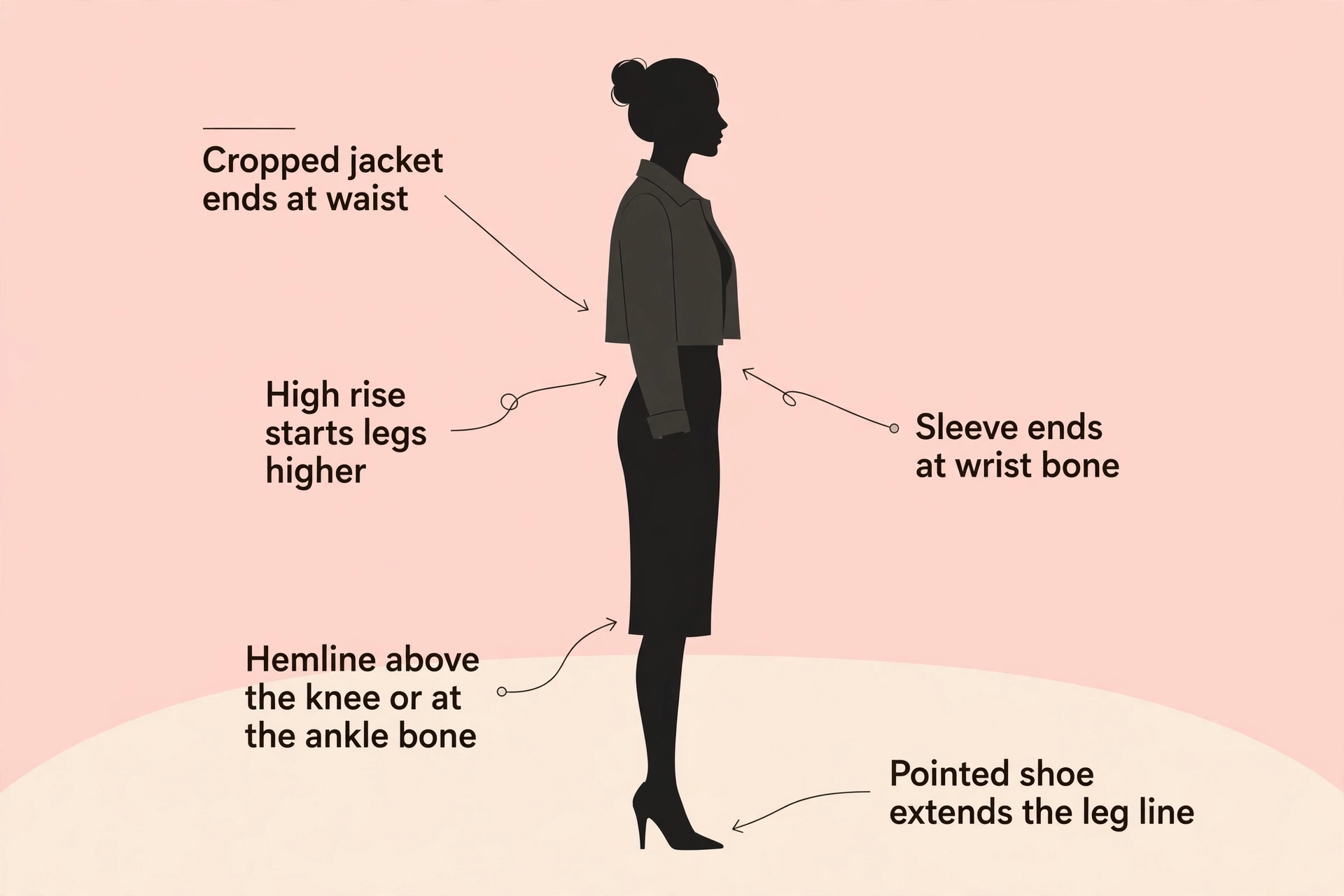
Rule one: build in thirds, never halves. Petite Fashion’s proportion guide puts the rule of thirds at the centre of petite dressing: instead of dividing the body in half, break the outfit into one-third top and two-thirds bottom, because an even split compresses both the torso and the legs. Cropped tops with high-rise jeans and cropped jackets over tailored trousers are its worked examples, and it notes that even a one-inch shift in waist placement changes how tall the wearer appears. The Apparel Search petite guide states the same lever as its first rule: protect the waist point, with high, clearly placed waists and tops that end at the high hip or tuck cleanly, while dropped waists and long untucked layers shorten the leg line.
Rule two: one volume at a time. A wide leg with a close top, a full skirt with a fitted bodice, a longer coat over slim layers: volume itself is not the enemy. Volume everywhere at once is what swamps a smaller frame, because there is less vertical space for the eye to cross before it reaches the next bulky shape. The proportion guide makes the matching point about visual weight: cleaner silhouettes, refined details, controlled volume.
Rule three: keep the line unbroken. A single colour or a tonal run from shoulder to shoe lets the eye travel without stopping, and uninterrupted travel reads as height. It is also why shoes keep reappearing in this post: a shoe that clashes with the trouser hem is a full stop at the exact point you want a comma.
Rule four: scale every detail to the frame. Prints, belts, bags, lapels, and jewellery are sized for the bodies in the campaign photos, who are not your height. Redraw them mentally one size down and most outfits correct themselves. Section five below gives the working tests.
Rule five: place the hemline, do not inherit it. Above the knee, at the ankle bone, or full length grazing the shoe are decisions. Mid-calf by accident and hems trailing on the pavement are inheritances from a taller woman’s pattern. The same instinct applies elsewhere: our guide to friday night outfits over 40 places hemlines deliberately for a changing body, and our friday night outfits when bloated moves the fitted point to the ribs — in both cases, as here, the outfit works because its landmarks were chosen, not accepted.
Seven Friday Night Outfits, Engineered for a Petite Frame
Here is the list itself: seven complete outfits, each stated as a formula with the proportion rule that makes it work, ordered from dressiest to most relaxed. Every one can be built from petite ranges or from standard pieces whose landmarks happen to land correctly on you.
1. The monochrome column dress or co-ord
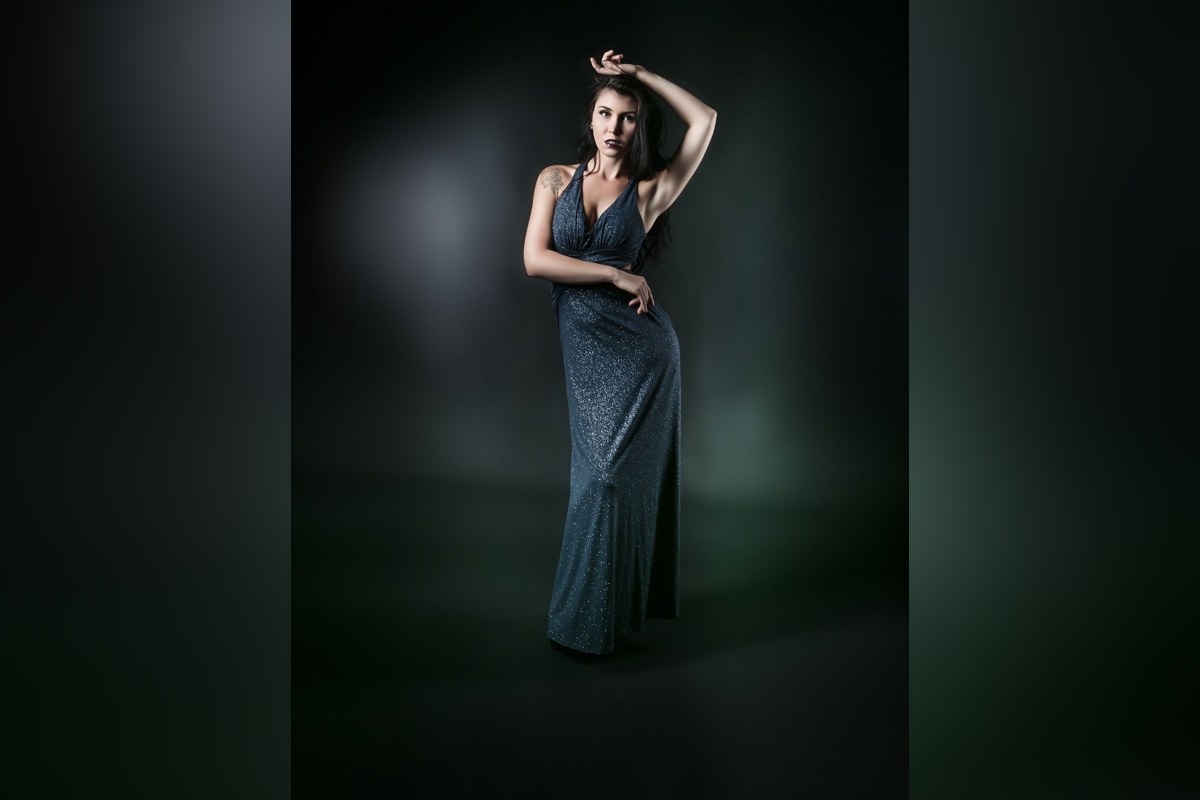
The formula: a dress, jumpsuit, or matching set in one colour from shoulder to hem, fitted or fluid but never broken by a contrasting belt, finished with a shoe in the same colour family or matched to your skin.
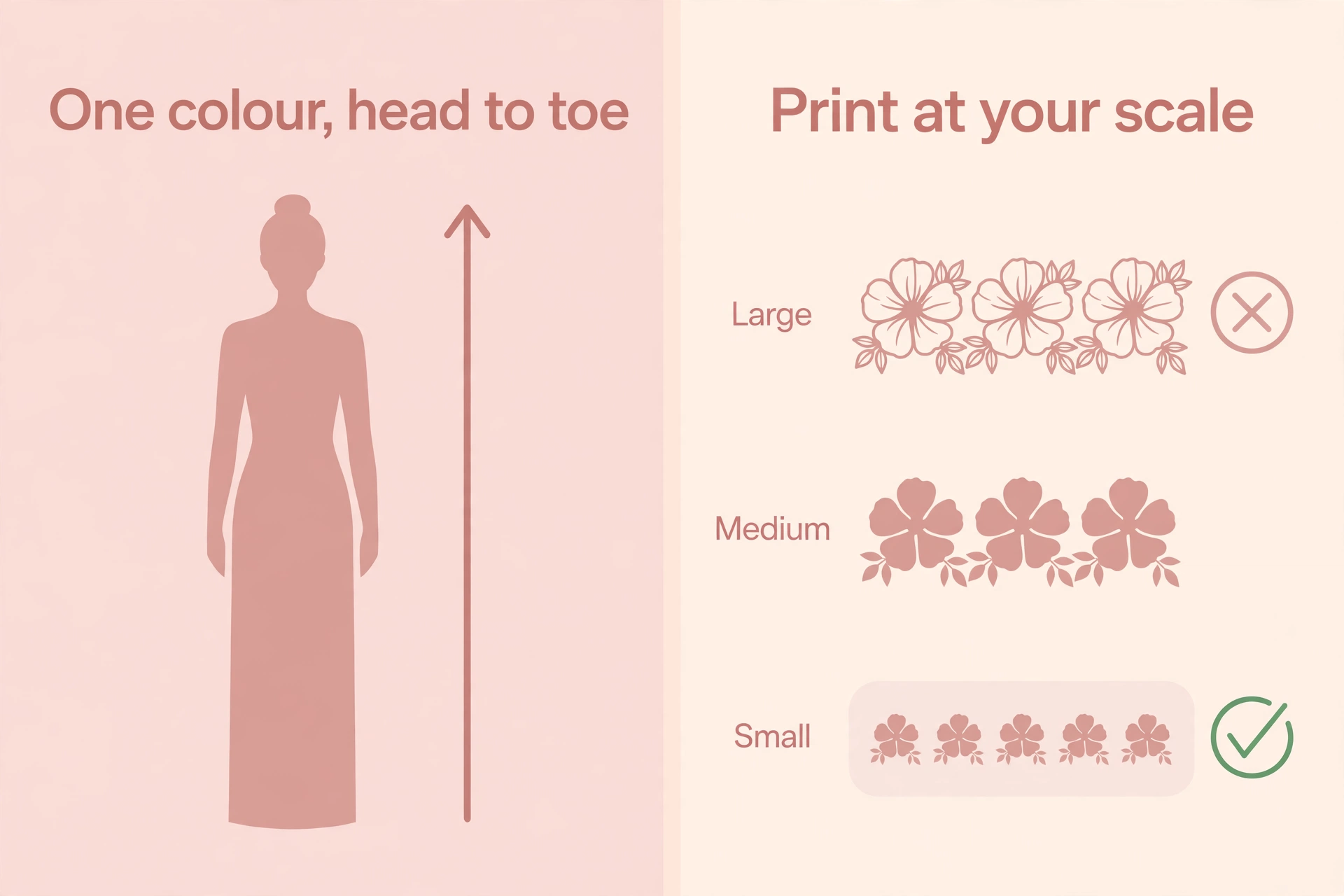
The rule: an unbroken vertical line. Stitch Fix stylists give monochrome as their top lengthening tip for petite frames, because dressing in one colour creates an uninterrupted vertical line, and they suggest varying shades and textures within the same colour family to keep it interesting. PureWow’s stylist guide records the same advice from Stitch Fix stylist Tamika Harris: one colour head to toe creates an uninterrupted line that helps you appear taller. Black is the classic, but burgundy, forest green, navy, and deep plum all run the same play, and a ribbed knit beside a smooth satin in one colour reads as styling rather than sameness.
This is the outfit for a Friday night date when you want the silhouette to do the talking. A column that skims works harder than a column that squeezes; our guide to the best bodycon outfits for every body type covers choosing that close fit silhouette by silhouette, while this outfit is about the line, whichever silhouette draws it.
2. High-rise jeans with a cropped evening top
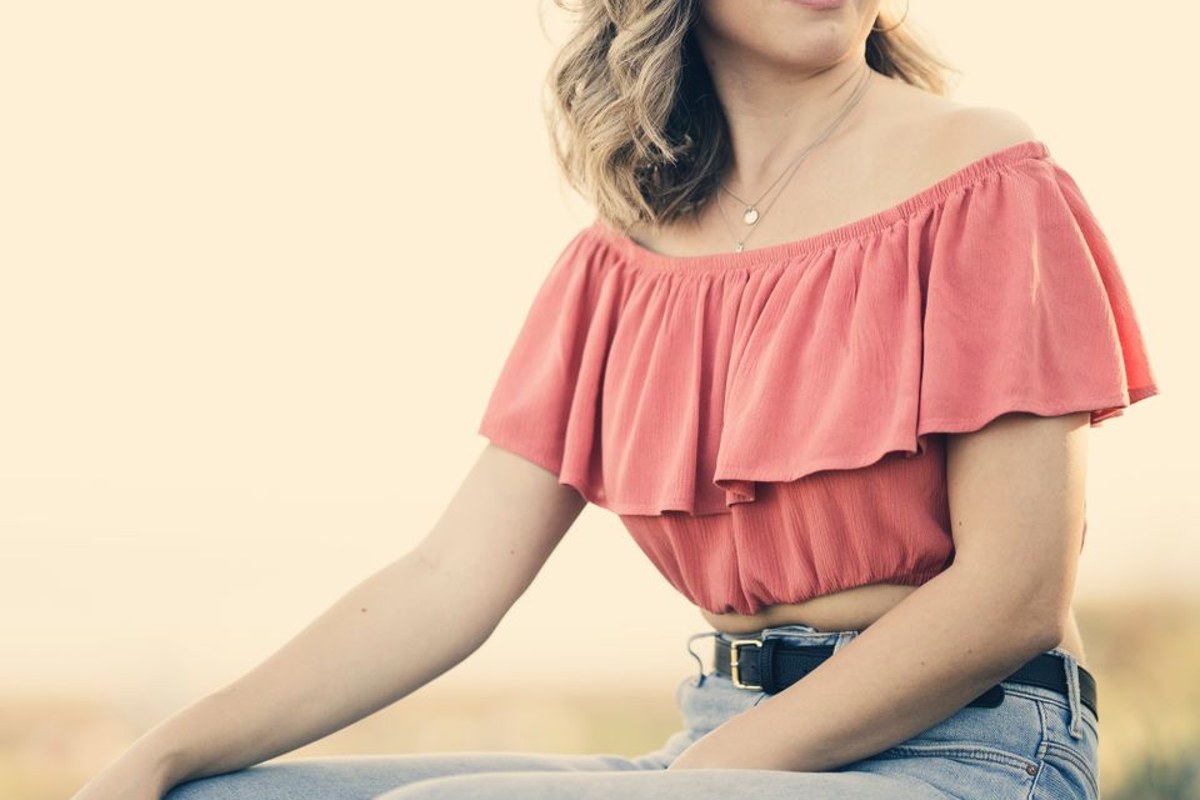
The formula: petite high-rise jeans ending at the ankle bone, a top that ends at or above the waistband — cropped, tucked, or a bodysuit — a slim belt at the natural waist if you want one, and a pointed shoe.
The rule: the one-third, two-thirds split, drawn by the rise. Stitch Fix’s petite stylists advise looking for jeans with a higher waist, because the high rise elongates the legs and balances proportions, and the Pumps & Push-Ups petite jeans guide explains what a true petite jean changes beyond length: the rise is shorter, the inseam is shorter, and the pattern and pockets are placed differently, with a standard petite high rise around 10 inches and a mid rise around 9. A standard high-rise jean hemmed to your length still carries that longer rise, so the waistband climbs toward your ribs while the crotch sits low — wrong in a way hemming cannot fix.
Build the full outfit step by step with our how-to on building a Friday night outfit from jeans, and if your pair is ripped, place the rips with the same landmark logic — our guide to how to style ripped jeans covers keeping distressing at the knee it was designed for rather than the shin it lands on in a standard cut.
3. The above-knee dress with a clean shoe line
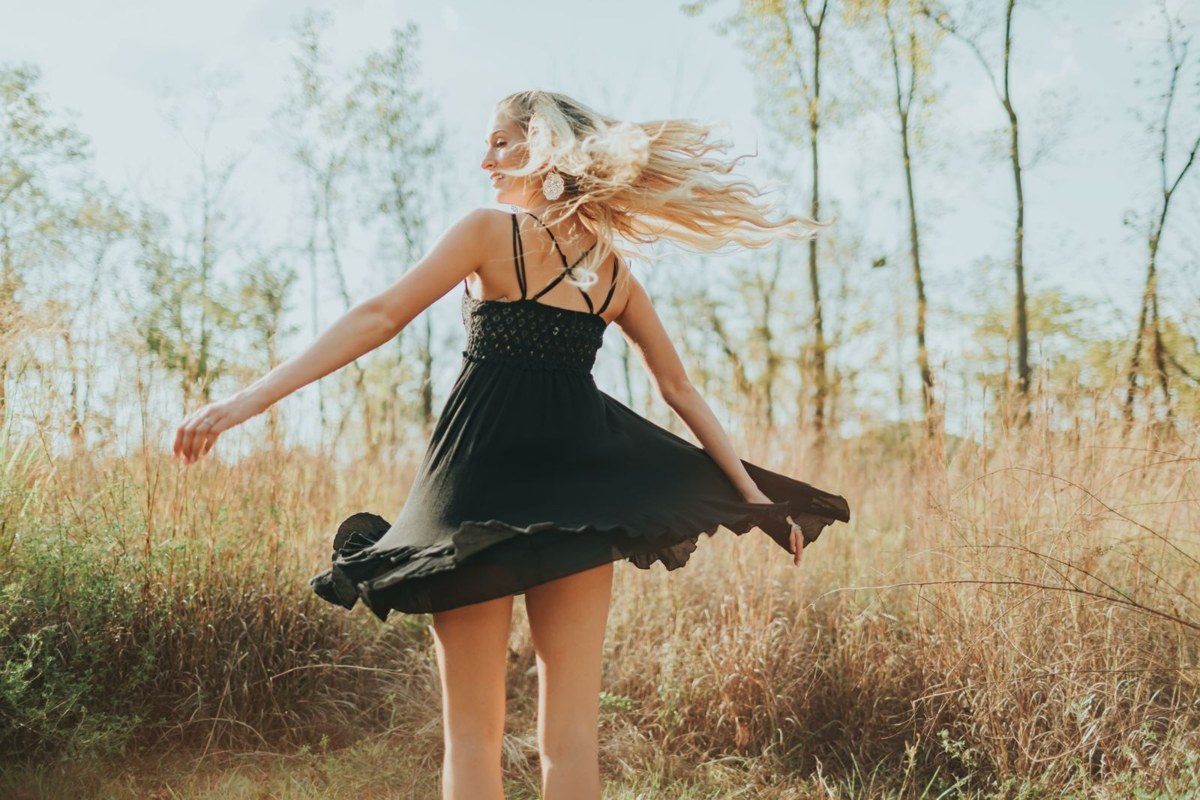
The formula: a mini or above-knee dress with its waist seam at your natural waist, a neckline that opens the chest, and a shoe with a low vamp and nothing heavy at the ankle.
The rule: leg shown is leg lengthened, provided the waist stays high. Stitch Fix’s petite dress advice suggests knee length or shorter for most petite dresses, and the thirds rule explains why the combination works: a short skirt is only half the equation, and the high waist seam is what converts shown leg into apparent leg length. This is the most forgiving outfit on the list, because above-knee lengths in standard cutting often land at a wearable place on a petite leg without alteration. Judge it by the waist seam, not the hem.
Keep the register deliberate rather than accidental: our explainer on how revealing a Friday night outfit reads walks through balancing a shorter hem with neckline and sleeve choices so the whole look stays chosen.
4. High-rise wide-leg trousers with a fitted top
The formula: petite wide-leg trousers hemmed to skim the top of the shoe, a fitted or tucked top that ends at the waistband, and a heeled pointed shoe tall enough to hold the hem off the floor.
The rule: volume below, discipline above, and a hem that grazes rather than pools. Wide legs are not banned for petites; unhemmed wide legs are. Banana Republic’s Icon jean shows the arithmetic on one product page: the same wide-leg style lists a petite inseam of 29 inches against 31 in regular and 34 in long, with an 11.5-inch high rise. Two inches is the difference between a trouser that skims the shoe and one that swallows it. Stitch Fix’s stylists add the styling half: wide-leg trousers create the illusion of longer legs when the hem barely skims the top of the shoes. If your pair puddles, that is a hemming appointment, not a verdict on the silhouette.
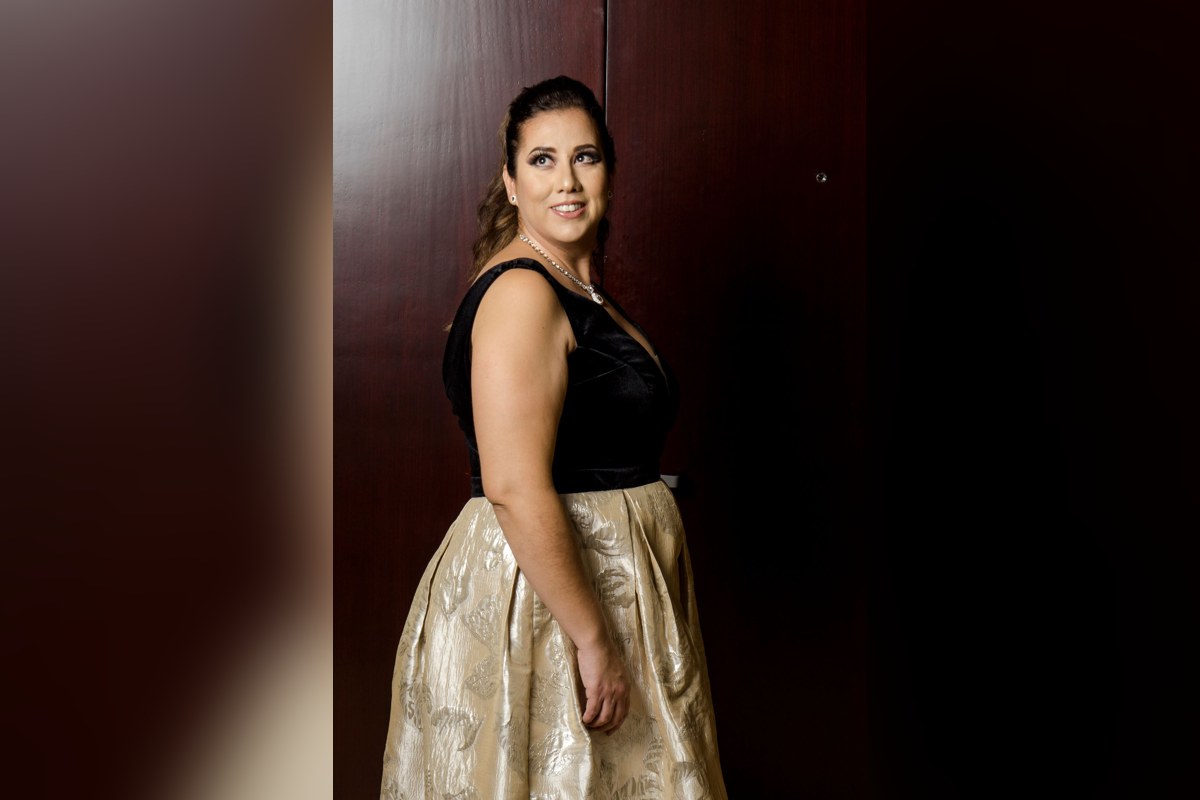
5. The petite wrap dress, waist at your waist
The formula: a wrap or faux-wrap dress in a petite cut, tied or seamed at your natural waist, hem above the knee or at the ankle bone, with a V-neckline doing the vertical work on top.
The rule: the waist seam must sit where your waist is. Stitch Fix names the wrap dress the best petite dress for a reason it states plainly: wrap dresses define your waist and flatter your curves without adding excess bulk in fabric, and a fit-and-flare shape builds the same hourglass from a fitted top and a flared skirt. The wrap has a second advantage: the tie is adjustable, so you can place the narrowest line at your natural waist even when the dress’s own seam sits a fraction low. A standard-cut wrap whose bodice is long will still blouse above the tie, which is why the petite version is worth hunting down. It is the most reliable dress on this list for a Friday night dinner, where you will be photographed seated and the waist placement does the visible work.
6. The scaled-print skirt outfit
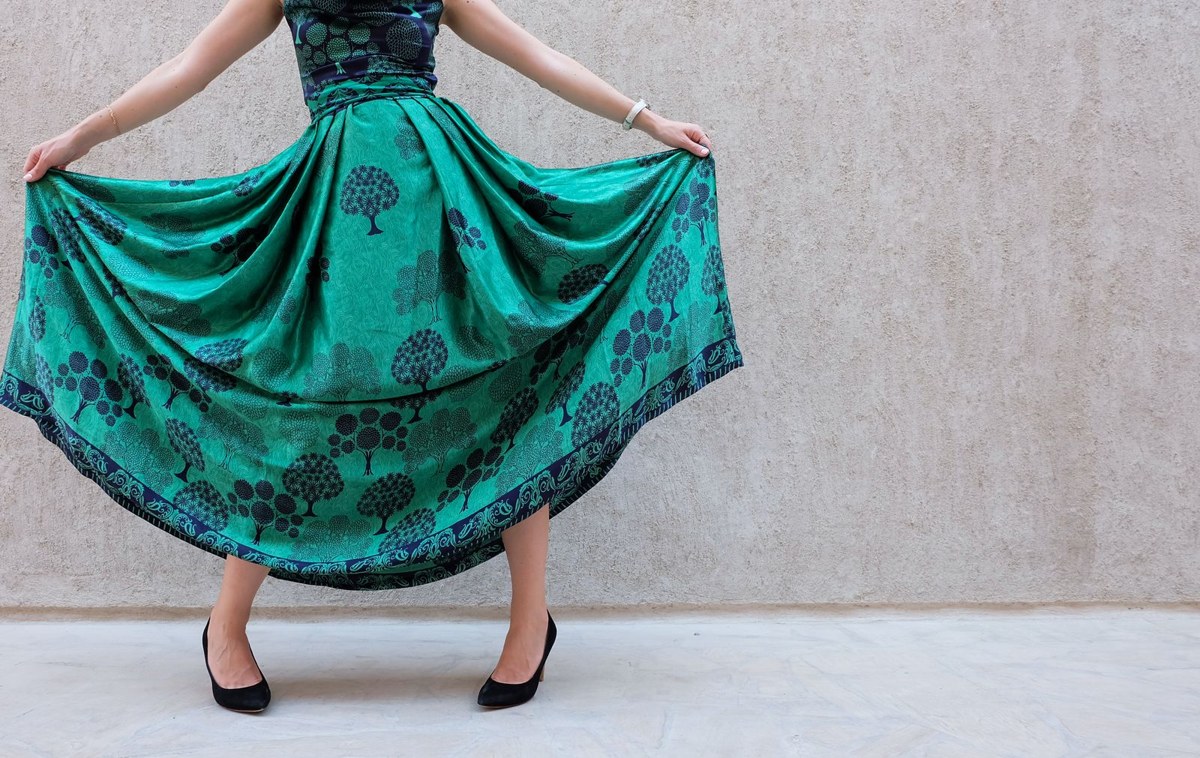
The formula: a midi or maxi skirt in a small-to-medium print, in a petite length ending at the ankle bone or grazing the shoe, with a plain fitted top tucked in and a shoe matched to the skirt’s ground colour.
The rule: the print’s repeat must be proportionate to the body wearing it. The Apparel Search petite guide gives the working test: the main motif of a petite print should be smaller than your own palm, and an all-over pattern should show several full repeats across a bodice. Petite Fashion’s proportion guide lands in the same place, advising smaller or medium-scale prints alongside medium handbags and narrower belts. A maxi is not off limits; a maxi in a giant floral with a hem trailing past your shoes is two scale errors stacked. In a petite-cut maxi the length is already solved, so only the print needs your judgement.
7. The tonal trouser suit with a cropped blazer
The formula: petite trousers and a cropped blazer in the same colour or close tones, a simple fitted top underneath, and a pointed shoe matched to the trouser.
The rule: the third piece ends where the legs begin. A blazer that ends at the waist or high hip keeps the two-thirds leg line visible underneath it, while a standard blazer ending mid-thigh draws a horizontal line across the longest part of the outfit and hands back everything the high rise earned. Worn open, the blazer’s two fronts also draw vertical lines of their own, which the proportion guide counts among its easiest vertical-movement tools. In one colour family, suit, top, and shoe merge into the column of outfit one, with tailoring on top.
Third Pieces at Petite Length
Jackets, blazers, and coats are where standard cutting ambushes petite women most reliably, because a third piece carries the most landmarks at once: shoulder, sleeve, button stance, pocket placement, and hem. Get the hem and shoulder wrong and the layer wears you to dinner.
The default petite third piece is cropped or waist-length. Stitch Fix’s stylists say it directly: cropped silhouettes are key because they highlight your waist, and structured styles that hit just above the hips create a balanced look. The same guidance warns against excess fabric in sleeves, naming balloon and batwing shapes as silhouettes that shorten the frame, and recommends three-quarter sleeves or full sleeves that stop right at the wrist instead.
Longer layers are a placement problem, not a ban. Worn open over a high waistline, a long coat keeps the thirds visible through its opening and adds two vertical lines; worn closed and belted at a dropped waist, it erases them. The layered builds in our guide to friday night outfits for fall translate directly if you shorten each layer by one step: the coat that ends mid-thigh on the model should end at your knee. In standard ranges, try the cropped and boxy cuts first — on a petite frame they often land exactly at waist length.
Print, Bag, and Belt: Getting the Scale Right
Scale is the most mechanical of the five rules, and the easiest to apply in a fitting room. Hold the print’s main motif against your palm. If the motif is bigger than your palm, it will read as the outfit’s main event and you as its frame. The companion test for all-over patterns: several full repeats should fit across a bodice — a print so large that only one and a half flowers fit across your chest was drawn for a longer torso.
Belts follow the same logic. Petite Fashion’s proportion guide suggests belts around half an inch to an inch and a quarter wide for petite frames, and PureWow’s stylist guide adds the placement half: a belt at the natural waistline adds structure and marks the proportions. A wide belt at the same place spends two of your scarce vertical inches on hardware. Bags scale down one step as well — a medium structured bag instead of the oversized tote — and jewellery goes delicate to medium. Vertical accessories are the exception that helps: the PureWow guide recommends long pendant necklaces and cross-body bags worn long, because they draw the eye down the body rather than cutting across it.
None of this forbids a bold print, a wide belt, or a big bag. It assigns them a budget: one oversized element per outfit, carried deliberately, with everything else at your scale.
The Shoe Line: Where the Leg Actually Ends
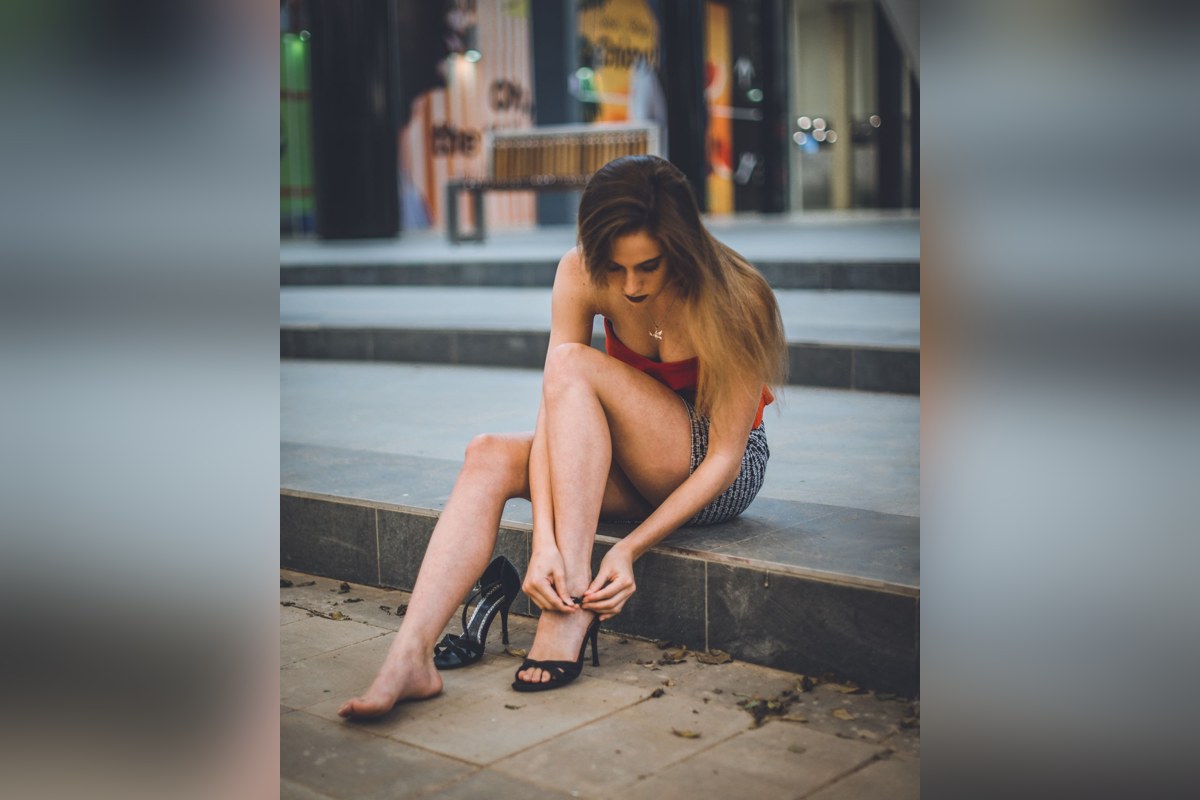
An outfit’s leg line does not end at the hem. It ends at the tip of the shoe, and the inches between hem and toe are either working for you or against you. Coveti’s pointed pump guide explains the mechanism: a pointed toe extends the visible length of the foot, so the eye reads one uninterrupted line from hip to tip instead of stopping at a round toe, and the effect is strongest with a low-cut vamp, a shoe close to your skin tone, and a hem above the ankle. Petite Fashion’s proportion guide adds the colour half: shoes that match your trousers, tights, or skin tone create a continuous line that extends the leg, while strong contrast at the ankle cuts it.
Put into practice, the shoe rules are short. With trousers, match the shoe to the trouser and let the point show past the hem. With bare legs, a shoe near your skin tone keeps the line running; with black tights, a black shoe does the same job. Treat heavy ankle straps and bright shoes under dark cropped trousers as deliberate breaks — sometimes worth it for the shoe itself, never free. Heel height matters less than most petite advice claims: a pointed flat in the right colour lengthens more reliably than a high round-toe heel in the wrong one, and the friday night outfit formula treats the finisher the same way, as the piece that completes the line.
What to Skip on a Petite Frame
A short skip list, all of it about landmarks rather than garments. Skip the standard-cut maxi whose waist seam sits on your hips and whose hem needs holding up in one hand; the petite version of the same dress is a different, wearable garment. Skip low-rise anything on a night you want length, because a low rise shortens the leg from both ends. Skip the long untucked top over trousers, which erases the waist point entirely, and the mid-thigh blazer worn closed, which draws its line across the widest part of the leg.
Skip, too, the strategy of hemming standard trousers and calling them petite: the rise, knee, and pocket placement stay where the taller pattern put them, which is why the Pumps & Push-Ups petite jeans guide distinguishes true petite cutting, proportioned all around, from short lengths that only trim the inseam. Keep one proven petite outfit ready, so a bad fitting-room evening never decides what you wear — and run the full-length check in our guide to what to wear Friday night: waist seam, hemline, and shoe tip all in frame at once.
Our view
Petite dressing is not a search for clothes that make you look taller at any cost. It is the refusal to wear another frame’s landmarks. A waist seam at your waist, a hem placed where you chose it, a print drawn at your scale, a shoe that finishes the line: none of these change your height, and together they change everything about how an outfit reads. Build the outfit on your proportions and it stops looking borrowed.
— Friday Night Style
Frequently Asked Questions
What height counts as petite for clothing?
Retailers draw the line in slightly different places. Talbots proportions its petite range for women 4’11” to 5’4″, ASOS designs petite for heights up to 5’3″, and Anthropologie and Nordstrom’s JS Collections guide both use 5’4″ and under. Treat the bands as a starting point and shop by garment measurements — rise, inseam, and sleeve — because proportion decides the fit.
Can petite women wear wide-leg trousers and maxi dresses?
Yes, in the petite cut or with the landmarks corrected. A wide leg works when the top is fitted or tucked, the rise is high, and the hem skims the top of the shoe instead of pooling. A maxi works when its waist seam sits at your natural waist, its print is scaled down, and its hem grazes your shoe rather than trailing.
Is hemming standard clothes the same as buying petite?
No. Hemming moves one landmark, the length. A petite pattern also shortens the rise and torso, raises the knee placement and waist seam, narrows the shoulders, and scales the details. Hemmed standard dresses and blazers usually still sit wrong at the waist and shoulder, where the eye reads fit.
What shoes lengthen a petite leg the most?
A pointed toe in a colour close to your trousers, tights, or skin tone, with a low vamp that shows the top of the foot. That combination extends the visible line from hip to toe without interruption. Heel height helps less than colour and shape.
How do I make a standard dress work on a petite frame?
Place the landmarks yourself. Belt or tie it at your natural waist rather than where its seam falls, choose it in a small-to-medium print, hem it to above the knee or the ankle bone rather than mid-calf, and shorten sleeves to the wrist bone. If the shoulder seam sits off your shoulder and the bodice sags, no belt fixes it — that dress needs its petite version. The comfort-first version of the same placement logic is in our guide to friday night outfits when bloated, which moves the fitted point to the ribs on purpose.
What is the fastest petite fix before a night out?
Raise the waistline. Tuck the top in fully, swap a long layer for a cropped one, or belt at the natural waist, and the outfit’s proportions reset from halves to thirds in under a minute. It costs nothing.
Questions About Friday Night Outfits for Petite Women?
Tell us the plan, the dress code, and the part of the outfit that is not working — we read every message.
Sources
- Talbots — Size Charts
- ASOS — Women’s Jeans, Trousers and Leggings Size Charts
- Nordstrom — JS Collections Women’s Petite Size Guide
- Anthropologie — Petite Clothing for Women
- Apparel Search — Women’s Petite Fashion Guide
- Stitch Fix — Your Petite and Curvy Fashion Questions, Answered
- PureWow — 5 Rules for Wearing Shorts If You’re Short
- Petite Fashion — The Science of Petite Proportions
- Banana Republic — The Icon Classic Wide-Leg Jean
- LOFT — Petite Parker Straight Pants in Texture
- Pumps & Push-Ups — The Ultimate Petite Jeans Shopping Guide
- Coveti — Pointed Toe Pumps: How to Wear Kitten, Mid and High Heels