
The text lands at half past five: dinner at seven, across town, and you are standing in front of a full closet wearing a towel and a rising sense of betrayal. Everything you own suddenly looks wrong, dated, or invisible. Nothing is actually wrong with your clothes. What has collapsed is your decision process, and a collapsed process has a fix. This is the timed system: one anchor piece, a strict build order, and twenty minutes from panic to dressed.
Friday Night Style
Twenty Minutes From Panic to Dressed
A timed closet system that builds a complete Friday night outfit from pieces you already own, starting from one anchor.
Key Takeaways
- The panic is a decision problem, not a wardrobe problem: shrink the choice set first and the outfit gets easy.
- Start from one anchor piece you already trust, and let it make most of the remaining decisions for you.
- Follow the 20-minute build order: anchor, matching half, third piece, shoes and bag, then finishers.
- Rescue basics with finishers — a layer, a shoe change, one piece of jewelry — instead of starting over.
- Skip experiments when rushed: no untested shoes, no first-wear pieces, no repairs that need more than two minutes.
Table of Contents
- Why a Full Closet Feels Empty at 6 p.m.
- Step One: Pick the Anchor Piece
- The 20-Minute Build Order
- Rescuing Basics With Finishers
- The Two-Minute Rescue Fixes
- What to Skip When You Are Rushed
- Set Up Tomorrow’s Easy Night Tonight
- Our view
- Frequently Asked Questions
- Sources
- Recommended
Why a Full Closet Feels Empty at 6 p.m.
Start by naming what is actually happening, because it is not a shortage of clothes. Research on decision fatigue describes how the quality of choices deteriorates after a long run of decisions, and by Friday evening you have made a full day’s worth before you ever open the closet door. Layer a deadline on top and it gets worse: a study of acute stress and decision-making found that stress on its own did little damage, but stress paired with time pressure measurably lowered decision quality. That pairing is exactly the last-minute outfit situation — a tired brain, a ticking clock, and forty hangers all asking to be evaluated at once.
The size of the set is the second problem. Work on choice overload shows that an overabundance of options can impair choosing rather than help it, producing stress and lower satisfaction with whatever gets picked. A full closet is a large choice set wearing a friendly disguise. Every additional top you consider multiplies the combinations you feel obliged to test, which is why the general friday night outfit formula works on calm evenings and fails under time pressure: the formula assumes you have time to deliberate. Tonight you do not, so the system below deliberates for you by removing options in a fixed order.
| Approach | How it starts | Decisions left open | How it usually ends |
|---|---|---|---|
| Browsing the whole closet | Pulling out anything that catches the eye | Every top against every bottom, shoe and layer | A pile on the bed and the first outfit you tried, worn resentfully |
| Starting from a full outfit idea | Imagining a complete look, then hunting its pieces | Fewer, but one missing piece breaks the whole plan | Fine when the key piece is clean and findable; fragile when it is not |
| Starting from one anchor piece | Choosing the one piece you trust most tonight | Only the pieces that must match the anchor | A complete outfit in about twenty minutes, with no restart |
Shrink the set before you judge anything
The first move is not choosing an outfit. It is making the closet smaller. Physically close off sections you are not considering: coats if the night is warm, work clothes, anything that needs repair. You are not tidying; you are cutting the option count so your tired brain can actually rank what remains. This is the same principle that makes a capsule wardrobe work on ordinary days, applied for one evening. As the capsule wardrobe guide puts it, a small coordinated set means almost everything matches, so getting dressed takes minutes instead of a negotiation. Tonight, your anchor rail is a capsule of five or six trusted pieces, built in two minutes from what you already own.
Set a clock, out loud
Give the build twenty minutes and say so. A named limit converts an open-ended spiral into a sequence with an end, and it changes how each small decision feels: a top is no longer being judged as perfect or wrong, only as workable within the next step. If you regularly get dressed for plans straight from work, the wider planning in our guide to what to wear Friday night helps on calmer weeks; tonight, the clock is the plan.
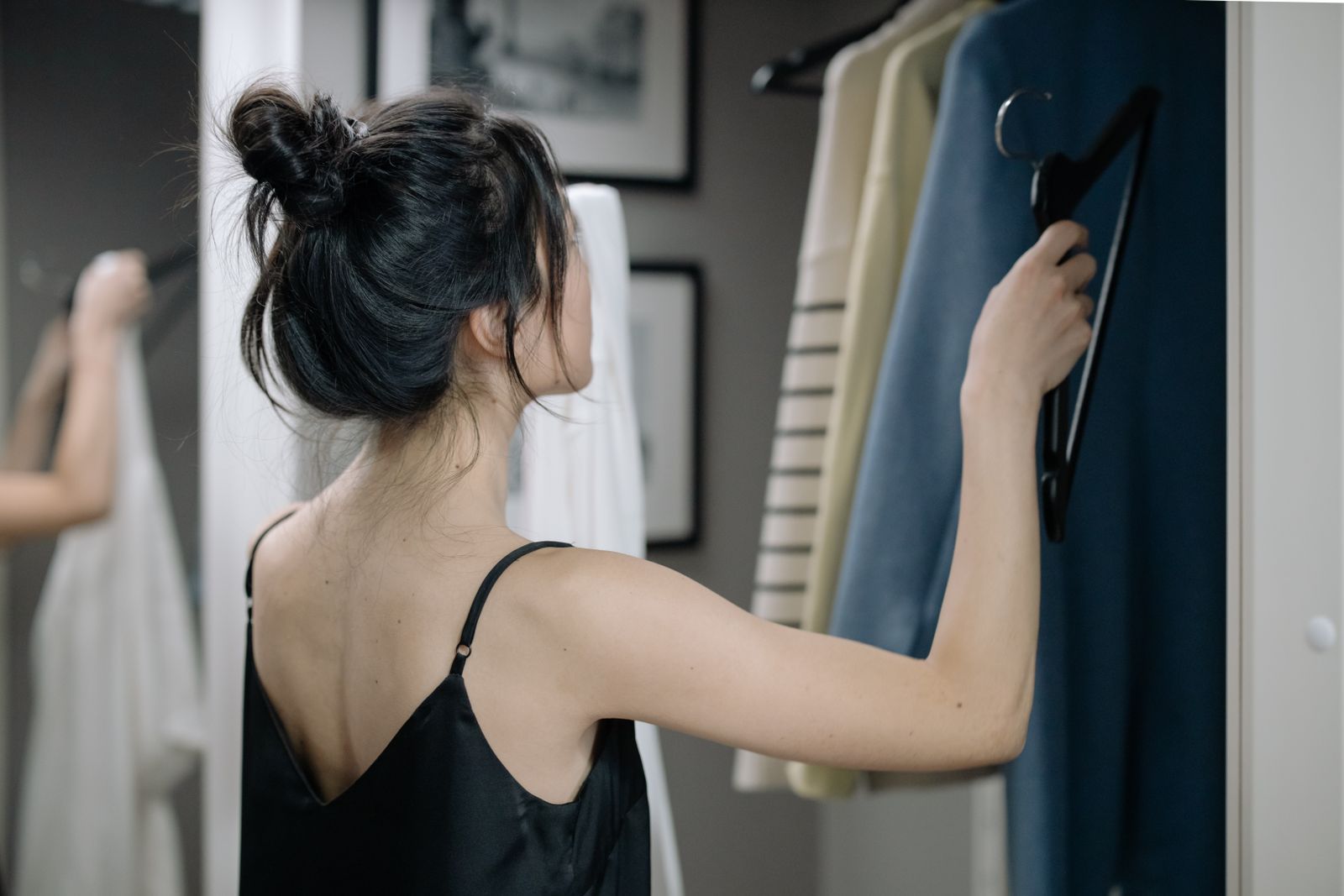
Step One: Pick the Anchor Piece
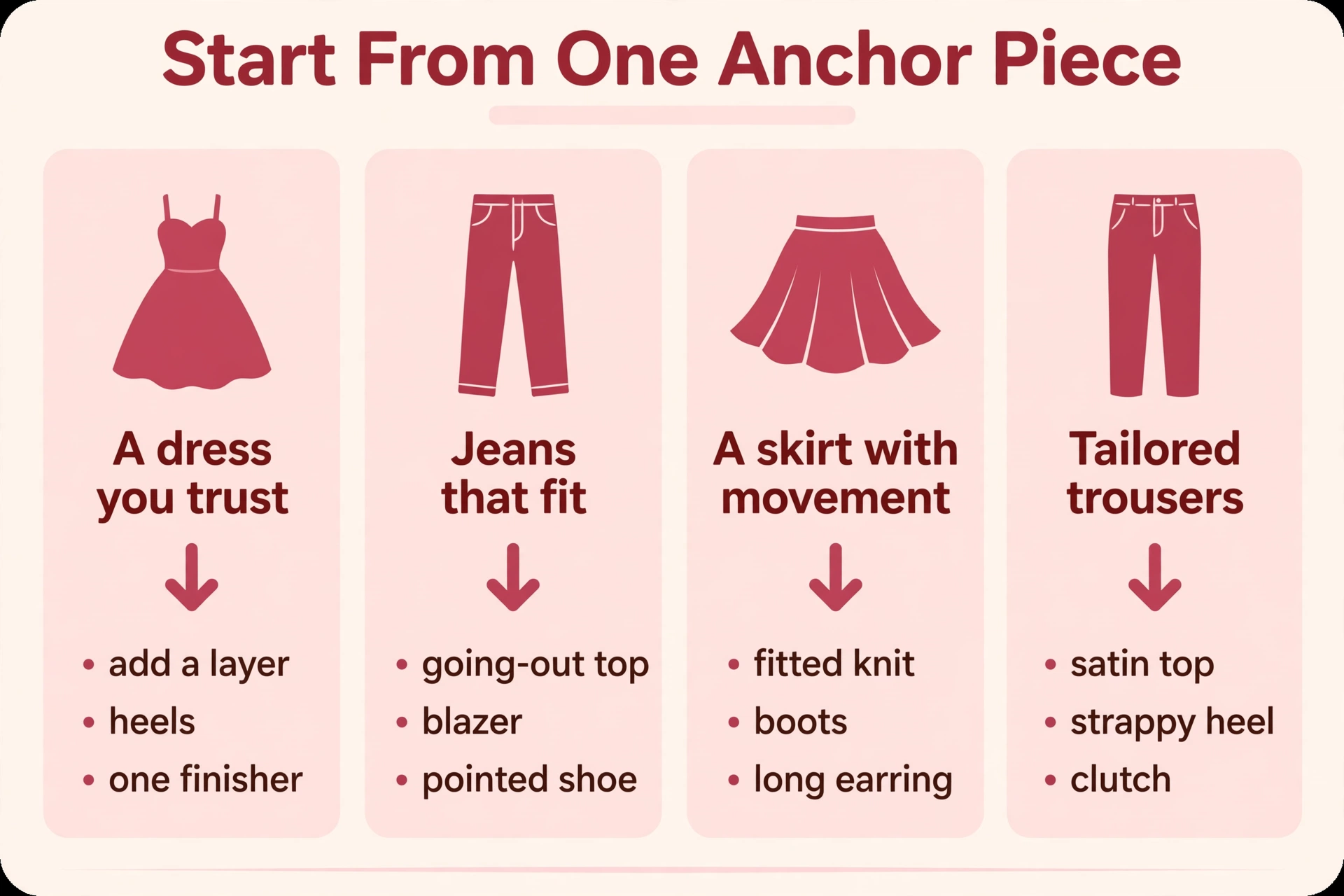
An anchor piece is the one item the whole outfit is built around, chosen for trust rather than excitement. Trust means four things: it fits today, not on a hopeful day; it is clean and ready to wear; you have worn it successfully before; and it suits the plan’s dress code without help. A dress you trust, jeans that fit, a skirt with movement, tailored trousers — any of these can anchor. What cannot anchor is a piece you love in theory: the top that needs a specific bra you cannot find, the trousers that only work with one shoe, the dress you have never actually worn out.
The anchor matters because it pre-decides most of what follows. A clear explanation of how fewer pieces create more outfits makes the underlying point: what makes a wardrobe useful is how well pieces connect to each other, not how many pieces there are. One strong anchor with known partners is a small, highly connected network. You are not looking for your best piece tonight. You are looking for your most connected one — the piece with the most pieces that already work with it.
The four anchors and what each one decides
If the anchor is a dress, the outfit is mostly decided: you need a layer if the night is cool, a shoe, a bag, and one finisher. If the anchor is jeans, the decisions narrow to a going-out top and a third piece, which is why the jeans-first build in our friday night outfit with jeans guide is such a reliable rushed-night fallback. If the anchor is a skirt, the top must balance its volume: a fuller skirt takes a fitted top, a straight skirt can carry more softness above it. If the anchor is tailored trousers, the top carries the evening signal — satin, drape, or a neckline that reads after dark — while the trousers quietly handle the polish.
Judge the anchor against the plan, not the mirror
Ask three questions of the anchor, in this order. Does it fit the venue and the people? Does it fit the weather between the door and the car? Does it fit your body as it is this evening? That last question is practical, not critical: on a bloated, tired, end-of-week body, the forgiving anchors earn their place, and our guide to friday night outfits when bloated covers which cuts stay comfortable seated through a long dinner. An anchor that passes all three questions does not need to be exciting. Excitement is the finishers’ job, later, when there is time to enjoy choosing it.
The 20-Minute Build Order
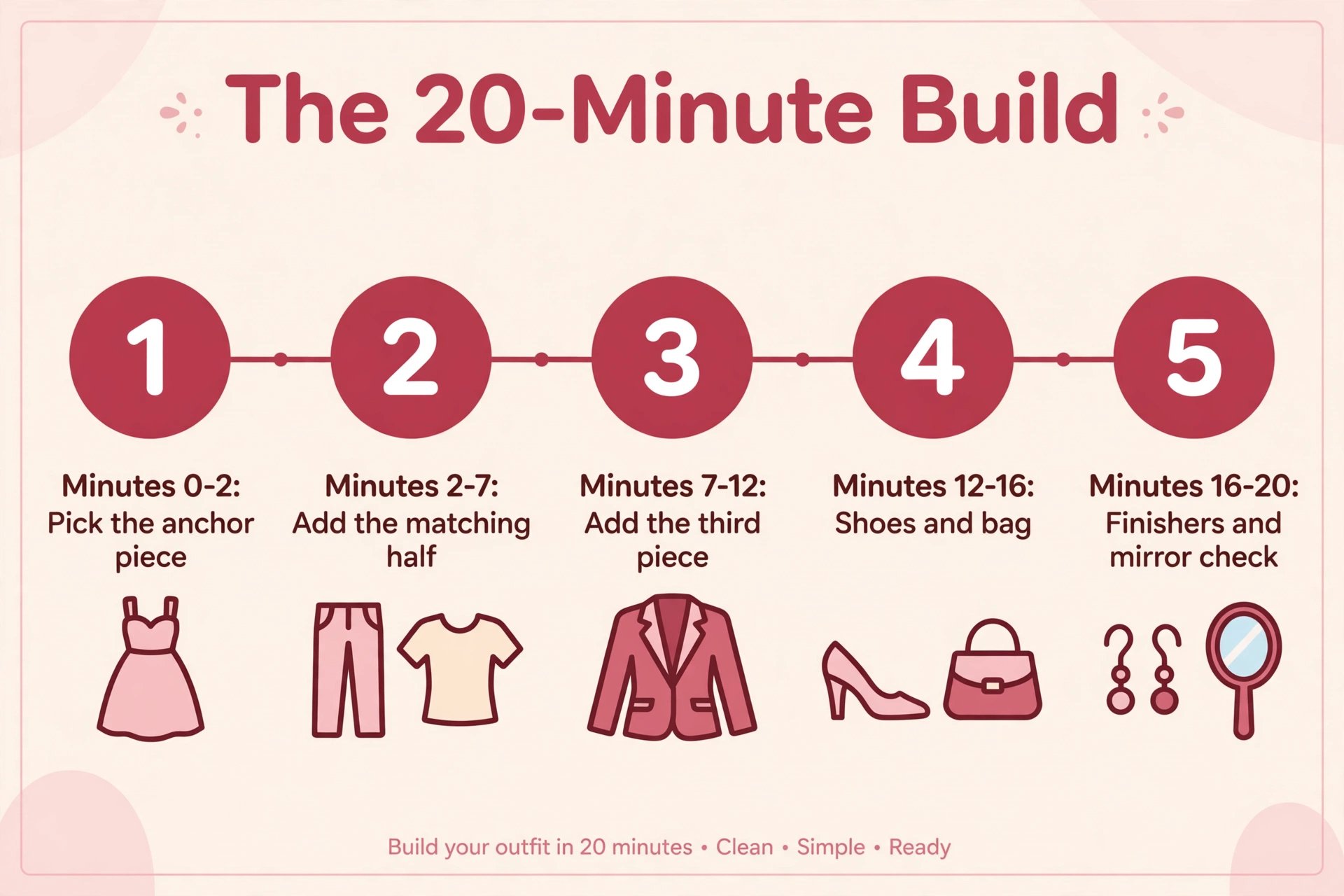
With the anchor chosen, build in this order and do not go backwards. Each step has a time box, and each step only chooses from what the previous step left open. That one-way flow is the whole trick: it stops the loop where a new shoe sends you back to change the top, which sends you back to change the bottom, until the bed is covered in rejected clothes and you are late.
Minutes 0–2: the anchor. Pull the anchor and hang it on the door where you can see it. Everything else is judged against it, in place, not in your head. Minutes 2–7: the matching half. If the anchor is a bottom, choose the top now — one top, tried on with the anchor, not three tops held up in turn. If the anchor is a dress, this step is the layer decision: cardigan, blazer, or nothing, settled by the weather and the venue. Minutes 7–12: the third piece. A blazer, a coat worn as part of the look, a scarf or a belt — the piece that makes two garments read as an outfit. Our guide to how to wear a trench coat shows how one long layer can carry that role across almost any base. Minutes 12–16: shoes and bag. Shoes first, because they set the hem and the posture; bag second, sized to what the night actually requires. Minutes 16–20: finishers and the mirror check. One or two finishers, the rescue fixes below if needed, and a final full-length look before you touch your hair or makeup.
Why the order protects you
Sequencing works because each decision is smaller than the one before. Choosing a top for a specific pair of jeans is a two-or-three-option question. Choosing shoes for a finished outfit is usually a two-option question. Compare that with the open closet, where every question is a forty-option question. Structured challenges make the same point at wardrobe scale: the Project 333 rules describe dressing from thirty-three items or fewer for a season, counting shoes and accessories, precisely so that daily choosing stays small. Your twenty-minute build is that idea compressed into one evening — a temporary set, a fixed order, and no reopening of settled steps.
If a step fails, swap sideways, not backwards
Sometimes the matching half genuinely fails: the top you wanted is in the wash. The rule is to swap within the step — a different top for the same anchor — never to abandon the anchor and restart the whole build. Restarting is what turns twenty minutes into fifty. The only true restart trigger is discovering the anchor itself is unwearable: stained, damaged, or suddenly wrong for a dress code you misread. Everything else is a sideways swap. Date nights follow the same logic, by the way: the looks in our guide to what to wear on a Friday night date hold up best when one trusted piece leads and the rest support it, rather than every piece competing to be the statement.

Rescuing Basics With Finishers
Most rushed-night outfits are not bad outfits. They are unfinished ones: good pieces, correctly combined, missing the signals that say evening. Finishers supply those signals in under four minutes, and they are why a plain base from your own closet can go out on a Friday night instead of losing to the panic purchase you cannot make anyway.
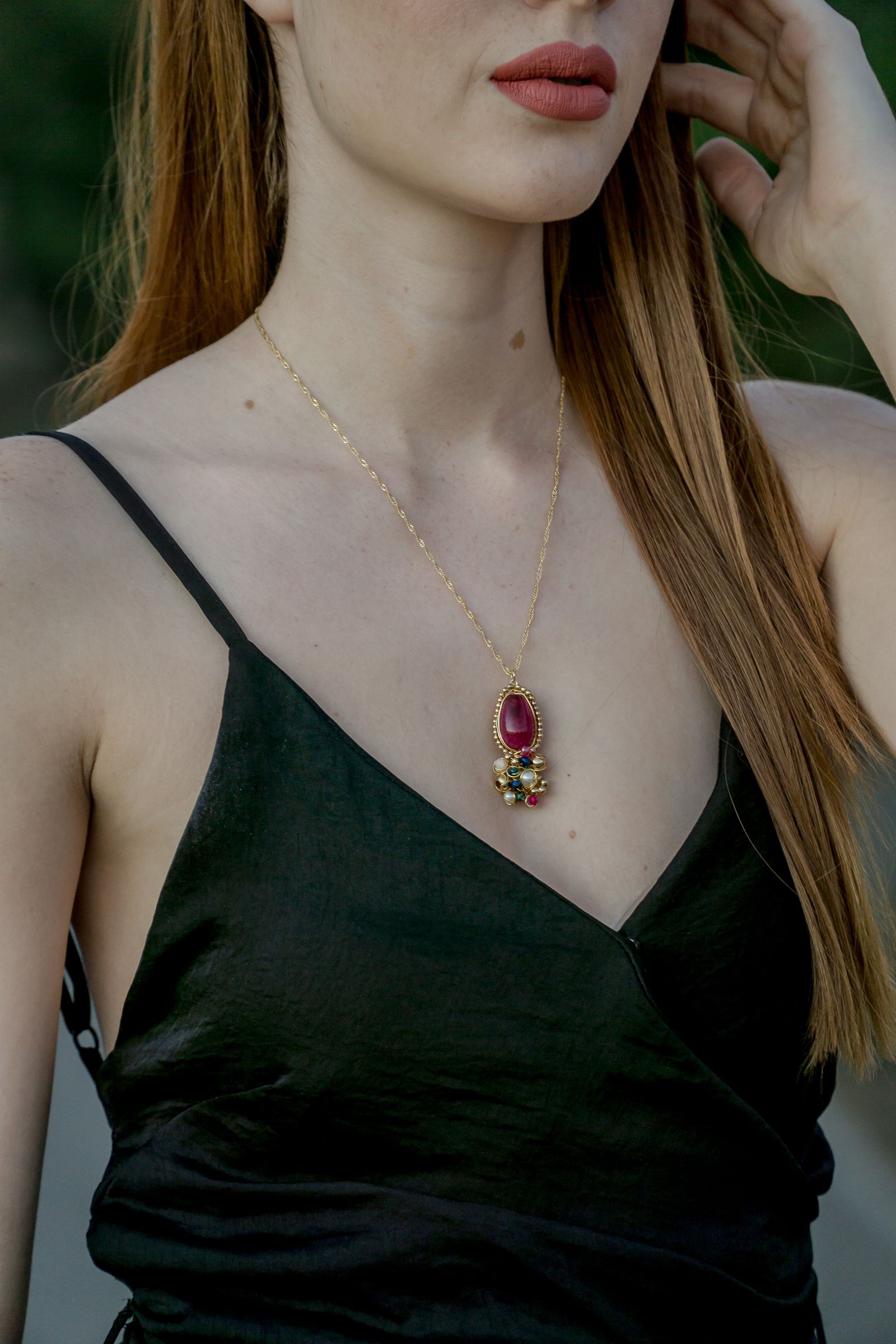
The strongest finishers, in order of speed: a shoe change, because swapping a flat or a trainer for a heeled or pointed shoe changes the posture and the register of everything above it; a third piece with structure, because a blazer or a sharp coat gives a soft base a frame; one piece of jewelry worn at the face or the wrist, where it catches light and movement; a belt, when the outfit has a waist that needs defining; and a bag swap, because the daytime tote argues with almost every evening look while a small bag agrees with nearly all of them. Notice what is not on the list: a different outfit. Finishers work on the outfit you have built, which is the only outfit there is time for.
One statement, not three
Under time pressure, the temptation is to add everything at once — the earrings, the necklace, the belt, the scarf — and produce noise instead of polish. Choose one statement finisher and let the rest stay quiet. This is the same balance our explainer on how revealing a Friday night outfit should be works through from another angle: one strong dial, deliberately set, reads as intention, while everything turned up at once reads as accident. A rushed night rewards intention most, because intention is exactly what panic strips away.
Fit and proportion checks that take seconds
Two checks catch most finisher mistakes. First, the waist check: if the top meets the bottom in a soft blur, tuck, half-tuck, or belt it — one defined point organizes the whole silhouette, and the proportion guidance in our friday night outfits for petite guide and our friday night outfits for tall guide both start from placing that point deliberately for your frame. Second, the length check: the layer should end at a point that makes sense with the hem below it, either clearly shorter or clearly longer, never hovering at the same line. Both checks happen in the mirror step, both take seconds, and both are fixable with pieces already in the room.
The Two-Minute Rescue Fixes
A chosen piece with a small flaw is not a failed piece. Most flaws that appear at 6 p.m. have a fix that takes less time than finding a replacement, provided you check the fabric first. The clothing care label guide explains the five label shapes — wash, bleach, dry, iron, professional care — and that an X through a shape means skip that process entirely. Read the label before any heat or steam touches the garment; ten seconds of reading protects the piece you are counting on.
Wrinkles. Steam is the fastest safe rescue for most fabrics. Rowenta’s guide to using a steamer advises hanging the garment, holding the fabric gently taut, and keeping the steamer upright a short distance from the cloth, moving slowly over the wrinkles. No steamer? Rowenta’s wrinkles without an iron guide offers the bathroom method — hang the garment in a steamy bathroom — and the dryer method, tumbling the piece with a damp towel so the moisture relaxes the fibers. Give a steamed piece a minute hanging before you wear it, so it cools smooth rather than re-creasing against warm skin.
Lint and hair. Whirlpool’s guide to removing lint recommends a lint roller or masking tape wrapped sticky-side-out around your hand, blotted along the fabric to lift lint, fuzz and hair. Work top to bottom, once, and stop: lint removal has a point of diminishing returns that arrives quickly, and the clock matters more than the last three specks on a hem nobody will see in evening light.
Static cling. Maytag’s guide to removing static notes that a few quick shakes reduce static, and that dryer sheets and steam help neutralize the charge that makes a skirt wrap around your legs. A lightly damp hand smoothed over the clinging area does the same job standing at the mirror, and takes ten seconds.
Shoes that might hurt. Cleveland Clinic’s guide to preventing blisters is blunt about the real fix: wear shoes that fit, and break new shoes in slowly before wearing them for long periods. On a rushed night that translates to one rule — the shoe you have already survived a night in beats the prettier shoe you have not. If a known shoe has one known rub spot, a bandage on that spot before you leave is a two-minute fix that saves the whole evening.

What to Skip When You Are Rushed
Skipping is a skill, and on a rushed night it protects more outfits than choosing does. Skip the first wear of anything: a new piece carries unknown fit, unknown comfort, and unknown behavior seated, and tonight has no margin for discoveries. Skip the repair project: a loose button you can secure with one safety pin is a fix, while a hem, a zip, or a strap that needs real sewing is tomorrow’s job wearing tonight’s deadline as a disguise. Skip the outfit that needs a specific underpinning you have to hunt for. Skip the second full outfit trial — one sideways swap per step is the budget, and a third candidate in any step means the step, not the clothes, needs the decision made for it: pick the safer one and move on.
Skip, too, the comparison scroll. Photographs of other people’s Friday nights are taken with unlimited time, professional light, and clothes chosen for the camera; measured against them, every real closet loses. If photos matter tonight, our guide to friday night outfits that photograph well covers what actually reads on camera — fit, contrast, and one clear focal point — all of which the anchor system already delivers. And skip apologizing for a repeated outfit. Nobody at dinner is auditing your rotation, and a repeated outfit built on a trusted anchor is usually the best-fitting thing in the room, because it has been tested by real evenings rather than by the mirror alone.
The seasonal traps to pre-decide
Some skips are seasonal. In cold weather the trap is the coat that fights the outfit; decide the layer as part of the build, as our what to wear Friday night in winter guide insists, rather than grabbing the warmest thing at the door and undoing the silhouette. In fall, the trap is the almost-right boot; the friday night outfits for fall wardrobe works because its layers and boots were matched in advance. Pre-deciding these two traps on a calm day is what makes the rushed version of the same night feel easy.
Set Up Tomorrow’s Easy Night Tonight
The honest secret of people who get dressed fast is that the work happened earlier. Ten calm minutes, once, buys you speed on every rushed night after. Hang a small anchor rail: five or six proven pieces that fit now, cleaned and ready, at the front of the closet where your hand lands first. Keep a finisher station together — the belt, the two pairs of earrings, the small bag, the safety pins, the lint roller — in one place, so the last four minutes of any build are a grab, not a search. Note, on your phone, the two or three complete outfits that have already survived real Fridays; a tested list beats a fresh idea under pressure, at any age, which is a point the tested rotations in our friday night outfits over 40 guide make just as well.
Then maintain the rail the way you would any small system: when a piece comes back from a successful night, it returns to the rail; when a piece fails twice, it leaves the rail, however much you like it. A close-fit anchor deserves the same honesty — the best bodycon outfits for every body type only earn rail space if you have actually worn yours comfortably for a full evening. The rail is not a capsule wardrobe commitment and it is not a shopping project. It is simply your own evidence, hung where the panic cannot argue with it.
Our view
A full closet and nothing to wear is not a shopping problem and it was never a taste problem. It is a tired brain facing forty options with twenty minutes to spend, and it yields to a system, not to more clothes. One anchor you trust, one fixed order, finishers instead of restarts, and the discipline to skip everything experimental — that is the whole method, and it works with the closet you already have. The outfit was in there all along. It just needed you to stop auditioning the other thirty-nine.
— Friday Night Style
Frequently Asked Questions
What if I have less than twenty minutes?
Compress, do not redesign. The anchor and the matching half become one step, the third piece is dropped unless the weather demands it, and finishers shrink to one: the shoe change. A two-piece outfit with the right shoes beats a three-piece outfit assembled in a sprint, and the mirror check is the one step that never gets cut.
What is the single best anchor piece to own?
The one with the most proven partners in your closet. For many women that is a pair of dark jeans that fit well, because tops, layers and shoes already in the wardrobe tend to work with them; for others it is a simple dress that needs nothing but a shoe and a layer. Count partners, not compliments.
My anchor piece is clean but wrinkled. Is it still usable?
Usually, yes. Steam it while it hangs, following the garment’s care label, and let it cool for a minute before dressing. Wrinkle rescue takes about two minutes for most fabrics. If the piece is heavily creased through the whole garment rather than in one area, swap sideways to the next anchor instead of steaming against the clock.
How do I stop every rushed night ending in the same outfit?
Rotate the anchor, not the system. Keep three or four tested anchors on the rail and start from a different one each time; the matching halves and finishers will differ around it, so the outfits differ without any new decisions being invented under pressure. A repeated system is a feature. A repeated outfit is just what happens when only one anchor is trusted — so build trust in a second one on a calm day.
Can this work for a dress code I did not expect?
Mostly, yes, because dress codes are usually met by the finishers rather than the base. The same anchor outfit reads more formal with a structured layer, a heeled shoe and a small bag, and more relaxed with a softer layer and a flat. If the code is genuinely strict, anchor on your most formal trusted piece and let the system run from there.
What should I do with the pile of rejected clothes afterward?
Hang them back the same night if you can, and notice what the pile is telling you: pieces pulled out and rejected three rushed nights in a row are not anchor material, whatever their merits. Move them off the rail. The pile is data, and the rail should be rebuilt from it after every few Fridays.
Questions About Last-Minute Friday Night Outfits?
Tell us the plan, the dress code, and the part of the outfit that is not working — we read every message.
Sources
- Wikipedia — Decision Fatigue
- Communications Psychology via PMC — Acute Stress Impairs Decision-Making
- iScience — Reducing Cognitive Demand Fails to Mitigate Choice Overload
- Metbrick — Capsule Wardrobe: How to Build One
- Fitinline — How Fewer Clothing Pieces Can Create More Outfit Options
- Project 333 — Rules and Wardrobe List
- The Practical Daily — What the Symbols on Clothing Care Labels Mean
- Rowenta — How to Use a Steamer
- Rowenta — How to Remove Wrinkles From Clothes Without an Iron
- Whirlpool — Tips to Remove Lint From Clothes
- Maytag — Ways to Remove Static From Clothes
- Cleveland Clinic — Best Ways to Prevent and Treat Foot Blisters