
The text lands at four: drinks after work, the good place, see you at five. You look down at the outfit that got you through the day and it reads exactly like what it is — a work outfit, a little tired, a little corporate, with no time to go home and start again. The fix is not a second outfit. It is a base chosen in the morning to work twice, and a five-minute switch — shed a layer, swap the shoes, add one statement, refresh your face — that turns the day look into a drinks look before you leave the building.
Friday Night Style
Same Outfit. Five Minutes. A Whole New Night.
The day-to-night transition system: a work base that converts for Friday night drinks with a layer shed, a shoe swap and one statement add.
Key Takeaways
- Build the morning outfit as a double-duty base: clean lines, a darker or richer palette, and one layer designed to come off.
- Run the switch in a fixed order — shed the layer, swap the shoes, add one statement, switch the bag, refresh your face — and it takes five minutes.
- Keep a small bag kit at your desk or in your tote so the switch never depends on remembering things on the day.
- Change one focal point only; a drinks look is the work look with its emphasis moved, not a costume change.
- Read the room before you switch: colleagues, clients and the venue decide how far the evening version should go.
Table of Contents
- Start With a Base That Works Twice
- The Five-Minute Switch, Step by Step
- The Layer Move: Shed, Drape or Swap
- The Shoe Swap and the Bag Switch
- One Statement Add, Nothing More
- The Bag Kit: What Lives at Your Desk
- The Two-Minute Face Refresh
- Five Work Bases, Five Drinks Looks
- Read the Room: Venue, Colleagues and Dress Codes
- When the Transition Goes Wrong
- Our view
- Frequently Asked Questions
- Sources
- Recommended
Start With a Base That Works Twice
Every successful after-work transition is decided at breakfast, not at five o’clock. The base is the outfit underneath the switch: the dress, trousers, skirt or jeans you wear all day, chosen so that removing or changing the pieces around it is enough to change its register. Who What Wear’s desk-to-drinks advice starts in the same place, with a desk-to-drinks outfit formula built on classic silhouettes in neutral colors, precisely because a quiet base leaves you free to move the accessories and the third piece later. Our own friday night outfit formula runs on the same spine — base, focal point, finishers — except here the focal point is deliberately withheld until evening.
What counts as a workable base is set by your office first. The Emily Post Institute’s business casual guide defines the daytime frame for women as a skirt, trousers or pants with an open-collar shirt, knit top or sweater, or a dress — and notes that a good business casual piece often works again as a dressier option in a social setting. Indeed’s guide to business casual attire adds the useful warning that the definition shifts by industry and company culture, with finance leaning conservative and creative workplaces allowing more flair. Build your base inside your own office’s version of the code, and the evening switch stays a styling move rather than a dress-code gamble.
| Work base piece | Daytime form | Five-minute night conversion |
|---|---|---|
| Sheath or wrap dress | Under a blazer or cardigan, with flats and a tote | Layer off, heels on, statement earrings, clutch |
| Tailored trousers and a silk blouse | Blouse tucked and buttoned, loafers, fine jewelry | Sleeves pushed up, one more button open, pointed heels, bolder lip |
| Button-up shirt and dark jeans | Shirt fully tucked, blazer over, ankle boots | Blazer draped or shed, shirt half-tucked, heeled boots, layered necklaces |
| Midi skirt and a fine knit | Knit tucked, cardigan on, low pumps | Cardigan off, belt at the waist, strappy heels, clutch |
| Slip dress under a fine turtleneck | Layered and covered, blazer optional, boots | Turtleneck off, dress alone, heels, one piece of statement jewelry |
Fabric is the silent half of the base
A base that converts has to survive the day first, and that is a fabric question. You will sit in this outfit for eight or nine hours before it performs, so crease-prone cloth arrives at the bar pre-wrinkled no matter how good the switch is. Who What Wear’s rundown of wrinkle-free fabrics points to wool, lyocell, polyester, cashmere, knits and spandex blends as the fibers that come out of a long day still looking smooth — which is why ponte, crepe, fine knits and wool blends carry most reliable day-to-night bases, while pure linen and crisp cotton shirting need a steamer you do not have. If your favorite work shirt is a crease magnet, it can still host drinks — it just needs the blazer to stay on, which is a layer decision, covered below.
Color and neckline do the quiet work
Darker and richer colors cross the day-night line with the least help, because evening light flatters depth and mutes the office associations of black, navy, charcoal and burgundy. A neckline that can change state helps too: a button-up worn closed by day and opened one button further at night, a wrap dress whose tie can be loosened a fraction, a blouse whose sleeves push cleanly to the forearm. These are the same levers our guide to what to wear Friday night uses for a night built from scratch; here they are simply pre-installed in the morning outfit.

The Five-Minute Switch, Step by Step
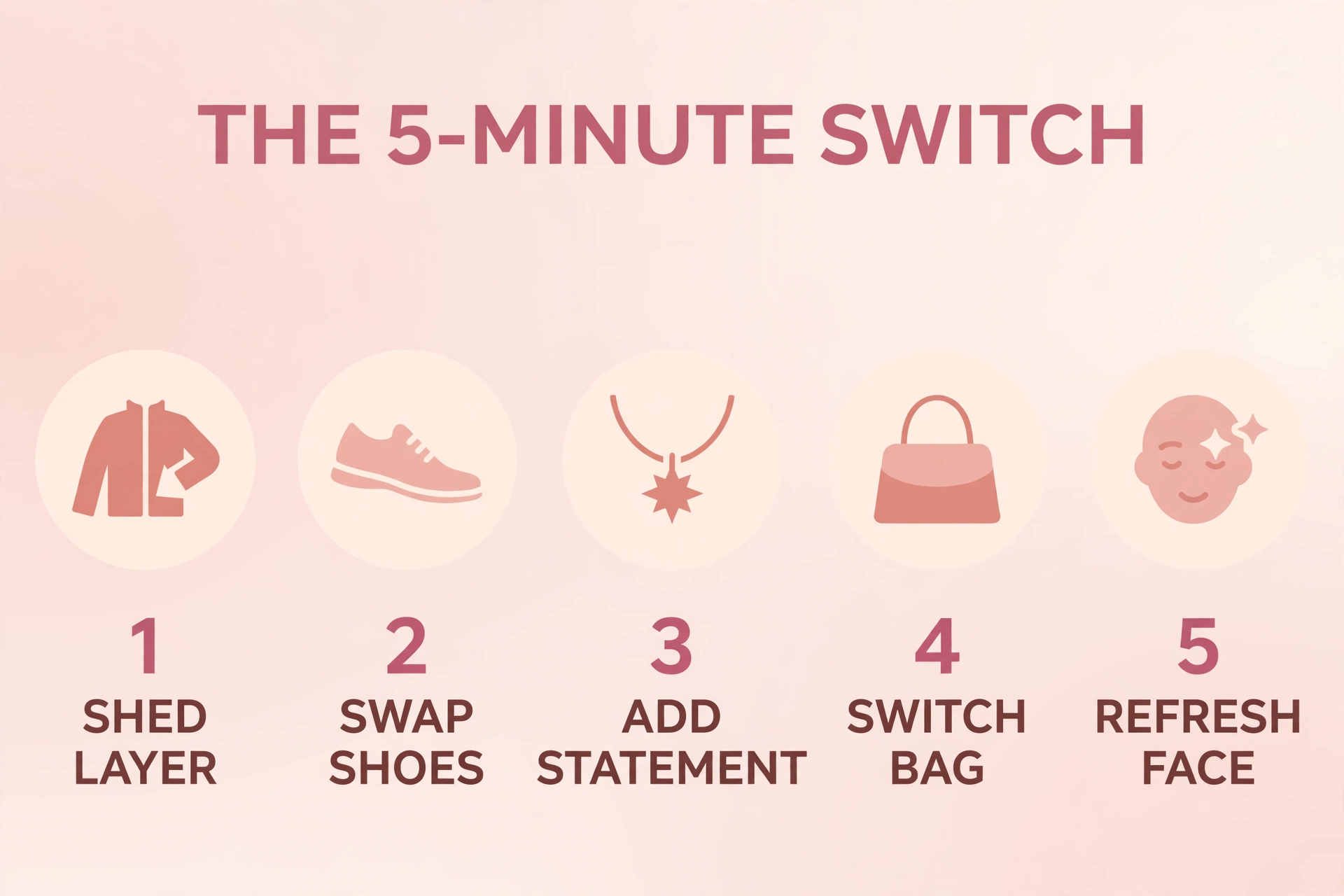
With the base right, the switch itself is a fixed five-step sequence, and the order matters. Layers first, because they change the silhouette. Shoes second, because they change the posture and the hemline. The statement third, while you can still see the outfit whole. The bag fourth, because it is a transfer, not a styling decision. Face last, closest to leaving, so it is fresh at arrival. The Muse’s classic three steps to transform your outfit — dress in layers, change the jewelry, kick off the shoes — is the compressed version of the same sequence, and it has survived because the order is right: biggest structural change first, detail changes after.
Time it honestly and it fits inside five minutes, most of it in the shoe swap and the face. Nothing in the sequence requires a changing room. The layer comes off at your desk, the shoes swap under it, the jewelry lives in your bag, and the face refresh takes one mirror — the same discipline that makes our last-minute Friday night outfits work when there is no plan at all, except here the plan was made at breakfast.
Rehearse it once
Run the full switch once at home, with a timer. You will learn which earring backs fumble, whether the heels fit in the tote, and whether the dress behaves when the cardigan comes off. A rehearsed switch is a calm switch — and calm is most of what separates looking effortlessly ready from looking like you changed in a restroom.
The Layer Move: Shed, Drape or Swap
The layer is the loudest signal in a work outfit. A blazer, cardigan or structured jacket says office louder than any other single piece, which is why the layer move does more than any other step. You have three options, and the right one depends on the base underneath. Shed it entirely when the base has a finished neckline and sleeves or straps your venue allows. Drape it over your shoulders when the evening is cool or the base is plain and benefits from the frame. Swap it when a different jacket — leather, velvet, a softer knit — is waiting in the kit and the work layer is the one thing holding the outfit in daytime.
The layer comes first in every serious day-to-night method for the same reason: wear a top or dress that transitions underneath, keep it work-appropriate with a cardigan, blazer or sweater, then remove the outer layer before you leave. Our own deep dives agree from the shirt side — the many lives of button-up style for women and the sharper lines of button-up style with a blazer both treat the jacket as the outfit’s volume control, the piece you adjust rather than the outfit you replace.

The blazer exception
Sometimes the blazer should stay. If the base is a simple camisole or a plain knit, the blazer worn open, sleeves pushed to the forearm, is the evening look — structure without the corporate read. What changes is how it is worn: unbuttoned, pushed up, and paired with the statement add so it reads as a choice rather than a uniform. The test is the mirror: if the blazer is the most deliberate-looking thing you are wearing, keep it; if it is the most dutiful-looking, shed it.
The Shoe Swap and the Bag Switch
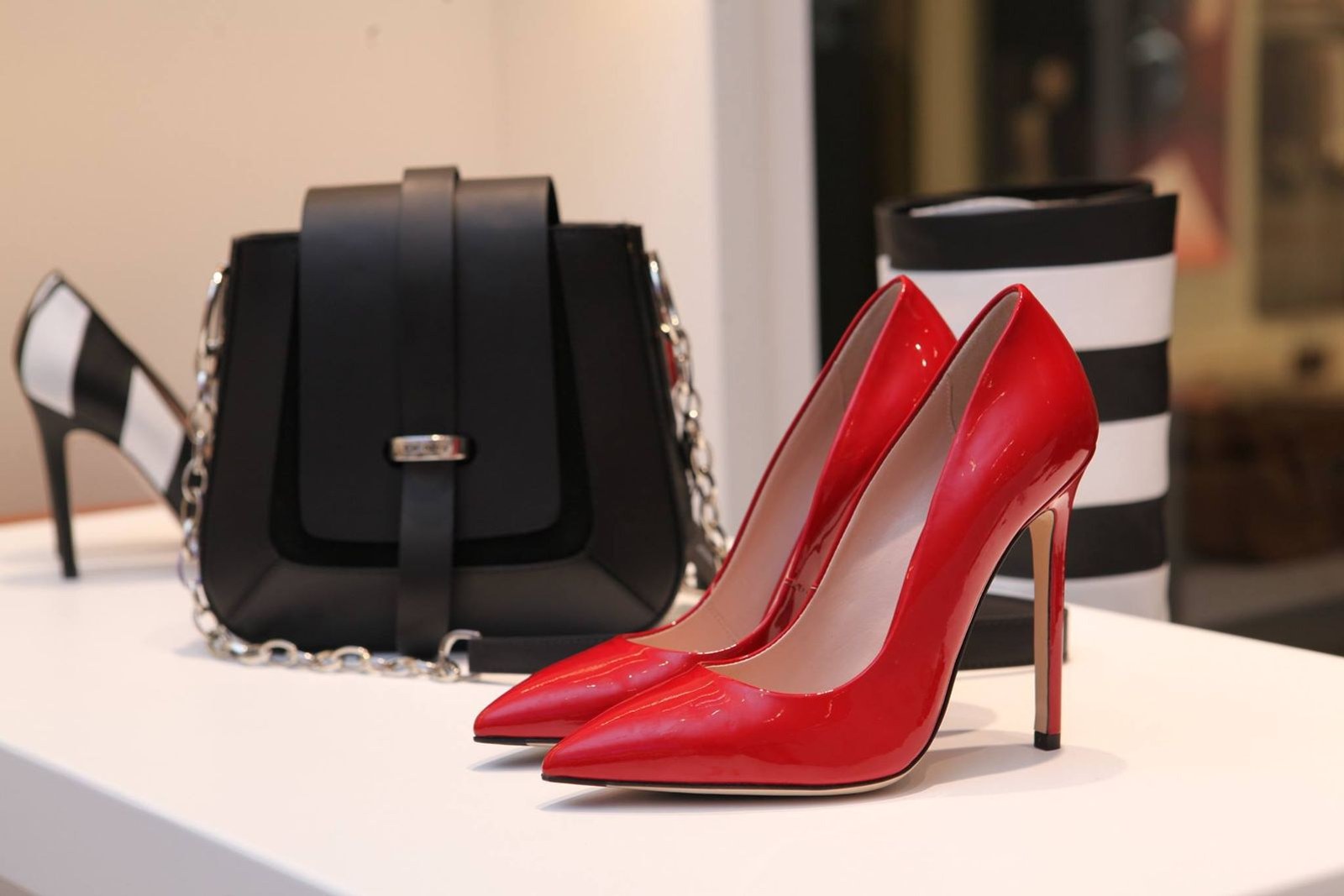
Shoes change an outfit’s intentions faster than any other single swap, because they change how you stand, how the hem falls and how formal the whole silhouette reads. Day shoes are chosen for walking and standing; drinks shoes are chosen for arrival. The swap does not have to mean a stiletto. A pointed flat with a metallic finish, a heeled ankle boot, a strappy low heel — anything that is clearly not the shoe you commuted in completes the signal. Keep the swap pair broken in: an evening that starts with pinching shoes ends early, and no outfit survives limping.
The bag switch is the step women skip, and it shows. A work tote announces the office all evening, however good the rest of the switch was. The fix is a clutch or small crossbody that lives inside the tote by day — holding the jewelry, the lipstick and the blot papers — and comes out at five with everything already in it. Transfer phone, card, keys and the kit pouch; leave the tote under the desk or in the car. Our guide to building a Friday night outfit with jeans makes the same point from the denim side: the outfit is finished by its smallest pieces, and the bag is the one everyone sees at the table.
What if you cannot store shoes at work?
Wear the middle shoe: the one pair that passes both shifts. A low block heel, a sleek ankle boot or a pointed loafer in a polished leather can work a full day and still read as evening at a bar, especially in black or a metallic. The switch then leans harder on the layer and the statement, which is fine — the system has five steps precisely so that no single step is load-bearing.
One Statement Add, Nothing More
The statement is the one piece that was not in the office: chandelier or sculptural earrings, a bold necklace, a cuff, a belt with presence, a silk scarf tied at the bag or the wrist. One. The moment two statements compete, the look stops reading as elevated workwear and starts reading as a costume change, which is the exact impression the system exists to avoid. Fashion Week Online’s desk-to-dinner advice gives accessories the heavy lifting of the transition, and its sharpest point is restraint: keep daytime pieces understated, then let one evening piece lead. A statement near the face does the most work per gram, which is why earrings are the default add — they sit in every conversation and every photo.
Choose the statement against the base, not against your jewelry box. A plain neckline takes a necklace; a detailed neckline takes earrings instead. Metal should match the bag hardware and shoe finish where you can manage it, not from fussiness but because coherence is what reads as intention. And calibrate how far to go with our guide to how revealing a Friday night outfit should be — drinks with colleagues sit at the polished end of that scale, and the statement is how you add evening without subtracting professionalism.

Jewelry that travels well
Kit jewelry has a job spec: light, unbreakable, impossible to tangle, fast to put on with one mirror. Hoops and drop earrings on secure backs, one cuff, one pendant on a chain that does not knot. Leave heirloom pieces at home — a piece you are afraid of losing will manage your evening for you.
The Bag Kit: What Lives at Your Desk
The system only works on a tired Friday if it does not depend on Friday-morning memory. The kit is a small pouch, assembled once, that lives in your desk drawer or tote: the statement earrings, the evening lipstick, blot papers, a mini scent, a travel brush or texture spray, safety pins and fashion tape, and the clutch itself, flattened. Fairygodboss’s desk-to-dinner tips argue for exactly this infrastructure — keep travel staples in your desk, from blotting sheets to a stain-removal stick, so a regular after-work social life never starts with a shopping trip. Add the stain stick to the list; a coffee mark from ten in the morning should not get a vote on your evening.
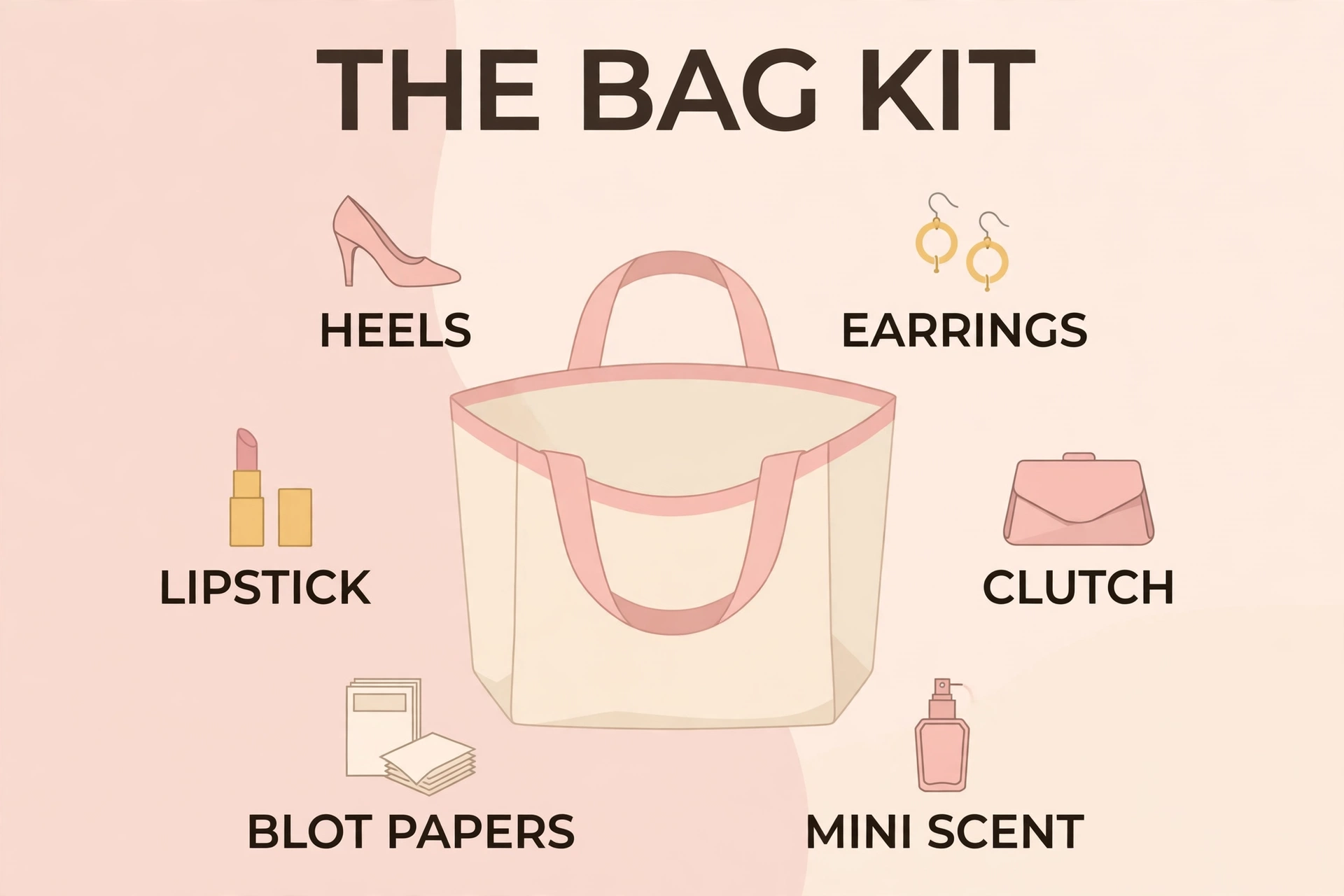
The shoe and layer storage question
If your office allows it, a desk drawer or locker that permanently holds the swap heels and one evening layer turns the whole system into a two-minute job. If it does not, the tote carries the kit and the shoes travel on the days drinks are likely — which, in most offices, is predictable: team birthdays, the end of a project, the standing Friday plan. Our Friday night outfits on a budget guide makes the cost case for the kit approach: a handful of small, endlessly reused pieces beats a new outfit per invitation on cost per wear every single time.
The Two-Minute Face Refresh
Evening light is dimmer and warmer than office light, and it flattens the makeup that looked fresh at nine. The refresh is therefore about contrast and one focal point, not about starting again. MasterClass’s summary of Bobbi Brown’s approach to taking makeup from day to night puts it plainly: evening makeup needs a little more saturation to stay visible in low light, added in layers over the day face rather than rebuilt — touch up the base where it has faded, deepen the eyes or add shimmer, and let a stronger lip carry the change. WebMD’s artist-sourced guide to work-to-night makeup adds the two moves that rescue a tired face fastest: blot shine with papers rather than piling on powder, and put shimmer at the inner corners and under the brow to fake wakefulness.
So the two minutes run: blot, then press powder only where shine broke through; pat concealer where the day wore it off; one coat of mascara over the morning’s; then the evening lip, applied properly — off with the old, balm, blot, color — because the lip is the refresh everyone actually sees across a table. Hair gets thirty seconds: shake it out at the roots, flip the part to the other side for instant volume, or twist it up and let two pieces fall. A changed part reads as a changed hairstyle in photos, which is half of why our guide to Friday night outfits that photograph well treats hair and lip color as part of the outfit, not an afterthought.

Choose eyes or lips, never both at full volume
The refresh fails when everything gets louder at once. Pick the focal point the outfit lacks: a plain base and bare neckline can carry the bold lip; a statement necklace near the face means the eyes stay simple and the lip stays close to your natural shade, deepened one step. One focal point on the clothes, one on the face, and the two should not be the same one competing twice.
Five Work Bases, Five Drinks Looks
The black dress, re-lit. A black sheath or knit dress under a blazer, with flats. At five: blazer off or draped, heels on, statement earrings, red or berry lip. Black carries the whole system with the least effort, and our all-black outfit guide’s texture rule applies — mix matte, satin and shine so the single color still has depth at a bar.
Tailored trousers and the silk blouse. Loafers and a fine chain by day. At five: sleeves pushed up, top button opened, pointed heels, cuff bracelet, clutch. The blouse was always the evening piece; the day layer was the disguise.
The button-up and dark jeans. For offices where Friday denim passes. Blazer on and shirt tucked by day; blazer draped, half-tuck, heeled boots and layered pendants at five. The shirt itself is the hardest-working transition piece in most wardrobes — our button-up style hub collects its many day forms, and nearly all of them have a night form one layer away.
The midi skirt and fine knit. Cardigan and low pumps by day. At five: cardigan off, belt cinched over the knit, strappy heels, earrings. Proportion does the work — the belt moves the outfit’s center from comfort to intention.
The wrap dress. Under a cardigan with ankle boots by day. At five: cardigan off, wrap adjusted a touch deeper, heels, pendant, lip. OutfitTrends’ collection of day-to-night outfit ideas returns to the wrap dress and the blazer for the same reason this list does: an anchor piece that already works in both settings, with layers and accessories moving it between them. For a dinner that follows the drinks, our what to wear to a Friday night dinner guide picks up exactly where this switch leaves off.

Adapting the five bases
Every base above adapts. The same switch works on the formulas in our Friday night outfits over 40 guide — the statement gets a little more sculptural, the heel a little lower and more stable, the system unchanged. And where the night is a date rather than colleagues, our what to wear on a Friday night date guide covers the softer register; the transition steps are identical, only the statement and the lip move one notch warmer.
Read the Room: Venue, Colleagues and Dress Codes
A transition is a social judgment as well as a styling one, because after-work drinks are still, partly, work. Two calibrations matter. The first is your office’s real code, not its written one: SHRM’s reporting on how dress codes evolve stresses that appropriate dress depends on the workplace and its culture, and that even relaxed codes expect a clean, neat, professional appearance that reflects well on the organization. Your evening version should stay inside the spirit of that — elevated, never careless — because your manager and your clients may be at the same bar.
The second calibration is the venue’s code. The Emily Post Institute’s attire guide places a dress, a skirt with a dressy top, a dressy pants outfit, or nice jeans with a dressy top under dressy casual — which is the register most after-work drinks actually want. A neighborhood bar asks less; a hotel lounge asks the top of that range. The base-plus-switch system lands in the middle by default, and you steer it with the statement: smaller and finer for the smart venue with senior colleagues, bolder for the casual venue with your own team.
The colleague rule
If you would not want the outfit photographed on the office social feed, it has crossed the line for colleague drinks. The evening’s purpose is connection, and managing an outfit all night is the opposite of connecting — the switch should make you forget what you are wearing, not think about it more.
When the Transition Goes Wrong
The base was day-only. A novelty print shirt, a creased linen dress, a top that only works under its jacket. No switch rescues a base that cannot be seen alone. Log it, and let that piece retire from drinks days; the morning test — could this be photographed at a bar with just the layer removed? — prevents the repeat.
Everything changed, so nothing reads. Heels, jewelry, hair, lip, scarf, belt, all at full volume: the result looks like a costume because it is one. Strip back to one statement and the day lip deepened one shade, and the look recovers. Restraint is not the boring option here; it is the entire technique.
The kit was at home. The earrings are in a dish by the sink and the heels are under the bed. This is a systems failure, not a styling one, and it is why the kit lives at the desk permanently and gets replenished the Monday after it is used, never the Friday of.
You skipped the mirror check. A strap adrift, a hem caught, lipstick on a tooth — the final thirty seconds exist for this. Stand, turn, check the back view with your phone if the mirror is single. The woman who arrives composed is usually just the woman who looked once more before leaving.
Our view
The women who look best at Friday drinks are rarely the ones who went home to change. They are the ones who stopped treating the work outfit and the evening outfit as two different wardrobes. A base that works twice, a kit that lives where the invitation lands, and a five-minute switch you have rehearsed once — that is the whole secret, and it is a system, not a talent. Build it once, and every four o’clock text stops being a wardrobe problem and becomes what it should have been all along: a plan you are already dressed for.
— Friday Night Style
Frequently Asked Questions
Can I go straight from work to drinks without bringing anything?
Yes, if the morning base was chosen for it. Shed the layer, push the sleeves, change the part in your hair, deepen the lip with whatever you carry daily, and let the tote be the only office signal you bring. The look will be quieter than the full switch, but the layer move alone changes the register more than most people expect.
What is the single most effective change?
The layer coming off — or being re-worn open and draped. It changes the silhouette, which is what people register first. The shoe swap is a close second, and the two together account for most of the transformation; jewelry and makeup refine what those two establish.
How do I do this in a strict, formal office?
Keep the base conservative and let the switch be smaller: blazer off and carried, shoes swapped for a polished heeled boot, one fine statement piece, lip deepened one shade. In a formal office the evening version should read as the same woman, off duty — not as a different dress code entirely.
What if drinks turn into dinner?
You are already dressed for it. The drinks version of the system sits at dressy casual, which is dinner’s register too. If anything, soften rather than add: lose the biggest statement if the restaurant is quiet, keep the clutch, and let the base carry the table.
How do I handle the switch in winter?
The layer logic reverses: the coat becomes the arrival piece, so choose the good one in the morning. Boots do double duty instead of a shoe swap, tights stay, and the switch concentrates on the statement, the bag and the face. The kit gains a lint roller and a static spray, because winter fabrics misbehave indoors.
Is it unprofessional to change at the office?
No — the switch is designed to happen at your desk or in a restroom in five minutes, using pieces you carried in your tote. It is indistinguishable from freshening up before an evening meeting, which offices expect. What reads as unprofessional is a full costume change; a layer, a shoe and an earring never will.
Questions About Friday Night Drinks After Work Outfits?
Tell us the plan, the dress code, and the part of the outfit that is not working — we read every message.
Sources
- Who What Wear — The Zero-Effort Outfit Formula to Take You From Desk to Drinks
- Who What Wear — The Best Wrinkle-Free Fabrics for Travel
- Emily Post Institute — Business Casual 101
- Emily Post Institute — Attire Guide: Dress Codes from Casual to White Tie
- Indeed — What Is Business Casual Attire?
- SHRM — Dress Codes Evolve Following Pandemic
- The Muse — Going Out After Work? 3 Steps to Transform Your Outfit
- Fairygodboss — 7 Simple Tips for Styling Your Outfit From Desk to Dinner
- Fashion Week Online — From Desk to Dinner: Transforming Your Look With Accessories
- MasterClass — Bobbi Brown’s Tips to Take Your Makeup From Day to Night
- WebMD — Makeup to Take Your Work Look to a Night Out
- OutfitTrends — Day to Night Outfit Ideas for Seamless Transitions