The invitation is real, the plan is good, and the money is not there. Every dress in your closet suddenly looks wrong, the one you actually want costs more than the whole night out, and buying it would mean thinking about the price tag while you are supposed to be dancing. The problem is not your taste. It is the way the outfit is being priced. This guide reprices Friday night by cost per wear, hunts the pieces secondhand, and builds complete outfits at three honest budget tiers.
Friday Night Style
The Outfit Is Not Expensive. The Wear Is.
Friday night outfits on a budget, built on cost-per-wear math, thrift hunting and one statement piece at a time.
Key Takeaways
- Judge every piece by cost per wear — price plus upkeep, divided by honest wears — never by the tag alone.
- Thrift and secondhand rails hold the best night-out value: statement dresses, coats and boots at a fraction of first-hand prices.
- Spend on one statement piece per outfit and let everything else be a basic you already own.
- The strongest upgrades cost nothing: fit, grooming, borrowing and swapping beat another purchase.
- Build by tier — a complete outfit is possible at a small, medium and moderate budget when each tier has a job.
Table of Contents
- Start With Cost Per Wear, Not the Price Tag
- The Budget List: Seven Outfit Builds by Tier
- Thrift Hunting for Night-Out Pieces
- One Statement Piece: The Math of the Splurge
- Free Upgrades: Fit, Grooming, Borrowing and Swapping
- How to Tell a Bargain From a Bad Buy
- A Budget Routine That Survives the Month
- Our view
- Frequently Asked Questions
- Sources
- Recommended
Start With Cost Per Wear, Not the Price Tag
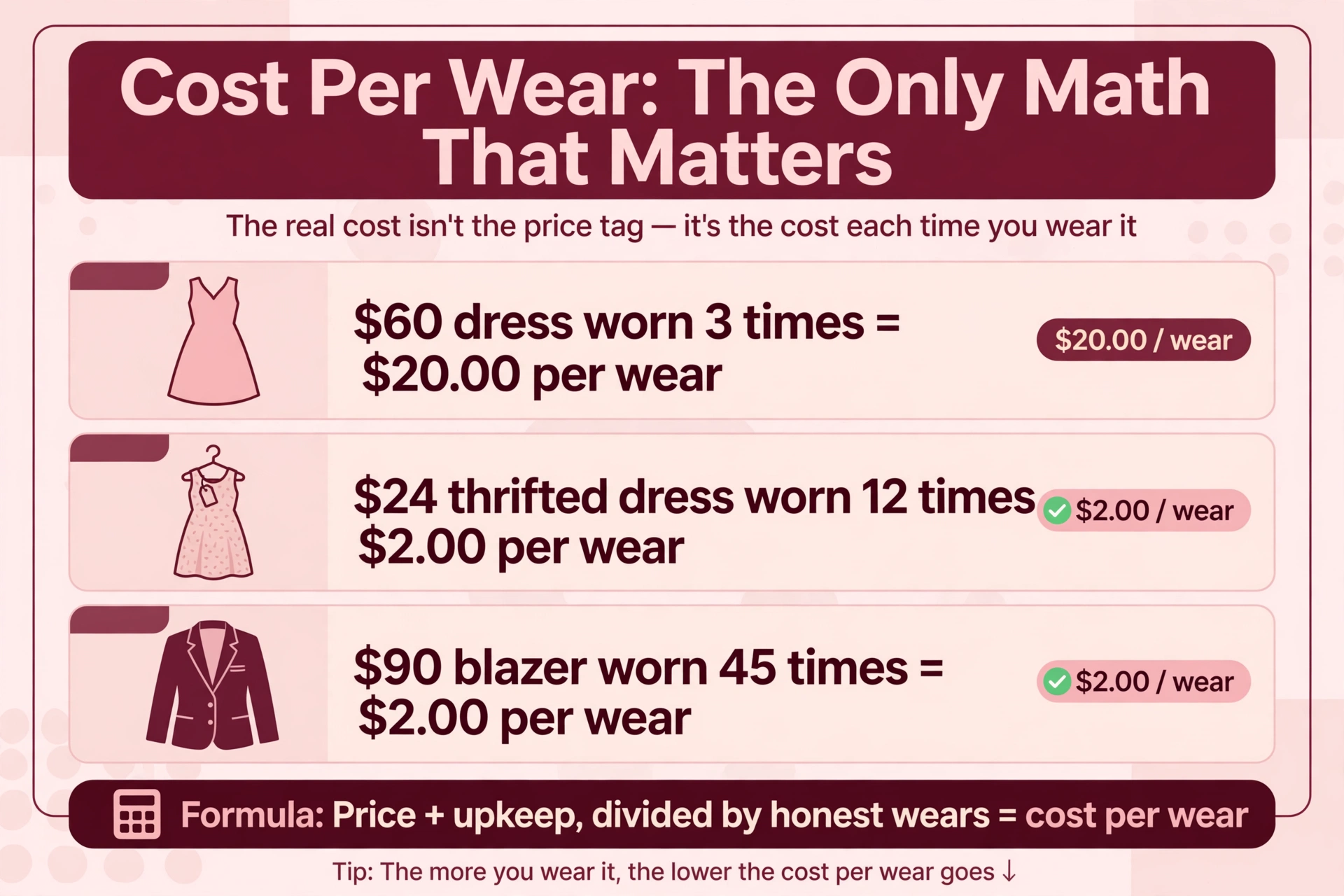
A price tag tells you what a dress costs once. Cost per wear tells you what it costs every single time you put it on, which is the number your budget actually lives with. The cost per wear formula is simple: take the purchase price, add lifetime upkeep such as cleaning, tailoring and repairs, and divide by the total number of times you will honestly wear it. A dress bought for a single night and worn three times is expensive at almost any price. A secondhand dress worn a dozen times is cheap at almost any price.
The same formula sits quietly underneath our friday night outfit formula: a base you rewear, one focal point, and finishers you already own is a cost-per-wear system wearing a styling hat. The pieces that repeat are the pieces that pay you back.
| Piece | Price paid | Honest wears | Cost per wear | Verdict |
|---|---|---|---|---|
| New occasion dress, bought for one night | $60 | 3 | $20.00 | The real splurge, whatever the tag said |
| Thrifted slip dress | $24 | 12 | $2.00 | Cheap because it repeats, not because it was cheap |
| Good blazer, new or secondhand | $90 | 45 | $2.00 | A higher price can tie a thrift find when it works harder |
| Sale top bought because it was marked down | $18 | 2 | $9.00 | A discount on something you barely wear is not a saving |
The honest-wears test
The denominator is where budgets are won or lost, so estimate wears honestly before you buy, not hopefully. Ask three questions. Does this piece work with at least three things I already own? Would I wear it to two different kinds of Friday night — dinner and drinks, a date and a party? Does it still work when the trend that made me want it has moved on? Three yes answers usually mean double-digit wears. One yes means the cost per wear will embarrass the price tag.
There is a second, quieter reason to run this math. The average household spends roughly two thousand dollars a year on apparel and services, according to the Bureau of Labor Statistics’ consumer expenditures report, and a common budgeting guideline holds clothing to about five percent of take-home pay, as the PSECU clothing budget guide sets out. Neither number tells you what to buy. Cost per wear does: inside whatever total your life allows, it pushes the money toward the pieces that will actually be worn.
Where the money leaks
Most Friday night overspending is not one big purchase. It is the single-wear dress, the shoes bought for one outfit, the top bought in a panic on the day. Each looks small; each carries a brutal cost per wear. The fix is not a smaller budget. It is a rule: nothing enters the night-out wardrobe unless its projected cost per wear beats the pieces already in it. That one rule turns the rest of this guide — thrifting, statement math, free upgrades — from tips into a system.
The Budget List: Seven Outfit Builds by Tier
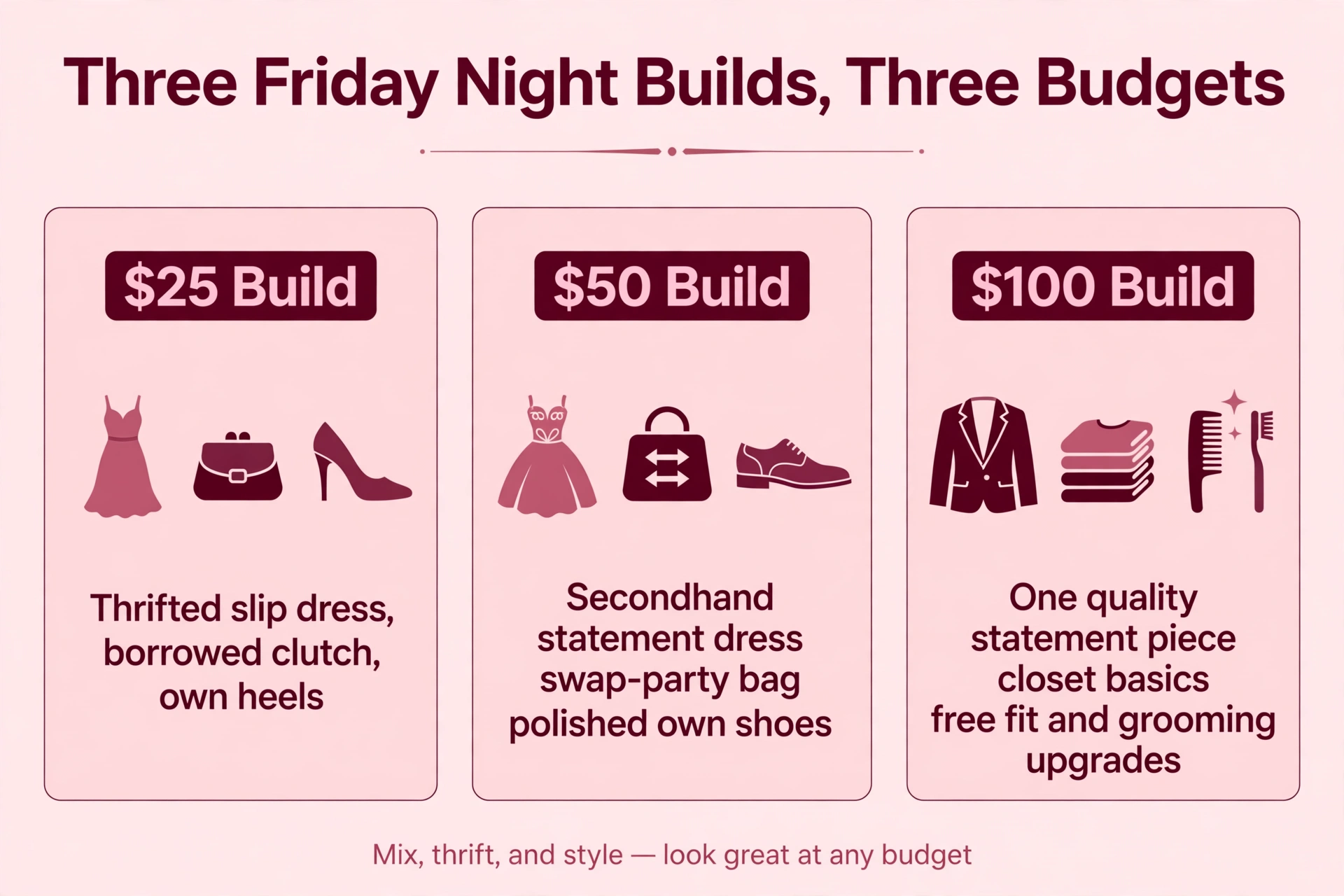
Each build below is a complete Friday night outfit with a tier, a job and a cost-per-wear logic. The tiers are not about looking cheaper or richer. They are about where the money goes: at the lowest tier almost everything is found or borrowed, at the middle tier one secondhand statement carries the look, and at the top tier one quality piece is bought to be worn for years. All three tiers lean on the same spine as our guide to what to wear Friday night: a base that fits, one thing the eye lands on, and finishers that make it deliberate.
1. The thrifted slip dress build (smallest tier)
A secondhand slip or bias-cut dress, your own heels, a borrowed clutch, and one piece of jewelry you already love. The dress is the hunt; everything else is inventory. Slip dresses are the most donated evening shape there is, which is why they are the easiest quality find on a thrift rail. Style it the way our turning thrift store finds into outfits guide styles any find: fit first, then one strong finisher, then stop.
2. The jeans-and-statement-top build (smallest tier)
Your best dark jeans, a thrifted or swapped going-out top, and the shoes you already break in every Friday. Jeans carry a near-zero marginal cost because you own them, so the whole budget can sit in one top. Our how-to on building a friday night outfit with jeans gives the full five-step build; the budget version simply sources step two, the top, secondhand.

3. The secondhand statement dress build (middle tier)
One genuinely good dress bought secondhand — satin, sequin, velvet or a strong print — worn with plain own-brand basics everywhere else. This is the tier where resale shines: a dress that was expensive when new is often the best-made thing on the rail, and its first owner absorbed the depreciation. The market context is on your side: thredUp’s annual resale report tracks a secondhand market growing far faster than the overall apparel market, which means more evening pieces entering resale, in better condition, every season.
4. The coat-as-the-outfit build (middle tier)
A secondhand wool or statement coat over the simplest black base you own. On a cold night the coat is the outfit for arrivals, photos outside and every walk between venues, so it earns the budget while the base costs nothing. It is exactly why our writer argues for buying coats secondhand: coats are the highest original-price, lowest-wear category in most closets, which makes them the richest thrift category of all.
5. The one-new-piece build (top tier)
One new, well-made statement piece — a blazer, a dress, a pair of boots — bought at full intention rather than on impulse, and worn over closet basics. The cost-per-wear table above shows why this can tie a thrift find: forty-five wears turns a serious price into a small one. Choose the piece using the quality checks in the bargain section below, and let it anchor several of the friday night outfits over 40 formulas just as easily as a younger wardrobe, because cost per wear has no age limit.

6. The all-black build (any tier)
Head-to-toe black from pieces you already own, separated by texture: matte jeans, a satin top, a structured blazer, a shiny shoe. All-black is the budget cheat code because mismatched price points disappear inside one color, and texture does the work money usually does. Our guide to the all-black outfit covers the texture rules in full; the budget point is simpler — it is the only build that can cost literally nothing tonight.
7. The swap-party build (any tier)
A dress or top that arrived through a clothing swap or a borrow, styled with your own shoes and bag. Swap pieces carry a cost per wear of zero at purchase, and they solve the other budget problem too: the feeling that everyone has seen this outfit. A swapped piece is new to your circle even though it cost nothing, which no sale rail can promise.
Thrift Hunting for Night-Out Pieces
Thrifting works for Friday night because evening clothes are worn gently and donated quickly. A dress worn twice to weddings is functionally new; a coat outgrown in taste rather than condition is a gift to the next owner. The waste figures explain the supply: the EPA’s textiles material-specific data estimates seventeen million tons of textiles generated in municipal waste in its most recent accounting, with over eleven million tons landfilled and a clothing recycling rate of only about thirteen percent. Rails are full because closets empty fast. Your job is to be the person who catches the good pieces on their way through.
Hunt by category, not by outfit
Go in looking for categories with the best secondhand economics, not for a complete outfit. Dresses first: the widest choice and the gentlest prior wear. Coats and blazers second: high original prices, durable construction. Boots third — our guide to the best places to find vintage boots maps where the good pairs surface. Tops last: they are cheap everywhere, so a thrift top only wins if it is genuinely special. Our own thrift store haul shows the category method in action, building a whole rail run around a small fixed total.
The two-minute rail check
Evening pieces fail in predictable places, so check them in a fixed order. Seams and stress points first: underarms, side seams, the base of a zip. Fabric second: hold it to the light, because thin or shiny-worn fabric cannot be rescued. Fastenings third: zips should run cleanly, buttons should all be present, straps should be anchored. Lining last: a torn lining is negotiable on price but a reason to walk away at full thrift price. Two minutes per piece, in that order, is what separates hunting from gambling.
Fit is the thrift multiplier
A thrifted piece that almost fits is not a bargain; it is a project. But a piece that fits everywhere except one simple place — a hem, a waist that needs taking in, a strap that needs shortening — is the best value on the rail, because other shoppers pass it by. This is the same lesson our writer learned building an entire fall wardrobe secondhand on a strict total: the budget survived because every piece was chosen to need, at most, one cheap alteration. Budget the alteration into the cost per wear before you buy, not after.
One Statement Piece: The Math of the Splurge
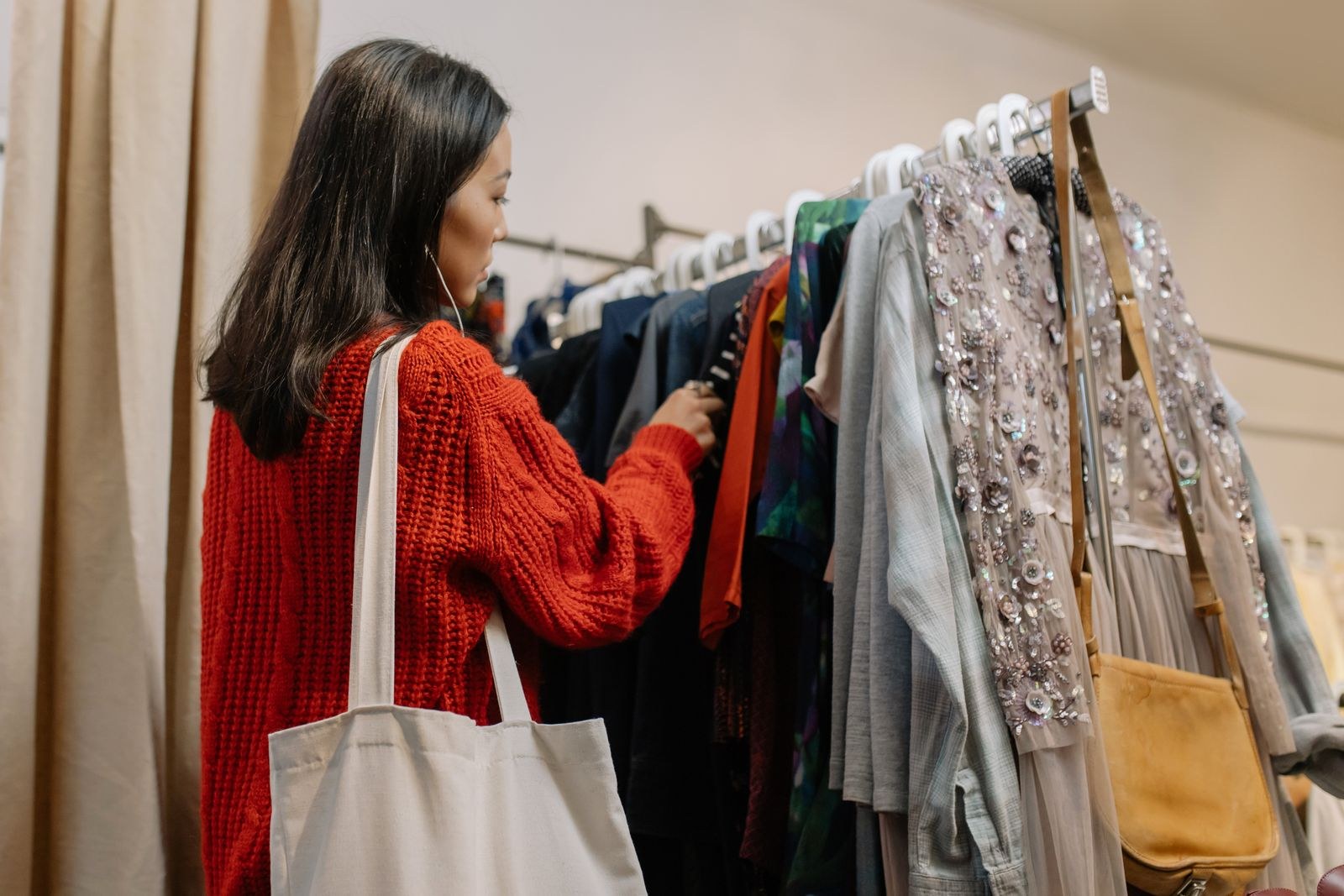
One statement piece per outfit is a styling rule, but it is also the budget rule that does the most work. A single strong piece — a sequin top, a satin skirt, a great blazer, a pair of boots with presence — makes plain basics read as an outfit. Two statement pieces compete, and you pay for the competition. Three is a costume budget. The math: if the statement piece is worn with three different bases, its wears triple while its price stays fixed, which is why the statement piece is the one place a higher price can be the frugal choice.
Choose the statement by repeat potential, not by drama. A black satin skirt pairs with a dozen tops. A blazer finishes jeans, dresses and trousers. Boots ground everything from a slip dress to denim. The Ellen MacArthur Foundation’s work on circular fashion business models makes the wider version of the same point: keeping clothes in use, longer and more often, is where both the money and the material value sit — the Foundation estimates hundreds of billions of dollars of value are lost every year to clothing that is under-worn and never recirculated. Your statement piece, worn forty times, is that principle at closet scale.
What never earns statement money
Skip statement spending on anything with a built-in expiry: a piece tied to one event’s theme, a color you wear nowhere else, a silhouette your life gives you two chances a year to use. Those are costume purchases wearing a statement’s price tag, and their cost per wear exposes them immediately. The best bodycon outfits for every body type guide makes the fit version of this point: a strong silhouette only pays back when the body wearing it will reach for it again and again.
Free Upgrades: Fit, Grooming, Borrowing and Swapping
The most underpriced section of any budget wardrobe is the part that costs nothing. Fit is first: a belt placed at your real waist, a hem taped to the right break, sleeves pushed to the forearm, a top tucked with intention. None of it costs money, and all of it reads as expense, because expensive clothes are mostly just clothes that fit on purpose. Our guide to how to wear a trench coat is a masterclass in this: the same coat reads twice its price belted, open and deliberately layered.
Grooming is second. Steamed fabric, polished shoes, lint-rolled black, a proper manicure and hair done with time to spare — these are the visible signals of a cared-for outfit, and they are priced in minutes, not money. WRAP’s research on extending the life of clothes found that keeping clothes in active use just nine months longer cuts their carbon, water and waste footprints by around a fifth to a third; the budget translation is that care — washing gently, repairing promptly, storing properly — is what turns a twelve-wear dress into a thirty-wear dress and halves its cost per wear without a single purchase.
Borrowing and the swap circle
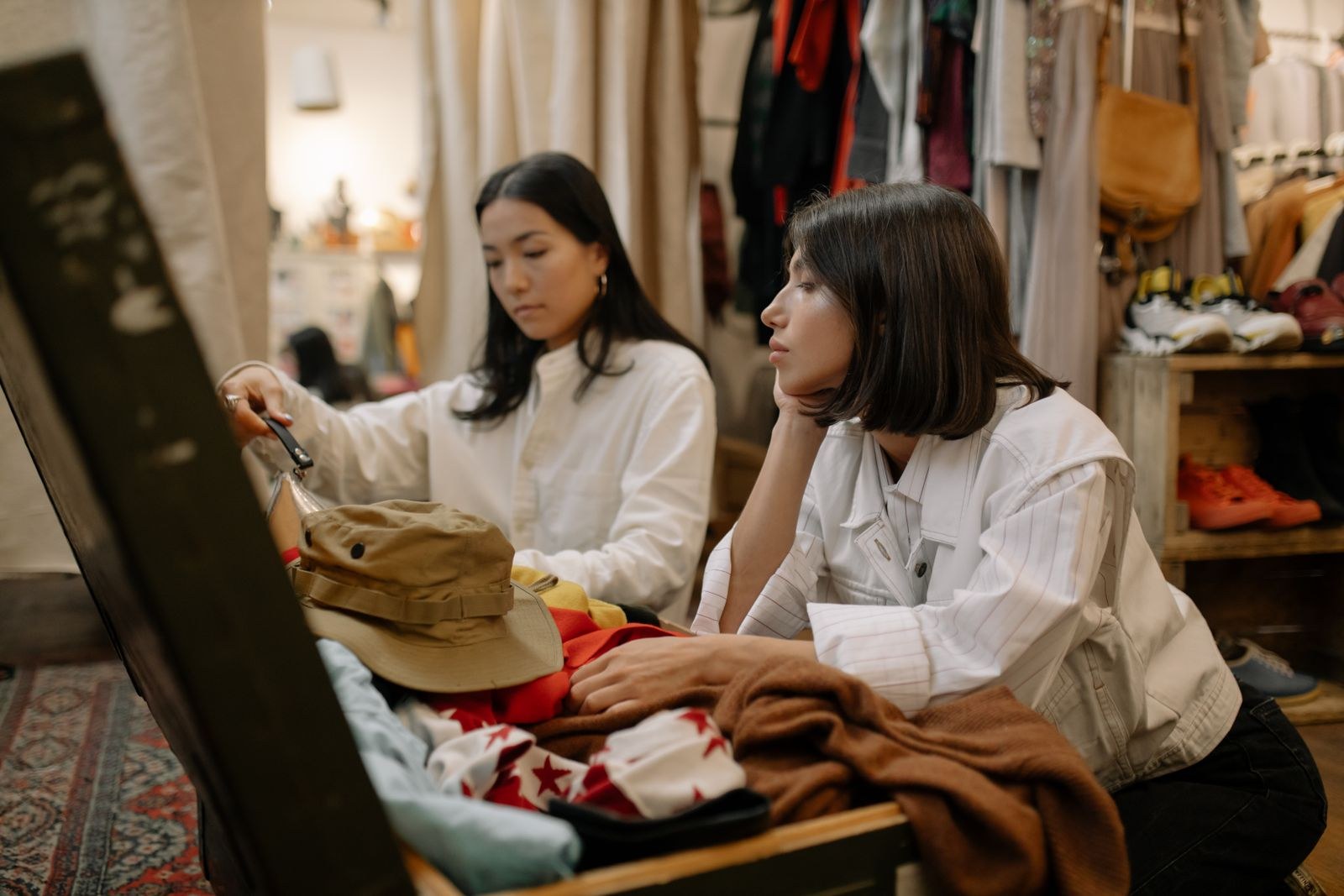
Borrowing is third, and it works best as a system rather than a favor: two or three friends of similar size, a shared understanding that evening pieces circulate, and everything returned clean and promptly. A borrowed clutch or statement earring completes an outfit at zero cost and zero closet space. The guide to hosting a clothing swap lays out the party version: everyone brings pieces in good condition, takes home the same number, and leaves with a refreshed wardrobe for the price of an evening with friends. Run one swap per season and the “nothing to wear” problem largely dissolves — our piece on upcycling an old sweater covers the other end of the same instinct, refreshing what you already own instead of replacing it.
The refresh shelf
Keep a small free-upgrade shelf by the mirror: fashion tape, a travel steamer or an iron, a lint roller, shoe polish, a needle and thread in black and nude, and spare buttons. Add one embellishment skill and the shelf gets stronger still — our how-to on embellishing a boring jacket turns a plain jacket into the statement piece with pins, trim or paint you may already own. And finish with jewelry you have: layered properly, existing necklaces do the work of a new purchase, as our guide to layering jewellery like a pro shows chain by chain.

How to Tell a Bargain From a Bad Buy
A bargain is a good piece at a low price. A bad buy is a flawed piece at any price, and thrift rails and sale racks both stock plenty of the second kind. The defense is a quality check that takes under two minutes. The designer Justine Leconte’s guide to telling good quality runs the same checks professionals use: read the fabric label, feel the weight and hand of the cloth, examine stitching and seam allowances, test the hardware, and scrunch the fabric to see whether it springs back or stays crumpled.
Stitch density is the fastest single tell. The ten-point quality checklist puts solid everyday construction at roughly eight to twelve stitches per inch, with long, loose stitching a sign the seam will fail early. On a night-out piece, also check that patterns meet at the seams, that the lining lies flat, and that any beading or sequin work is anchored rather than glued. A secondhand piece that passes these checks will usually outlast a new piece that fails them — which is the entire argument of our fast fashion vs vintage comparison, settled in favor of construction over newness.
Read the care label before the price label
Care is a cost, so the care label is part of the price. Under the FTC’s Care Labeling Rule, every garment sold in the United States must carry at least one safe cleaning method, as the University of Kentucky’s care labels guide explains — which means the label will honestly tell you whether this bargain needs dry cleaning after every wear. A dry-clean-only dress worn monthly can add its own purchase price in cleaning within a season. A washable dress at twice the thrift price is often the cheaper dress by Christmas. Put expected cleaning into the cost-per-wear numerator, exactly as the formula asks, and let the label vote.
A Budget Routine That Survives the Month
Systems beat willpower, so give the wardrobe a small routine. Start with a written spending plan: the Consumer Financial Protection Bureau’s approach, summarized in the Minnesota Department of Commerce’s spending and savings plan, is to track income, track where money actually goes, calendar the bills, and only then set the budget — in that order, because a clothing line set before the bills are visible is fiction. Give Friday nights a named, modest line inside that plan, and let it roll over: a quiet month funds a statement piece later.
Then run a one-in, one-reviewed rule. When a new night-out piece arrives, review the rail: what has not been worn in a season gets swapped, sold or donated, which keeps the wardrobe small enough that everything in it earns wears. And keep a standing wish list of the three pieces that would unlock the most outfits from what you own — a black blazer, say, or boots that work with everything. Thrift hunting from a list is how the good pieces get found; thrift hunting without one is how closets fill with almost-right bargains. The goal was never to spend nothing. It is to make every dollar show up on a Friday night, worn and re-worn, exactly like the approach behind our friday night outfits for fall builds, where layering pieces earn their place across a whole season.
Our view
A budget is not the enemy of a good Friday night outfit. The tag is just the wrong place to look. Priced per wear, the thrifted dress you reach for monthly is the luxury item, and the full-price dress worn twice is the extravagance — the receipts say so even when the mirror disagrees. Hunt secondhand by category, spend once on a statement that repeats, take every free upgrade going, and let the math, not the markdown, tell you what a bargain is. That is not dressing cheaply. That is dressing like the money was yours.
— Friday Night Style
Frequently Asked Questions
How do I calculate cost per wear?
Add the price you paid to what the piece will cost you over its life — cleaning, alterations, repairs — and divide by the number of times you will honestly wear it. A piece bought for one night needs to be judged on one wear, not on the wears you hope for. Recalculate after a season with the real wear count; the pieces that surprise you will change how you shop.
What should I buy first on a very small budget?
One versatile evening piece that works with what you already own: a thrifted slip dress, a satin skirt, or a blazer that finishes your jeans and dresses alike. Buy for repeat potential, not for a single plan. Shoes, bags and jewelry should come from your closet, a borrow or a swap until the core piece is earning wears.
Is thrifted evening wear hygienic and safe to wear?
Wash or clean every secondhand piece before its first wear, following its care label, and inspect seams, straps and fastenings before you rely on them for a night out. Buy shoes secondhand only when the soles and insoles are in genuinely good condition. Treated that way, secondhand evening wear is simply clothing with a previous owner.
How do I thrift when I rarely find my size?
Hunt categories where fit is forgiving — coats, blazers, slip dresses, skirts with elastic or wrap waists — and use online resale filters, which let you search your exact size across far more stock than one shop’s rail. Budget one simple alteration into the price; a taken-in waist turns an almost-right find into a fitted piece for less than the difference between thrift and new.
What is the cheapest way to make an old outfit feel new?
Change one visible element and upgrade the finish. Swap the statement piece, restyle the jewelry, change the shoe, steam everything, and do hair and nails with time to spare. A different focal point over a familiar base reads as a new outfit in person and in photos, at zero or near-zero cost.
Should I ever buy a one-night outfit at full price?
Only with open eyes: price it at one wear and decide whether that single night is worth the full amount to you. Sometimes the honest answer is yes — a milestone night can carry a deliberate splurge. The mistake is not the splurge; it is pretending the dress will be worn again when you already know it will not.
Questions About Friday Night Outfits on a Budget?
Tell us the plan, the dress code, and the part of the outfit that is not working — we read every message.
Sources
- Money and Planet — The Cost Per Wear Formula
- U.S. Environmental Protection Agency — Textiles: Material-Specific Data
- thredUp — Annual Resale Report
- Ellen MacArthur Foundation — Making Circular Business Models the Norm
- WRAP — Clothing: Extending the Life of Clothes
- PSECU — How Much Should Your Clothing Budget Be?
- Justine Leconte — How to Tell if Clothes Are Good Quality
- University of Kentucky Cooperative Extension — Care Labels and Your Clothes
- U.S. Bureau of Labor Statistics — Consumer Expenditures
- Environment America — How to Host a Clothing Swap
- EuSpree — How to Tell if Clothes Are Well-Made
- Minnesota Department of Commerce — Create a Spending and Savings Plan