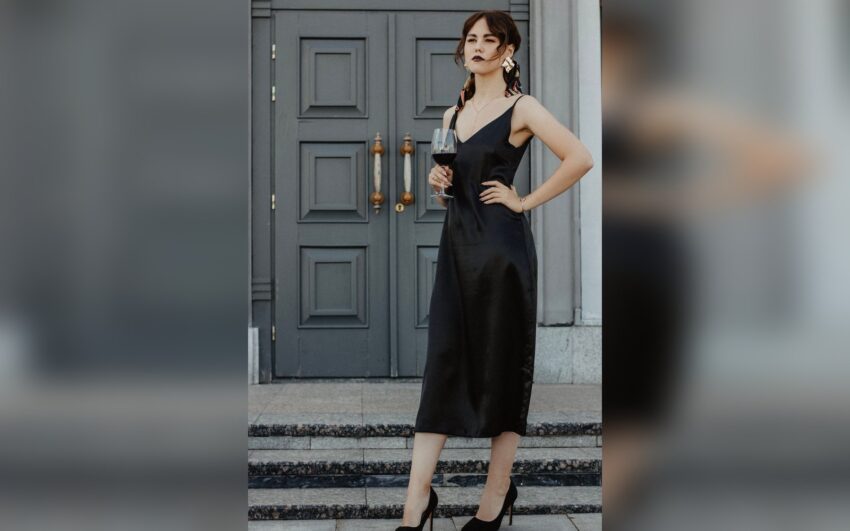
The dress looked perfect on the hanger and even better on the model, and on you it pulls, gaps, rides up and sits wrong in three places at once. That is not your body failing the dress. It is the wrong silhouette meeting the right body. This guide replaces guessing with a decision system: measure three points, name your shape honestly, then choose among wrap, fit-and-flare, slip, sheath, empire and shirt dresses by silhouette first, neckline second, hemline third and fabric last.
Friday Night Style
The Dress Is Not Wrong. The Silhouette Is.
A step-by-step system for picking a Friday night dress for your body type — silhouette, neckline, hemline and fabric, in that order.
Key Takeaways
- Measure bust, natural waist and hips first — your shape is the relationship between those three numbers, not a size or a label.
- Choose the silhouette before anything else: wrap, fit-and-flare, slip, sheath, empire and shirt dresses each solve a different proportion problem.
- Pick the neckline to balance your shoulders and bust, and the hemline to place the visual end of your legs where you want it.
- Fabric decides whether a good silhouette actually works — drape skims, structure holds, and bias cut moves with the body.
- If a dress needs you to stand a certain way all night, it is the wrong dress, whatever your shape.
Table of Contents
- First, Find Your Shape With Three Measurements
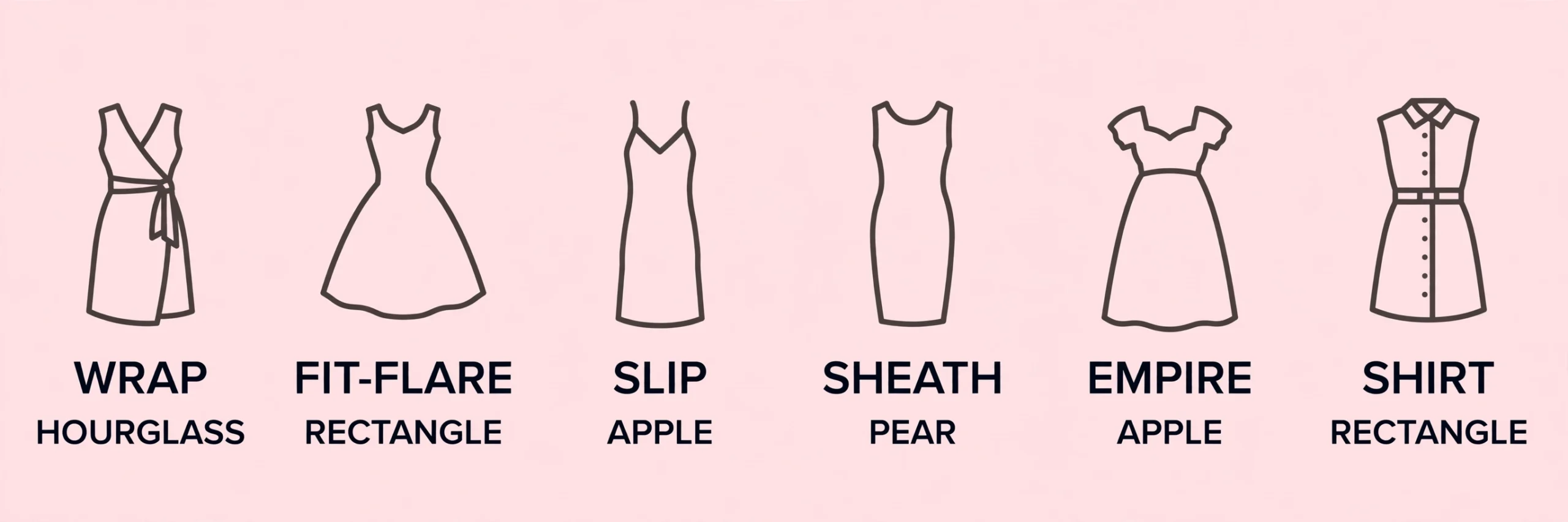
- The Six Silhouettes and What Each One Does
- Wrap Dresses: The Adjustable Answer
- Fit-and-Flare: Built-In Waist, Room to Move
- Slip and Bias-Cut Dresses: Drape Does the Work
- Sheath Dresses: The Clean Column
- Empire Dresses: The Waist Moves Up
- Shirt Dresses: Structure You Can Belt
- Necklines: The Frame Above the Dress
- Hemlines: Where the Dress Ends
- Fabric: The Silent Half of Fit
- A Five-Minute Fitting-Room Check
- Our view
- Frequently Asked Questions
- Sources
- Recommended
First, Find Your Shape With Three Measurements
Forget the size on the label. Shape is a relationship, and you can find yours with a soft tape in five minutes. Measure your bust around its fullest point with the tape level, your natural waist at the crease that forms when you bend slightly to one side, and your hips around their widest point, as the step-by-step how to measure bust, waist and hips guide sets out. Keep the tape snug, never tight, and write all three numbers down.
Stitch Fix’s stylists make the same point in their guide to dressing your body type: body shape is about the proportions between shoulders, bust, waist and hips, entirely separate from size or weight. Two women in the same dress size can need opposite silhouettes. The shape names below are tools, not verdicts.
The five shapes, in plain language
If your bust and hips are close in size and your waist is clearly narrower, you are reading as hourglass. If your hips are noticeably wider than your bust and shoulders, that is pear, sometimes called triangle. If your middle carries the fullness and your waist is the widest or least defined point, that is apple, sometimes called round or oval. If bust, waist and hips run close together in a straighter line, that is rectangle. If your shoulders or bust are the widest point and your hips run narrower, that is inverted triangle. Most women sit between two descriptions; dress for the one your measurements lean toward, then adjust with the neckline and hemline steps later in this guide. The rule of thirds for proportion is a useful cross-check here: outfits tend to read best when they divide the body into thirds rather than halves, and the right silhouette does that dividing for you.
| Body shape | Best first silhouettes | Neckline to try first | Hemline to try first |
|---|---|---|---|
| Hourglass | Wrap, sheath, fit-and-flare | V-neck or sweetheart | At or just above the knee, or midi |
| Pear | Fit-and-flare, empire, A-line shirt dress | Boat neck or off-shoulder | Just below the knee or midi |
| Apple | Empire, wrap, bias-cut slip | Deep V-neck or scoop | At the knee, showing the leg below it |
| Rectangle | Fit-and-flare, belted shirt dress, wrap | Sweetheart or square | Mini or knee, wherever it adds a break |
| Inverted triangle | Fit-and-flare, full-skirted wrap, empire | V-neck or scoop, kept simple | Midi with volume, or a flared mini |
Use the table as a starting grid, not a cage. Nordstrom’s own dresses for your body type guide works from the same core shapes and lands in the same place: waist-led styles for hourglass, A-line and empire for pear, defined waists for rectangle, flowing shapes for apple.
Height is a second filter, not a shape
Shape tells you the silhouette; height tells you the lengths. If you are petite, the proportions in our guide to friday night outfits for petite women apply inside every silhouette below — shorter rises, hems that do not swallow the leg, and prints scaled to your frame. If you are tall, our friday night outfits for tall women covers the length numbers that decide whether a midi is really a midi on you. Run the shape system first, then filter the winners through your height. A wrap dress is still a wrap dress; only its hem and tie placement move.
The Six Silhouettes and What Each One Does
A silhouette is the outline a dress makes before anyone notices color, print or details. Each of the six below places its narrowest point, volume and movement in different places, which is why each feels right on a different body. Fabrico’s guide to dress silhouettes for your shape puts it plainly: the A-line family flatters almost everyone, the wrap adjusts to your own body, fit-and-flare creates curves on any figure, the column celebrates a straighter line, and the empire waist offers length and ease. Read the six as six answers to one question — where should this dress be close, and where should it let go?
That is also the difference from our piece on best bodycon outfits for every body type, which fits one close silhouette well to every shape. This guide steps back a level: sometimes bodycon is the answer, and sometimes the better answer is a dress that is close somewhere else entirely.
Read a dress on the hanger in ten seconds
Before any dress reaches the fitting room, answer three questions from the hanger. Where is its narrowest point? That is where it wants your narrowest point to be. Where does the skirt begin to open? A flare from the waist behaves completely differently from a flare from the hip. And what does the fabric do when you lift a sleeve and let it fall — drop straight, swing, or hold its shape? A fitter’s guide to plus-size dress silhouettes builds its whole method on those hanger questions, because a silhouette is a geometry problem before it is a shopping problem. Ten seconds of geometry saves ten minutes of disappointment.
Wrap Dresses: The Adjustable Answer
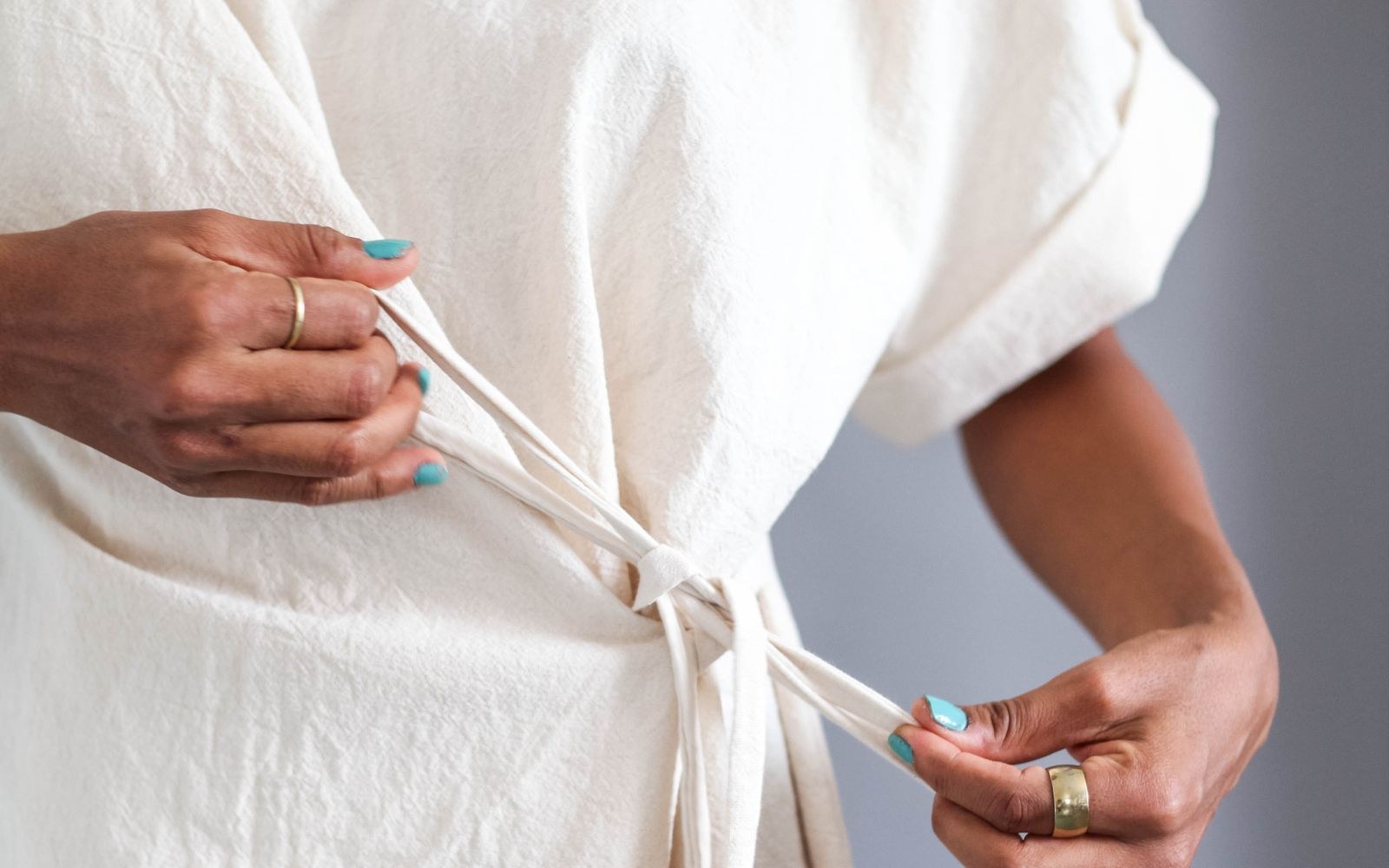
The wrap dress crosses over at the front, ties or fastens at the waist, and lets you set the fit yourself — which is exactly why it appears in almost every body-shape guide ever written. Evie’s best dress silhouette by body type recommends wrap styles for pear shapes because the tie cinches the waist without fabric bunching at the hips, and the same adjustability is what makes the wrap the safest first try for hourglass and fuller-bust figures too. The V the crossover creates lengthens the torso, the tie marks the waist wherever your waist actually is, and the skirt falls away from the tie point instead of clinging past it.
The design’s staying power is not an accident. Diane von Furstenberg’s wrap dress became part of fashion history — a version sits in the Smithsonian’s collection, as her Interview magazine profile recounts — because a dress a woman could put on, adjust and move in answered a real problem rather than a trend. On a Friday night, adjustability is comfort: the tie that fits before dinner still fits after it, which is why the wrap is also our reach in friday night outfits when you feel bloated.
When a wrap fails, and the fix
A wrap fails in two predictable places. If the crossover gaps when you sit, the bust needs a small hidden snap or a camisole underneath — a two-minute fix, not a reason to abandon the style. If the tie sits above or below your natural waist, the dress is cut for a different torso length; try the petite or tall version of the same dress before you try a different silhouette. Faux-wrap dresses, with a fixed crossover and a zip, solve the gapping problem entirely and keep the same visual lines, at the cost of the adjustability.
Fit-and-Flare: Built-In Waist, Room to Move
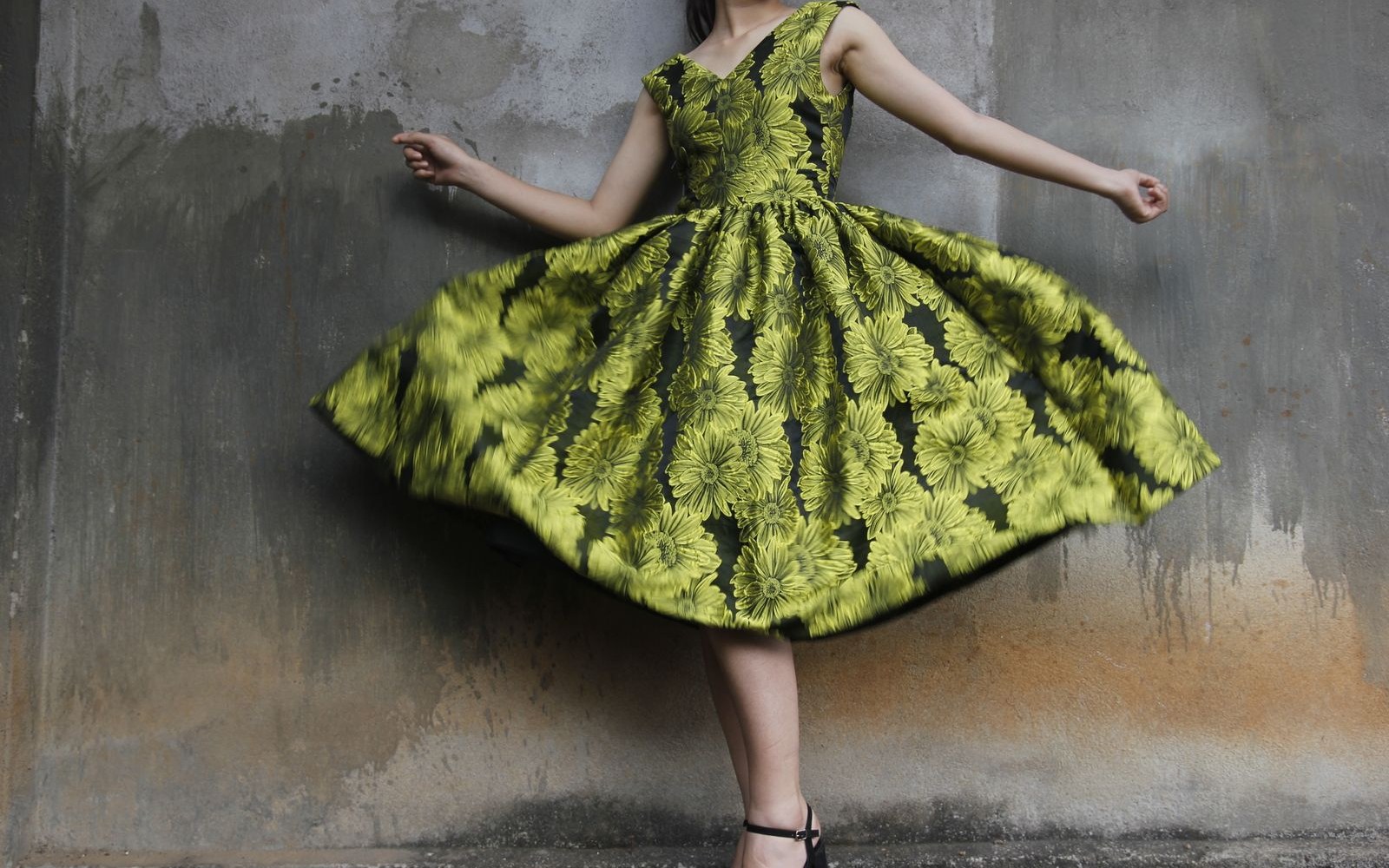
Fit-and-flare does with seams what the wrap does with a tie: a fitted bodice meets a skirt that opens from the waist into real volume. For rectangle shapes, that contrast manufactures the waist definition the body does not supply on its own. For pear shapes, the fitted top keeps the upper body clean while the skirt passes over the hips without negotiating with them. For inverted triangles, the skirt’s volume balances a stronger shoulder line. It is the silhouette behind most of the formulas in our friday night outfit formula — a defined middle, one clear focal point, and room to actually dance.
Fit-and-flare checks that matter
The bodice must fit before the skirt can flatter: if it is loose, the waist seam wanders and the effect blurs. The skirt should open from your natural waist, not the hip — a low flare clings through the middle first, which is a different dress wearing the same name. And the fabric needs body to hold the flare; in a limp fabric the shape collapses by the second hour. Structured cotton, ponte, scuba and heavier crepe hold it. Chiffon reads softer and more romantic — a choice, not a flaw.
Slip and Bias-Cut Dresses: Drape Does the Work
The slip dress looks like the simplest dress in the world — thin straps, no waist seam, fabric falling from bust to hem — and it is the most technically interesting. Most good slips are cut on the bias, meaning the fabric is cut at a diagonal to its woven grain. As the textile explainer on grain in woven fabric sets out, cloth cut on the bias is more elastic and more fluid than the same cloth cut straight, which is why a bias slip skims and flows instead of hanging in a tube. A fuller explanation of how the bias cut drapes adds the practical warnings: bias cloth keeps moving after it is cut, grows a little under its own weight, and should be stored folded rather than hung, or the hem you bought is not the hem you will wear.
Who the slip serves best
The slip serves bodies that want suggestion rather than structure: apple shapes, because there is no waistband to argue with the middle; straighter rectangles who like a clean column; and anyone whose night involves sitting, eating and moving, because bias fabric gives as you move. It will not invent a waist, and thin, shiny fabric shows every layer underneath — choose matte or lined slips and seamless underlayers. For calibrating how much a dress reveals, our guide to how revealing a Friday night outfit should be works through the comfort side.

Sheath Dresses: The Clean Column
The sheath follows the body in one tailored line, close but not tight, with darts or princess seams doing the shaping and a hem near the knee. It is the dress version of good posture. Hourglass figures wear it almost without adjustment, because the seams are drawn where their curves already are. Rectangles wear it as a clean, deliberate column. Pear shapes can wear it in a fabric structured enough to pass over the hip without pulling — if fine wrinkles radiate from the hip, the dress is a size or a fabric away, not a shape failure.
The sheath fitting rules
A sheath should skim, with roughly an inch of ease you can pinch at the side seam. The waist seam or dart point should sit at your waist, the hem should clear the knee cleanly, and you should be able to sit, climb a step and reach a top shelf without the dress travelling upward. If it passes those three tests, it will also photograph well — the same clean line is why sheaths and columns recur throughout our guide to friday night outfits that photograph well. If it fails the sit test, no neckline will save it. Put it back.

Empire Dresses: The Waist Moves Up
The empire dress moves the waist seam to just under the bust and lets everything below fall in one uninterrupted line. That move gives apple shapes a defined point that is not their middle, gives fuller busts a seam where support actually lives, and gives anyone a long, leg-lengthening line. It is also the most forgiving silhouette across an evening of eating and sitting — the same reason it anchors our friday night date outfits for winter.
The empire trap, and how to avoid it
The trap is fabric. An empire seam in a stiff fabric tents away from the body and reads shapeless; the same seam in a fluid fabric — crepe, chiffon, soft jersey — falls close and reads intentional. The second trap is placement: the seam must sit under the bust, never across it. If the seam crosses the fullest point, the dress is the wrong size or the wrong cut for your bust, and sizing up usually fixes the seam while ruining everything else. Try a different empire before you size up out of the style. Fitters who work across fuller figures make exactly this point about empire and fit-and-flare: the two styles place the waist in opposite places, so if one placement fights your body, the other is the natural next try.

Shirt Dresses: Structure You Can Belt
The shirt dress borrows the collar, button front and cuffed sleeve of a shirt and runs them into a dress. Its gifts are structure and adjustability at once: the collar frames the face, the button line draws a long vertical the eye follows, and a belt — its own, or yours — sets the waist wherever you choose to put it. Belted at the natural waist, it is a rectangle’s easiest route to a defined middle. Worn open-collared with the belt loose, it skims an apple shape without clinging. The vertical button line also makes it a quiet elongator, which is why a monochrome shirt dress works inside an all-black outfit without reading like a uniform.
Shirt dress details that decide the look
Fabric decides whether a shirt dress reads crisp or slouchy: poplin and denim hold the collar and the line; rayon and silk soften it toward evening. Leave the top button or two open to create a V. If the front gaps at the bust, tape solves tonight — but a dress that needs tape every time is telling you its button spacing was not drawn for your bust, and the wrap or sheath will serve you better.

Necklines: The Frame Above the Dress
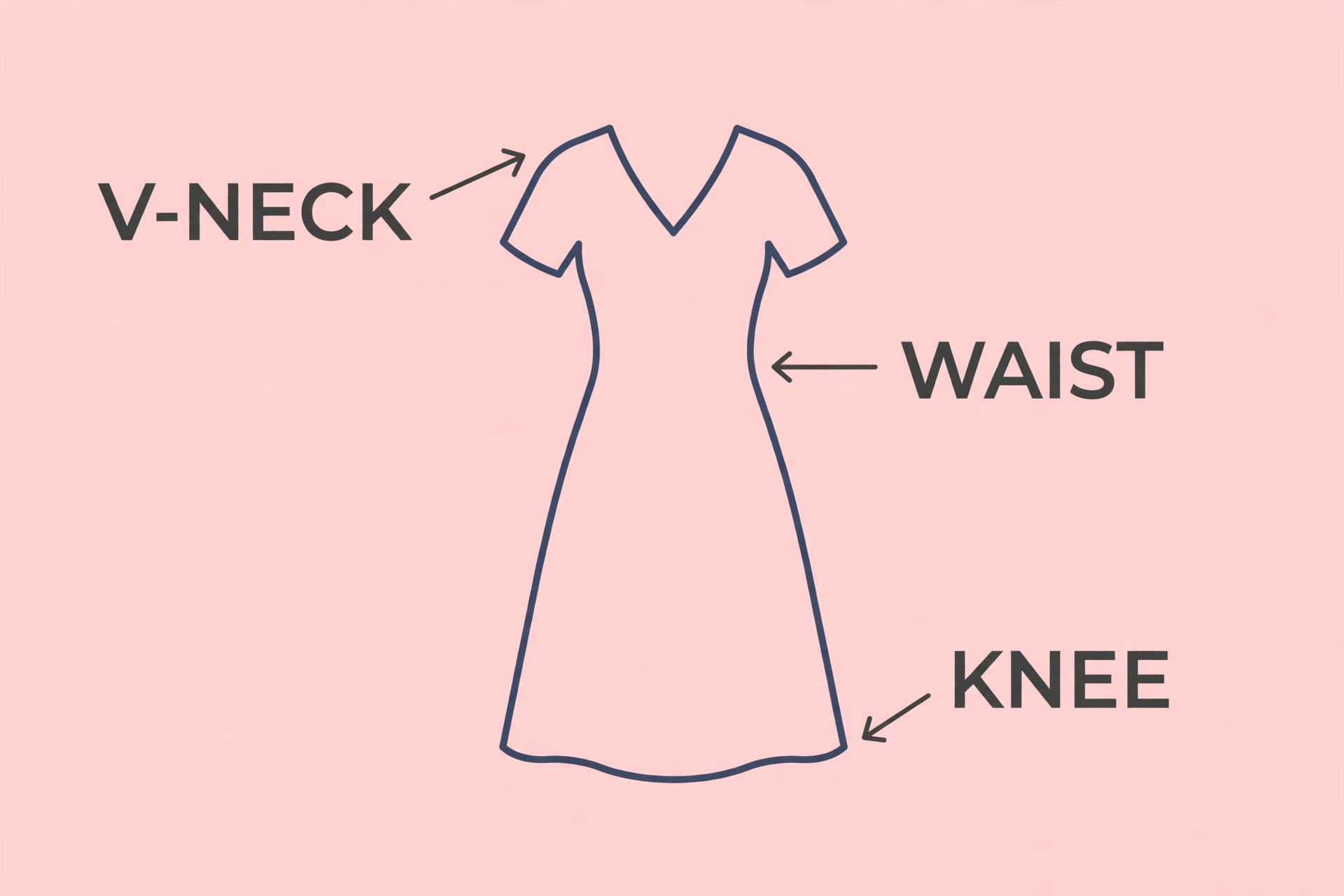
Once the silhouette is chosen, the neckline does the balancing. It is the closest part of the dress to your face, and it sets how wide your shoulders read, how long your neck looks and where the eye lands first. GlamCheck’s necklines guide works through the family with that balance in mind: a V lengthens the neck, a boat neck widens the shoulder line, a sweetheart adds curve at the chest. Vilmere’s dress necklines guide lands in the same places — V-necks elongate, sweethearts frame and lift, halters bare the shoulders, boat necks broaden, square necklines add structure.
Match the neckline to the job
For pear shapes, the neckline’s job is width and interest up top: boat necks, off-shoulder lines and detailed or embellished bodices pull the eye up and balance the hip. For inverted triangles, the job is the opposite: a clean V or scoop softens the shoulder line and draws the eye down the center. For fuller busts, a V or sweetheart that ends above the fullest point gives shape without spilling; for smaller busts, a higher, wider neckline or a halter creates the horizontal interest the silhouette needs. Hourglass figures can wear nearly any neckline that respects the balance they already have — the mistake to avoid is a very high, wide neckline on a full bust, which can turn balance into bulk.
Hemlines: Where the Dress Ends
A hemline is a full stop, and the eye treats wherever it lands as the end of the leg. The most flattering landing spots are the narrow points: just above the knee, just below it, mid-calf at the slimmest part of the calf, or the ankle. The least forgiving spot is the widest part of the calf, where a midi that ends there cuts the leg at its broadest and shortens the whole read. This is why the same dress in two lengths can look like two different dresses on the same body, and why hemming is the highest-value alteration there is — a point our main guide to what to wear Friday night makes about every outfit, not just dresses.
Hemlines by shape and plan
Above-knee hems give apple and rectangle shapes a clean leg line. Knee and just-below-knee hems suit hourglass sheaths and wraps. Midis belong to fit-and-flare and empire silhouettes — but check the calf rule first. Maxis serve tall frames and empire lines best; on a petite frame a maxi needs a defined waist and a lighter fabric or it wears you. And weigh the hem against the plan as honestly as against the mirror; our friday night outfit with jeans guide exists for the nights when the honest answer is not a dress at all.
Fabric: The Silent Half of Fit
Silhouette is the drawing; fabric is the building material, and the same drawing in the wrong material fails. Structure fabrics — ponte, scuba, heavier crepe, tailored cotton — hold a line away from the body; they are the sheath’s and fit-and-flare’s best friends. Fluid fabrics — chiffon, georgette, silk, soft jersey — fall close and move; they belong to empire, slip and wrap dresses. A little stretch makes a sheath sit-through-able; a lot turns any silhouette into a second skin, which is a different intention entirely. If that intention is yours, dress it deliberately with how to dress sexy without trying too hard rather than arriving there by fabric accident.
A two-second fabric test in the shop
Scrunch a handful of the skirt and let go: creases that fall out will survive a car ride and a long dinner; creases that stay will show the evening on your lap. Hold the dress to the light — if your hand shows through an unlined layer, plan underlayers or choose the lined version. Drape that falls in soft vertical folds will skim; fabric that pulls into horizontal lines will argue with you all night.
A Five-Minute Fitting-Room Check
Run every finalist through the same five minutes. Look at the silhouette first, details second — if the outline is wrong, no print will rescue it. Sit, cross your legs, and stand again; the dress should return to place without a tug. Reach up, reach forward, take three long strides. Check the back for a waist seam riding off your waist and fabric pooling at the hip. Then ask the only question that counts — would I choose this on a night when I want to think about everything except my dress? If budget is the real constraint, the same silhouette in a simpler fabric is the smart buy — our guide to friday night outfits on a budget shows how to hunt it, and the same system applies unchanged in our friday night outfits for women over 40.
Our view
A body type is not a problem to be dressed around. It is information — three measurements and the relationship between them — and a dress is a set of decisions that either uses that information or ignores it. The women who look effortlessly right on a Friday night are not the ones with a particular shape. They are the ones whose dress was chosen in the right order: silhouette for their proportions, neckline for balance, hemline for their legs, fabric for their evening. Learn your order once, and the hanger stops lying to you.
— Friday Night Style
Frequently Asked Questions
How do I find my body type if I am between two shapes?
Dress for the shape your measurements lean toward, then borrow one move from the neighboring shape. A pear with a fuller bust takes the pear silhouettes but the hourglass necklines. Most women are blends; work by strongest signal first.
Which dress silhouette suits almost every body type?
The wrap and the fit-and-flare come closest, because both let the waist be set or built at the wearer’s own narrowest point and let the skirt fall away from there. They fail least often across shapes, which is why this guide treats them as the first two try-ons for anyone starting from zero.
Does a slip dress work on an apple shape?
Yes, in a bias-cut or fluid fabric with no waist seam to fight the middle, and ideally with a V or scoop neckline to lengthen the line. Avoid very thin, shiny, unlined slips, which show every layer beneath; a matte, lined slip with seamless underlayers is the version that works.
What is the most flattering hemline for short legs?
Just above the knee, or a midi that ends at the narrowest point of the calf — both end the leg at a slim point and keep the line long. Avoid hems that stop at the widest part of the calf, and keep the waist defined so the proportions divide into thirds rather than halves.
Should I size up for a fuller bust in a sheath or shirt dress?
Size for the bust and tailor the waist, rather than sizing the whole dress to the waist and straining the bust. A sheath taken in at the waist keeps its clean line; a shirt dress that gaps at the buttons cannot be taped into looking tailored. If tailoring is not an option, a wrap gives the same polish with built-in adjustment.
Can I wear a sheath dress with a rectangle shape?
Yes — worn as a clean column, a sheath suits a straighter frame, especially with a square or scoop neckline and a belt added at the waist when you want definition. Choose a fabric with structure so the dress holds its own line instead of borrowing yours.
Questions About Picking a Friday Night Dress for Your Body Type?
Tell us the plan, the dress code, and the part of the outfit that is not working — we read every message.
Sources
- Stitch Fix — How to Dress for Your Body Type
- Judyp Apparel — Dress for Your Body Type
- Nordstrom — Best Dresses for Your Body Type
- Fabrico — How to Choose the Right Dress Silhouette for Your Body Shape
- Evie Magazine — The Best Dress Silhouette for Your Body Type
- Mansa Fashion — Plus-Size Dress Silhouettes: A Fitter’s Guide
- GlamCheck — Necklines Guide: Every Neckline and Who It Suits
- Vilmere — Dress Necklines Guide: Every Type Explained
- Wikipedia — Grain (Textile)
- Deyn — Bias Cut Explained: Grain, Drape, Sewing and Storage
- Discover Fashions — How to Measure Bust, Waist and Hips at Home
- Interview Magazine — Diane von Furstenberg