Every piece is nice. The dress fits, the shoes were not cheap, the bag goes with everything — and yet the whole outfit looks flat, and you cannot name why. That gap between good pieces and a flat result is not taste and it is not your body. It is a small set of repeatable mistakes that quietly drain the shape, contrast and finish out of a look. This list works like a diagnostic: find the symptom in the mirror, match it to the mistake, and apply the fix before you leave.
Friday Night Style
Good Pieces. Flat Look. Find the One Mistake.
A symptom-by-symptom diagnosis of the eight mistakes that flatten a Friday night outfit — and the fastest fix for each one.
Key Takeaways
- A flat look is almost never a bad piece — it is a proportion, contrast or finish mistake hiding among good ones.
- Split the outfit in thirds, not halves: an even top-to-bottom split is the single most common flattening mistake.
- Every outfit needs contrast somewhere — texture, color value, or shine — or the eye finds nothing to land on.
- Shoes and bags are proportion tools: the wrong shoe ends the leg line early, and the wrong bag scale unbalances the whole frame.
- The last five minutes decide the finish: smooth the under-layer, steam the fabric, and add one deliberate detail.
Table of Contents
- Start With the Symptom, Not the Shopping
- Mistake 1: The Half-and-Half Split
- Mistake 2: One Texture From Head to Toe
- Mistake 3: Shoes That End the Leg Line Early
- Mistake 4: A Bag at the Wrong Scale
- Mistake 5: Under-Layer Lines Doing the Talking
- Mistake 6: Color Value Collapse
- Mistake 7: Matching Everything Exactly
- Mistake 8: Skipping the Finish
- Our view
- Frequently Asked Questions
- Sources
- Recommended
Start With the Symptom, Not the Shopping
The instinct, standing in front of the mirror at seven o’clock, is to conclude that the outfit needs something new: a different top, a better dress, the shoes you did not buy. Resist it for five minutes. A flat look is a diagnosis problem before it is a shopping problem, and the diagnosis is fast once you know what flatness is made of. An outfit reads flat when the eye travels across it and finds no decisions: no clear break where one piece ends and another begins, no contrast of surface or shade, no point where the look was clearly finished on purpose. Each mistake below removes one of those decisions. Each fix puts it back, usually with pieces already in the room.
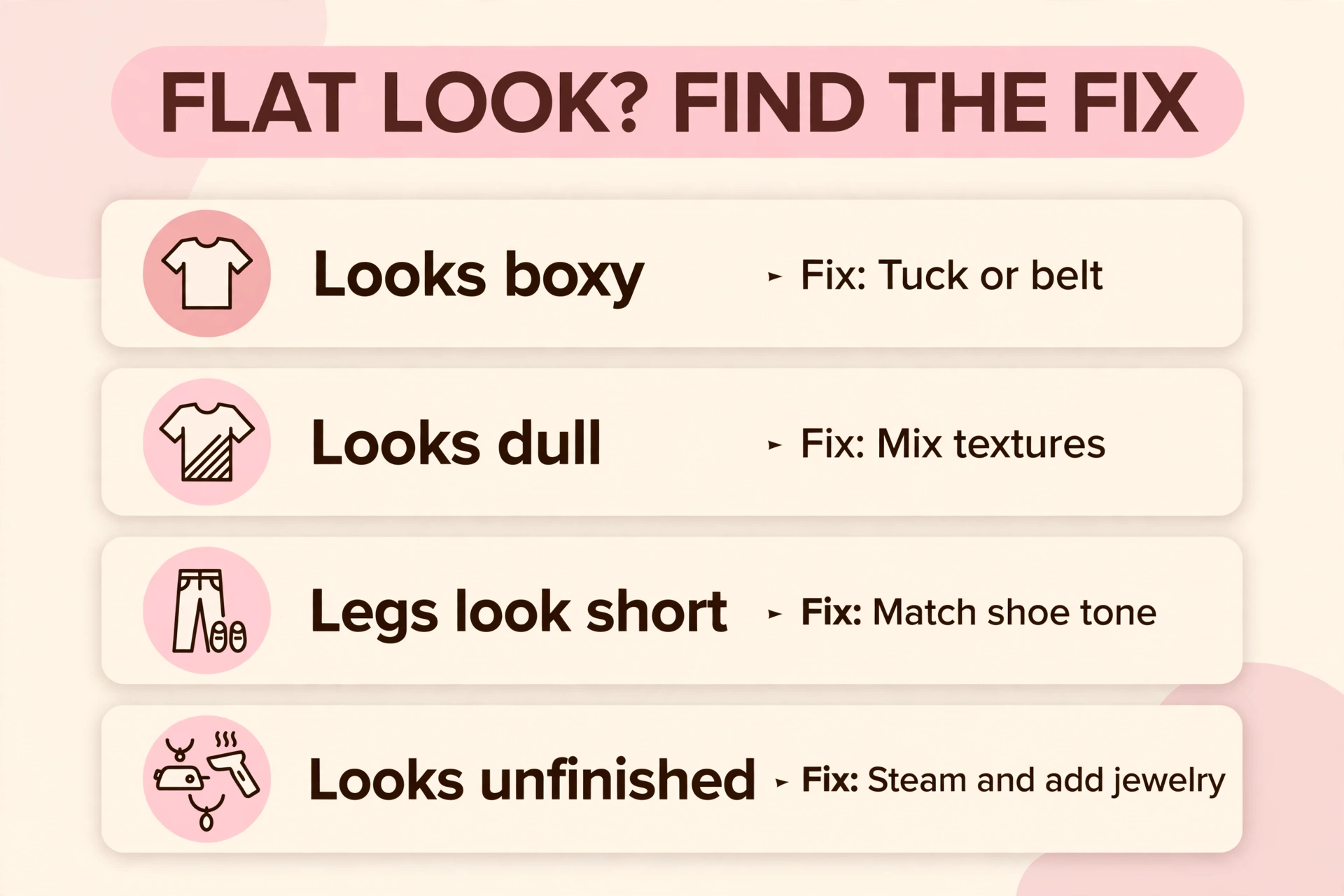
Work down the table first. It maps the four complaints women describe most often to the mistake most likely causing them and the fastest available fix. Then read the matching section for the full reasoning, because the same symptom can have a second cause hiding underneath it — the boxy dress, for example, is often a proportion mistake and a finish mistake at the same time. If your plans changed at the last minute and the outfit was rebuilt in a hurry, our guide to last-minute Friday night outfits shows how to assemble from your own closet without creating half the mistakes on this list in the first place.
| Symptom in the mirror | Likely mistake | Fastest fix |
|---|---|---|
| The outfit looks boxy and shorter than you are | Mistake 1 — the half-and-half split | Tuck, half-tuck or belt to move the break to a third |
| Everything blends into one dull surface | Mistake 2 — one texture head to toe | Swap one piece for an opposite surface: matte against shine |
| Legs look cut off at the ankle | Mistake 3 — shoes ending the leg line | Choose a shoe closer to your skin tone or the hem’s tone |
| The outfit looks fine until the photos come back | Mistake 6 — color value collapse | Add one clearly lighter or darker piece and re-check in grayscale |
How to use the mirror honestly
Judge the outfit at a distance, not at arm’s length. Up close you see garments; from across the room you see proportions, contrast and lines, which are the things this list is about. Take one full-length photo in the best light you have, look at it for ten seconds, and name the flattest thing about it in one sentence. That sentence is your starting mistake. Fix that one thing only, then look again. Most outfits need one or two corrections from this list, not eight — the women whose looks never read flat are not avoiding every mistake by instinct, they are catching the one or two their outfit actually made. Our explainer on how revealing a Friday night outfit runs the same kind of calm self-check on a different dial, and the habit transfers: read the total effect first, then adjust.
Mistake 1: The Half-and-Half Split
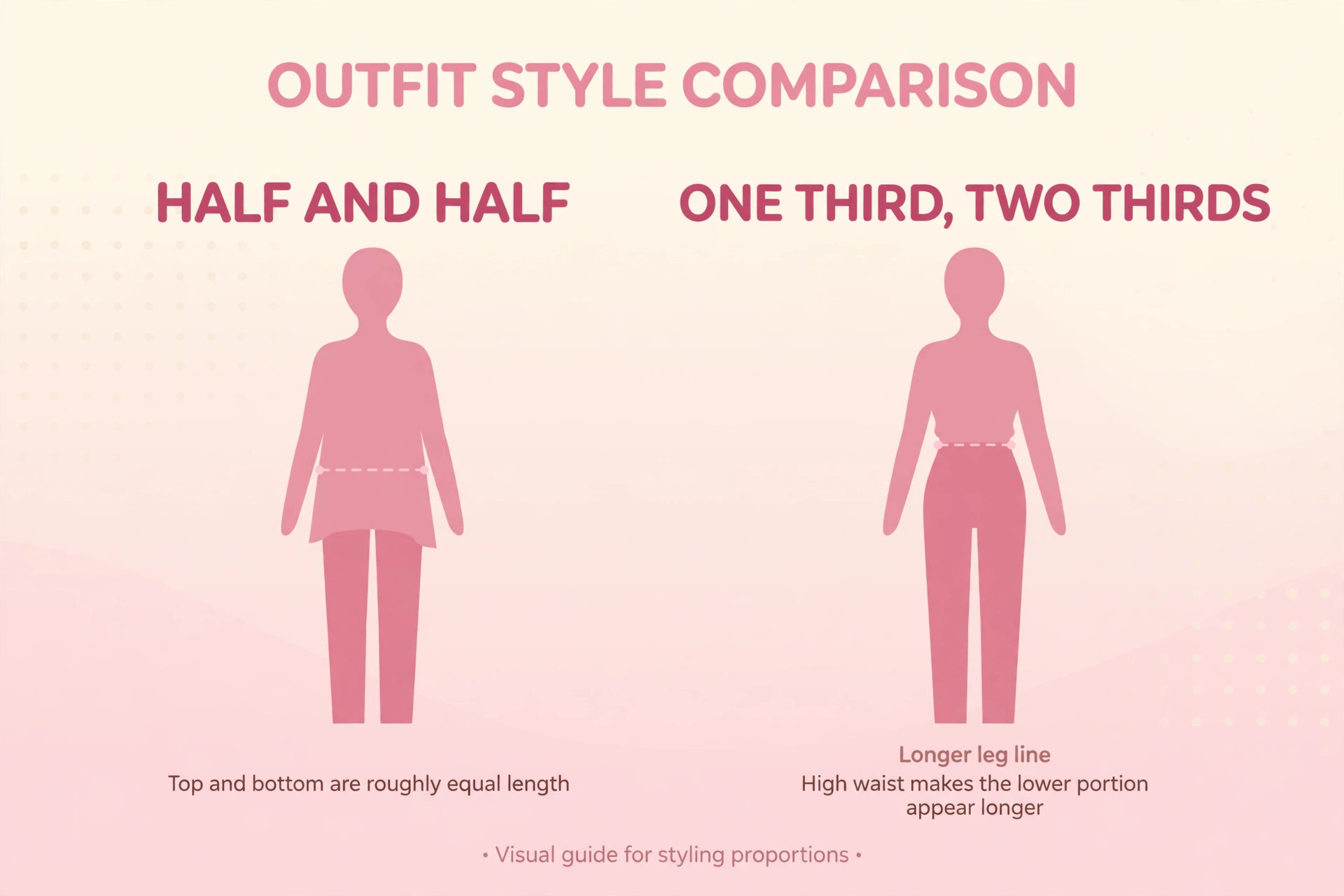
The most common flattening mistake is also the least visible when you are looking for it in individual pieces, because every piece can be right while the division between them is wrong. When a top and a bottom meet at the exact middle of the body — an untucked top ending at the hip over full-length trousers, a dress belted precisely at the natural waist with equal visual weight above and below — the eye reads two equal blocks stacked on each other. Equal blocks look static and wider than the same body divided unevenly, which is why this mistake so often gets misdiagnosed as a fit problem or a body problem. It is neither. It is a line placed in the wrong spot.
The corrective principle is the rule of thirds. As The Curvy Fashionista explains in its guide to the rule of thirds in fashion, dividing an outfit into roughly one third and two thirds instead of halves is a long-standing visual principle that makes a look feel balanced and deliberate rather than accidental. A practical styling breakdown of how to use the rule of thirds shows the mechanics: a tucked or cropped top with high-waisted bottoms gives the legs the longer two thirds, while a longer layer over a shorter, sleeker base reverses the ratio just as effectively. Neither version is about a body type. Both are about giving the eye one main field and one accent instead of two competing equals.
The three fastest proportion fixes
You rarely need new clothes for this one. The tuck is the fastest lever: a full tuck draws the break exactly at the waistband, and a front tuck draws it there while letting the sides fall softly, which suits anyone who dislikes a hard horizontal line. The second lever is layer length — a jacket that ends at the hip and one that ends mid-thigh place the visible break several inches apart, so swapping the layer can fix the ratio without touching anything underneath. The third lever is the belt, placed at the point where you want the division rather than where the garment happens to suggest it. This is also where body-specific dressing connects: the same thirds logic is what makes the builds in our guides to Friday night outfits for petite women and Friday night outfits for tall women work, because both start from where the break falls rather than from the pieces themselves.
Volume is the other half of proportion
Proportion has a second axis: fullness. A voluminous top over voluminous trousers erases the body’s shape entirely, and a skin-tight top over skin-tight bottoms leaves the eye nowhere to rest. The reliable combination is one fuller piece against one slimmer one, whichever end carries the volume. If both halves of tonight’s outfit are relaxed, that — not the color, not the pieces — is likely your flatness. Anchor one half: swap the wide trouser for a straight leg, or the oversized top for a fitted one, and the other half suddenly looks intentional. The positive version of this whole system, building the look up instead of troubleshooting it down, is our Friday night outfit formula — read this list as its mirror image.

Mistake 2: One Texture From Head to Toe
An outfit built from a single surface — all matte jersey, all smooth cotton, all one flat knit — gives light nothing to do. Texture is what lets the eye separate one piece from the next when colors are close, and it is what keeps a simple outfit interesting at conversation distance. Without it, pieces merge into one continuous, dull field, and the look reads unfinished even when it is perfectly clean and fitted. The symptom is specific: the outfit looks better in your head, where you can feel the differences, than in the mirror, where only surfaces register.
The fix is contrast of surface, and the guidance is consistent: pair opposites. A detailed guide to mixing textures in an outfit works through the reliable pairings — shiny against matte, soft against structured, smooth leather against nubby knit — and notes that texture contrast does the most work exactly where color contrast is absent, in neutral and monochrome looks. Who What Wear’s stylists make the same case in their roundup of all-black outfit ideas, where velvet, satin, leather and embellishment are what stop head-to-toe black from reading as a uniform. If black is your default, our own deep dive into the all-black outfit applies those texture rules piece by piece.
The two-texture minimum
Hold every outfit to a two-texture minimum and most of this mistake disappears. A satin top over matte jeans is two. A knit dress with a leather jacket is two. A smooth dress with a sequinned or beaded bag is two, which is why one textured accessory can rescue an otherwise plain base. The related edge case is the deliberate mix of opposites — soft against hard, romantic against structured — which our guide to how to mix soft and hard treats as a look in its own right. The mistake is never simplicity itself; a slip dress alone can be a complete look. The mistake is simplicity with no surface decision anywhere in it.

Mistake 3: Shoes That End the Leg Line Early
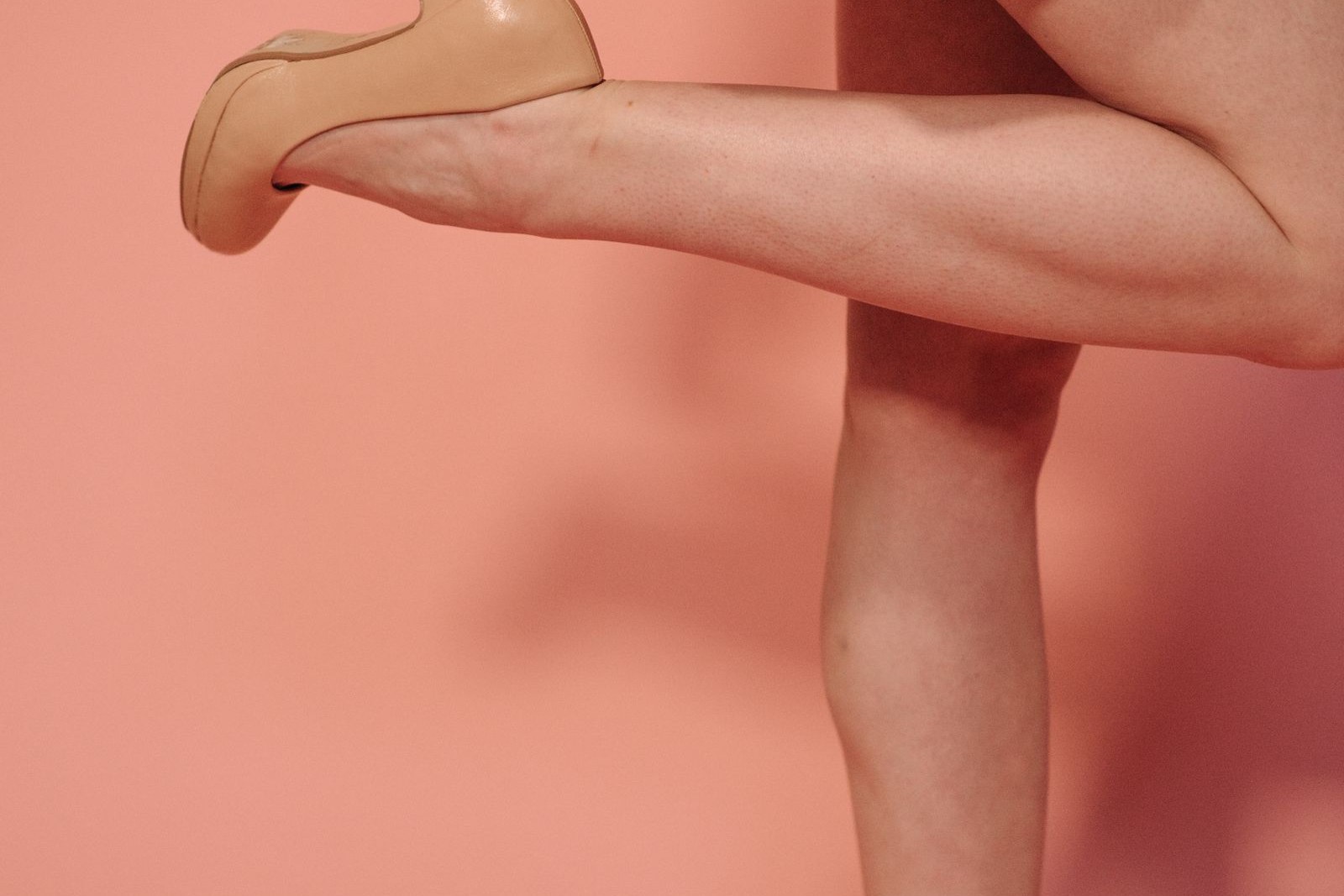
Shoes are where the leg line either continues or stops, and a shoe that stops it early — a heavy ankle strap on a bare leg, a high-contrast boot cutting mid-calf under a midi hem, a dark chunky shoe under a pale cropped trouser — shortens everything above it. The outfit can be well proportioned from the waist up and still read flat and stubby overall, because the eye takes its length reading from the longest unbroken line in the look, and this mistake breaks that line at its final segment.
The classic correction is continuity of tone. Styling guidance on nude shoes and longer-looking legs explains the mechanism plainly: a shoe close to your own skin tone does not interrupt the visual line from leg to foot, so the leg reads longer than the same leg ending in a contrasting shoe. The principle generalizes beyond nude heels. A shoe that matches the trouser continues the trouser’s line; a shoe that matches the skin continues the leg’s line; a low vamp and a pointed toe extend the foot’s line forward. What breaks the line is the hard stop — contrast placed exactly at the ankle with nothing carrying the eye past it.
Match the shoe to the hem, not the bag
The old instinct to match the shoe to the bag is part of how this mistake happens, because it optimizes the wrong relationship. The shoe’s visual job is with whatever it touches: the hem above it and the leg inside it. With cropped trousers, keep the shoe low-cut and close in tone to the leg or the fabric. With a midi dress, beware the boot that ends where the hem ends, doubling the horizontal line. With jeans, the full-length builds in our how-to on a Friday night outfit with jeans show how a heeled boot under the hem keeps the line unbroken from waist to floor. And when the plan involves hours on your feet, solve it with a lower heel in the right tone rather than a high heel in the wrong one — the line matters more than the height.
Mistake 4: A Bag at the Wrong Scale
A bag is a shape worn against the body, and at the wrong scale it quietly re-proportions everything around it. An oversized tote against a sleek evening outfit drags the look back to daytime and swamps a smaller frame; a tiny bag against a voluminous coat or a fuller silhouette can read as an afterthought, a dot floating beside the outfit rather than a part of it. Because the bag is usually chosen last and by habit — the same one you carried all day — this mistake survives outfits that got everything else right.
Scale guidance for bags is fundamentally about proportion to the frame and the outfit’s volume. A detailed guide to choosing a handbag for your body type sets out the working measurements: where the strap drop lands the bag on the body matters as much as the bag’s size, since a bag that lands at the hip emphasizes the hip and one held at the waist emphasizes the waist, and bags beyond a certain height begin to overwhelm smaller frames. The evening translation is simple. Match the bag’s scale to the outfit’s scale, carry it at the point you are happy to underline, and let a night look carry a night-sized bag — the day tote’s contents can be edited down to the five things the evening actually needs.
Structure counts as scale
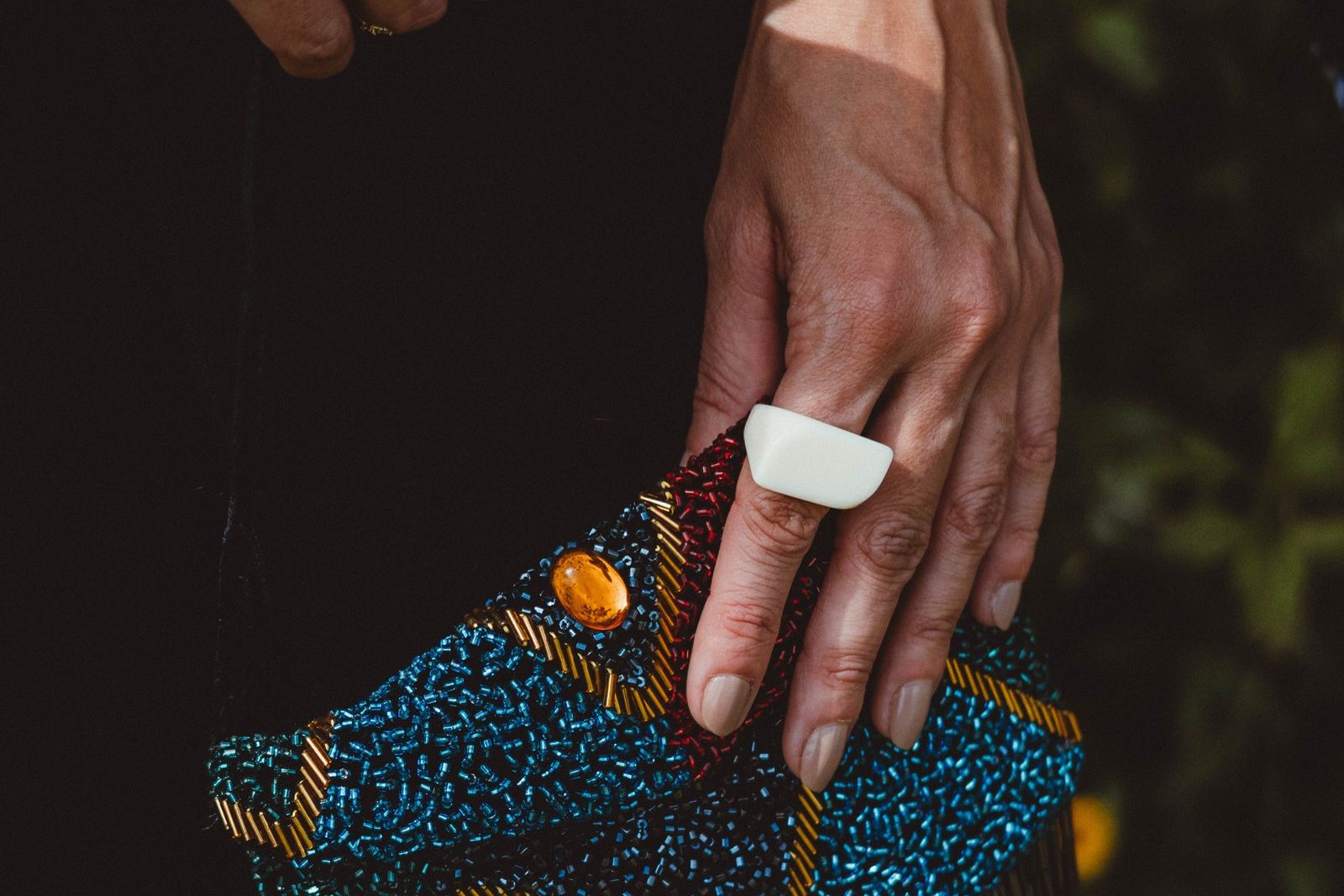
A soft, slouching bag beside a structured, tailored outfit reads larger and messier than its measurements, while a structured bag beside a soft, fluid outfit adds the definition the outfit is missing. Treat structure as part of scale: the more polished and architectural the clothes, the more a defined bag shape flatters them; the softer the clothes, the more a relaxed bag belongs. This is one reason the same clutch can look perfect with a slip dress and lost against a tailored suit. Judge the bag in the mirror, on the body, with the outfit — never on the shelf and never by habit.
Mistake 5: Under-Layer Lines Doing the Talking
Some flat looks are actually noisy looks: the eye is busy, but with the wrong information. Bra straps sliding into view, a seam or outline showing through a smooth dress, a camisole hem creating an extra horizontal line at the hip, shapewear ending mid-thigh under a clingy skirt — each of these draws a line the outfit did not choose, and unchosen lines read as carelessness no matter how good the pieces are. The symptom is a look that seems fine in motion and wrong in every photo, because the camera catches the under-layer’s lines at their clearest.
The fix begins with choosing the under-layer as deliberately as the dress. Styling advice on elevating a slip dress returns repeatedly to what happens underneath the bias cut: smooth, seamless foundations let the fabric skim and move as designed, while textured or ill-fitting layers telegraph straight through it. The same logic applies to any smooth or clingy fabric. Match the under-layer’s coverage to the dress’s neckline and back before you leave, choose seamless edges where the outer fabric is thin, and check the seated view as well as the standing one — lines that behave while you stand often appear the moment you sit. Our explainer on how to dress sexy without trying too hard makes the connected point from the other side: the looks that read effortless are the ones where every visible line was intended.
The bloat-day version of this mistake
On a night when your body feels unpredictable, the under-layer temptation runs the other way — more compression, more layers, more holding in — and the result is often visible edges and a silhouette broken into segments. The kinder and better-looking approach is in our list of Friday night outfits when you feel bloated: drape and empire lines that skim, fabrics with movement, and foundations chosen for smoothness rather than squeeze. Comfort is not the enemy of this fix. Discomfort creates the adjusting, tugging and visible strain that flatten a look fastest.
Mistake 6: Color Value Collapse
Value is how light or dark a color is, separate from which color it is — and value collapse is what happens when every piece in an outfit sits at nearly the same value. A mid-grey top with charcoal trousers, a beige dress with a tan bag and nude shoes of the same depth, a navy top with black jeans under low light: the hues differ, but the values merge, and the outfit becomes one undifferentiated block. This is the mistake behind the most baffling version of flatness, the outfit that looks considered in the shop’s bright light and like nothing at all in the restaurant’s dim one — and it is a leading reason outfits disappoint in photos, a problem our guide to Friday night outfits that photograph well tackles from the camera’s side.
The diagnostic is pleasingly objective. A practical guide to colour pairing rules for outfits recommends photographing the outfit and viewing it in black and white: if everything turns into a single grey block, there is no value contrast, and the outfit will read flat however interesting its colors are. The same guide’s framework — build with a dark, a light and a mid-tone in play — gives the fix its shape. Stitch Fix’s stylists lay out the underlying relationships in their guide to what colors go well together, starting from the color wheel: colors opposite each other create strong contrast, neighbors create harmony, and value is the dial that decides how visible either relationship becomes.
One clear step is enough
You do not need a high-contrast outfit; you need at least one clear value step somewhere. A lighter shoe under a dark dress, a pale bag against a deep-toned outfit, a bright top under a dark jacket, a metallic that catches light where everything else absorbs it — any one of these restores the eye’s ability to parse the look into pieces. Tonal dressing still works beautifully when the values are stepped deliberately, shade by shade, instead of landing accidentally on top of each other. The starting-point guide to what to wear Friday night builds its core looks on exactly this kind of decided contrast, which is why they survive different venues and lighting.
Mistake 7: Matching Everything Exactly
The matchy-matchy instinct feels like care, and that is what makes it dangerous. Shoes matched precisely to the bag, jewelry bought and worn as a set, a top and bottom in the same dye lot of the same color, lipstick matched to the dress: each match removes a small decision, and enough removed decisions produce an outfit that reads as assembled by rule rather than styled by a person. It flattens because perfect matching eliminates the slight tensions — of tone, texture and finish — that make a look feel alive and current.
The alternative is coordination by family rather than by identity. A personal styling guide to color theory for personal styling frames the useful half of matching: colors that share a temperature — warm with warm, cool with cool — harmonize without needing to be the same color, and pieces chosen in that shared temperature look related while keeping their individual character. Apply that everywhere. Let the bag be a cousin of the shoe, not its twin: same family, different shade or finish. Let one piece of jewelry lead and the others support at a different scale. Wear the tonal outfit, but step the shades (Mistake 6) and vary the surfaces (Mistake 2) so the family resemblance reads as intention. The looks in our roundup of Friday night outfits for women over 40 model this well — coordinated, polished, and never matched into stiffness.
When matching is the point
Two exceptions deserve naming so the rule does not overshoot. A matching set — a co-ord designed to be worn together — is a single garment decision, not a matching mistake; break it up only if it reads flat, with a contrasting shoe or layer. And a deliberate monochrome look is a statement, provided it passes the texture and value tests above. The mistake is not sameness chosen as a concept. It is sameness accumulated by habit, one safe match at a time, until nothing in the outfit was actually chosen.
Mistake 8: Skipping the Finish
The final mistake is the cheapest to fix and the most common on a rushed Friday: the outfit was styled but never finished. Wrinkles from the wardrobe, a hem sitting unevenly, shoes that needed a wipe, jewelry left off entirely, hair treated as separate from the look — each is small, and together they send one message: this outfit stopped being decided about ten minutes ago. Flatness, very often, is just an unfinished outfit photographed at the moment it left the house.
Finishing starts with the fabric’s surface. A comparison of steaming versus ironing clothes from Reader’s Digest, drawing on laundry experts, sets out the practical choice: steam relaxes wrinkles without contact and suits delicate evening fabrics such as silk and chiffon, while an iron gives the crisper result on structured pieces — either way, five minutes of one or the other is the difference between a garment that looks stored and one that looks worn on purpose. Then fit’s last details: a practical clothing alterations guide for women argues that small adjustments — a hem breaking cleanly at the shoe, a strap shortened so a neckline sits where it was designed to — are what make ordinary clothes look deliberate, and the ten-minute home versions (fashion tape, a hem turned and taped, a strap pinned to length) cover most Friday emergencies.
The five-minute finishing order
Work in a fixed order so nothing gets skipped when time is short. First, steam or press the most visible garment. Second, check the under-layer lines from Mistake 5 in the mirror, standing and seated. Third, shoes: wipe, and confirm they continue the leg line rather than ending it. Fourth, one piece of jewelry placed deliberately — not the whole set (Mistake 7), one decision. Fifth, the bag swap, at the right scale (Mistake 4), with only the night’s essentials inside. Five minutes, five decisions, and the outfit that was flat at the door is finished by the time you reach it. The budget version of this entire philosophy — that the strongest upgrades cost nothing — runs through our guide to Friday night outfits on a budget, where fit and finish do the work money usually does.

Our view
Flat is not a verdict on your clothes or your body; it is a list of small, fixable causes wearing a disguise. In our experience the same three mistakes do most of the damage — the half-and-half split, the missing contrast of texture or value, and the skipped finish — and the same five minutes at the mirror catches all three. Diagnose before you shop. The outfit you already own is usually one tuck, one swap and one steam away from the look you thought you needed to buy.
— Friday Night Style
Frequently Asked Questions
My outfit has good pieces but still looks flat. Where do I start?
Start with proportion, because it is the most common cause and the cheapest fix. Check where the top and bottom divide you: if the break sits at the halfway point, tuck, half-tuck or belt to move it toward a third. Then check contrast — one texture or value difference — and only then consider whether any piece itself is wrong. Most flat outfits are fixed by the first two checks.
How can I tell if my colors are the problem?
Photograph the outfit and look at the photo in black and white. If the pieces merge into a single grey block, the values are too close together, whatever the colors are. Fix it with one clearly lighter or darker element — a shoe, a bag, a layer — rather than by changing the whole palette.
Do these mistakes apply to dresses, or only to separates?
They apply to dresses through their details. A dress has a proportion break wherever its waist seam, belt or hem places it; it has texture in its fabric and finish; its look is still ended by the shoe and scaled by the bag. Run the same eight checks, reading “pieces” as the dress plus everything worn with it.
Is an all-black outfit automatically a mistake?
No. All-black fails only when it is also one texture and one value — matte black on matte black at the same depth. Mix surfaces such as satin, leather, knit and embellishment, step the blacks slightly apart, and black becomes one of the strongest night looks rather than a flattening one.
What if I only have five minutes before I have to leave?
Use the finishing order from Mistake 8: steam the most visible piece, check under-layer lines, wipe and confirm the shoes, add one piece of jewelry, swap to the right-scale bag. If one more minute exists, spend it on the tuck — moving the proportion break fixes more flatness per second than anything else on this list.
Questions About Friday Night Outfit Mistakes?
Tell us the plan, the dress code, and the part of the outfit that is not working — we read every message.
Sources
- The Curvy Fashionista — The Rule of Thirds in Fashion
- Fashion-a-holic — How to Use the Rule of Thirds in Fashion
- 40+ Style — How to Mix Textures in Your Outfits
- Who What Wear — All-Black Outfit Ideas
- Fabulous After 40 — Do Nude Shoes Make Your Legs Look Longer?
- Foley + Corinna — How to Choose a Handbag for Your Body Type
- Glam — Tips to Elevate a Slip Dress for Any Occasion
- 3Style — Colour Pairing Rules for Outfits
- Stitch Fix — What Colors Go Well Together
- Palette Hunt — Color Theory for Personal Styling
- Reader’s Digest — Steamer vs. Iron: Which Removes Wrinkles Faster and Easier?
- The Well Dressed Life — Clothing Alterations Guide for Women