
The dress was perfect at home. Then came the walk from the car, the puddle at the curb, the hem drinking up wet pavement, the shoes slipping on the venue’s polished floor, and the pale fabric turning see-through under the streetlights. Rain does not ruin a Friday night outfit by soaking it all at once. It ruins it in five small places, and every one of them can be decided before you leave the house. This is the arrive-dry system: fabric first, hem second, shoes third, then the coat and bag that protect everything underneath.
Friday Night Style
Rain Outside. Dry Arrival. Same Great Outfit.
The fabric, hem, shoe and coat rules that get a Friday night outfit through wet weather without giving up the look.
Key Takeaways
- Rain attacks an outfit in a fixed order: the fabric spots or turns sheer, the hem wicks up wet pavement, and the shoes slip or soak through.
- Choose fabrics that shed water or hide it: coated trench cloth, tight-weave wool, leather, dark denim and matte synthetics survive; silk, suede and pale chiffon do not.
- Keep every hem above the puddle line, and let the coat run longer than the dress so the layer that gets wet is the layer you take off.
- Closed shoes with a textured sole and a low, stable heel beat any open or smooth-soled shoe on wet ground.
- A zip-shut bag and an umbrella wider than your shoulders protect the dry core of the outfit, which is the part the evening actually sees.
Table of Contents
- Start With the Fabric, Not the Forecast
- The Hem Rule: Keep Fabric Off Wet Pavement
- Shoes That Survive the Walk
- The Coat Is the Outfit Until You Arrive
- Bags, Umbrellas and the Dry-Core Strategy
- Three Rainy-Night Builds, Venue by Venue
- If You Get Caught Anyway: The Five-Minute Rescue
- Our view
- Frequently Asked Questions
- Sources
- Recommended
Start With the Fabric, Not the Forecast
Most rainy-night outfit failures are chosen at the wardrobe door, hours before the first drop lands. The forecast only tells you that water is coming. The fabric decides what the water does when it arrives: whether it beads and rolls off, soaks in and darkens, leaves a ring as it dries, or turns a pale layer transparent against your skin. So the system starts here, with a fabric audit of the outfit you planned, and a swap for any piece that fails it. The starting point is the same one our guide to what to wear Friday night uses for every plan: build from the pieces that work, not the pieces you wish worked.
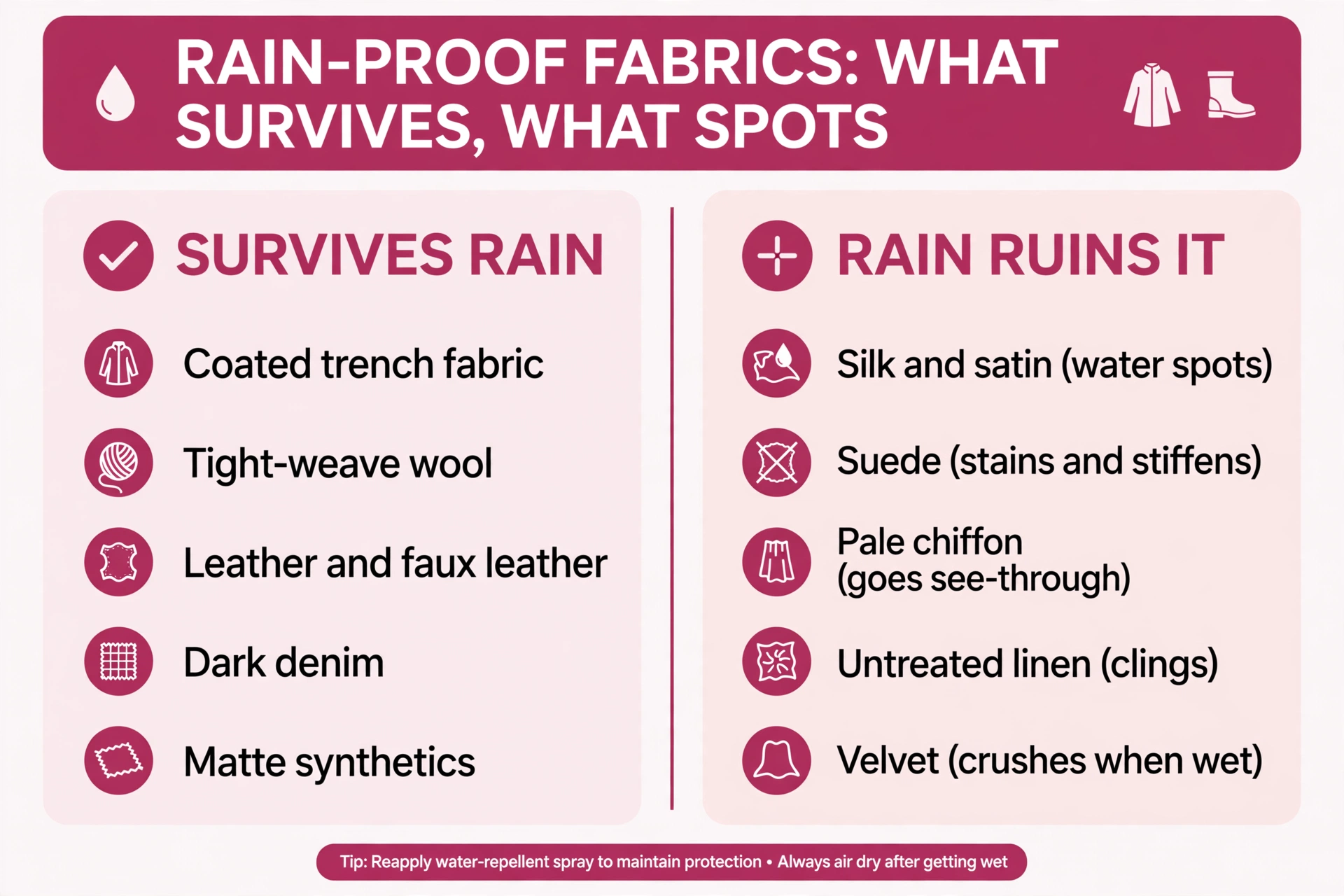
Work down the table first. It sorts the common evening fabrics by what rain actually does to them, because the differences are physical, not taste. A coated or tightly woven fabric holds water on its surface, where it can be shaken off at the door. A loose, absorbent fabric takes water into the fibre, and that is where spotting, clinging and see-through panels come from. REI’s technical explainer on how rainwear works draws the underlying line: a durable water repellent finish makes water bead and roll off, while an untreated fabric wets out, feels cold and clammy, and loses its shape against the body. Evening clothes rarely carry that finish, which is why the weave and fibre have to do the job instead. Columbia’s comparison of waterproof versus water-resistant makes the companion point: water-resistant construction sheds light rain for a while, but only a sealed, waterproof layer keeps water out indefinitely, so plan for the coat to be that layer and the dress underneath to forgive the splashes that get past it.
| Fabric | What rain does to it | Verdict for a rainy night |
|---|---|---|
| Coated trench cloth, gabardine | Water beads on the tight weave and rolls off | Wear it — this is the outer layer |
| Tight-weave wool | Absorbs vapour without feeling wet, resists odour | Wear it — trousers, skirts, blazers |
| Leather and faux leather | Surface wipes dry; needs care after a soaking | Wear it — jackets, skirts, boots |
| Dark denim | Gets heavy and darkens, but hides splashes completely | Wear it — cropped or cuffed, never dragging |
| Silk and satin | Water leaves rings and spots as it dries | Skip it, or keep it fully under the coat |
| Pale chiffon and georgette | Turns sheer and clings the moment it is wet | Skip it on a rainy night |
| Suede | Stains, darkens unevenly and stiffens as it dries | Skip it — shoes and bags included |
Why wool and tight weaves forgive rain
Wool is the quiet hero of the rainy-night wardrobe, and the reason is structural. Woolmark’s fibre guide to wool fibre properties explains that a wool fibre can absorb a large amount of moisture vapour before it feels wet against the skin, and that its natural outer layer resists staining and odour while it does so. A wool trouser or skirt that catches drizzle on the walk in will feel dry minutes after you sit down, where a cotton or viscose piece stays cold and damp for the rest of the evening. The layer logic matters too: a shell that keeps rain out still has to let body heat and vapour escape, or you arrive dry from the rain and damp from yourself. That is why the trench over a breathable wool or knit base beats a plastic-feeling waterproof layer worn against the skin.
The fabrics rain punishes, and why
Silk and satin fail in the opposite way. A detailed fabric care guide notes that silk is extremely prone to water spotting, because mineral deposits are left behind as droplets evaporate on its smooth surface, and that it weakens when wet. One splash across a satin skirt is not a damp patch that dries invisibly. It is a map of rings that stays visible all evening. Pale, fine fabrics fail differently: chiffon, georgette and thin viscose go sheer when wet because water fills the air gaps in the weave that normally scatter light, and they cling to whatever is underneath. If the dress you love is one of these, the answer is not a different dress. It is a longer coat, a slip layer in a matching tone, and a route that keeps you under cover. The texture thinking behind these swaps is the same as our guide to how to mix soft and hard: a hard, shedding surface outside, a soft one protected inside.
The Hem Rule: Keep Fabric Off Wet Pavement
Fabric rarely gets soaked from the sky. It gets soaked from the ground. A hem that touches wet pavement wicks water upward, step by step, until the bottom third of a dress or trouser leg is dark, heavy and cold. The fix is a measurement, not a mood: on a rainy night, every hem ends above the puddle line. For dresses that means knee length or shorter, or a midi worn with a heeled boot that lifts the hem clear of the ground. For trousers it means a cropped or cuffed leg, never a puddle-breaking wide leg. Our Friday night outfit formula builds proportion from the hem upward for exactly this reason: where the fabric ends decides how the look reads, and in rain it also decides how much of it survives the walk.
Dress and skirt lengths that work
A knee-length or above-knee dress is the natural rainy-night shape, because the hem clears standing water even when you step off a curb without looking. A midi can work, but only as a system: a slimmer cut that will not swing into wet railings and car doors, a fabric from the survives column of the table, and a shoe with enough lift to keep the hem off the ground. A maxi is the one length to retire for the night. Even under an umbrella, a floor-length hem trails through every wet lobby and taxi floor, and it dries slowest of all because there is simply more wet fabric. If your plans involve the kind of polished dinner in our guide to what to wear to a Friday night dinner, the knee-length version of the same look reads just as dressed up, and it arrives that way too.
Trousers, jeans and the cuff trick
Jeans are a rainy-night staple because dark denim hides splashes completely, but the length rule still applies. The builds in our how-to on a Friday night outfit with jeans start from a hem that breaks cleanly at the shoe, and on a wet night that break matters twice over: a stacked or dragging hem wicks water up the leg and stains from the inside out. Cuff a straight leg once, choose a cropped wide leg that ends mid-calf, or tuck a skinny leg into the boot and let the boot take the weather. Wool trousers follow the same rule with one advantage, which is that a cropped wool trouser over a heeled ankle boot is a complete, polished outfit that rain can barely touch. The comfort-first thinking in our list of Friday night outfits when you feel bloated transfers here too: a defined waist and a clean, lifted hem look deliberate, never bundled.
Shoes That Survive the Walk
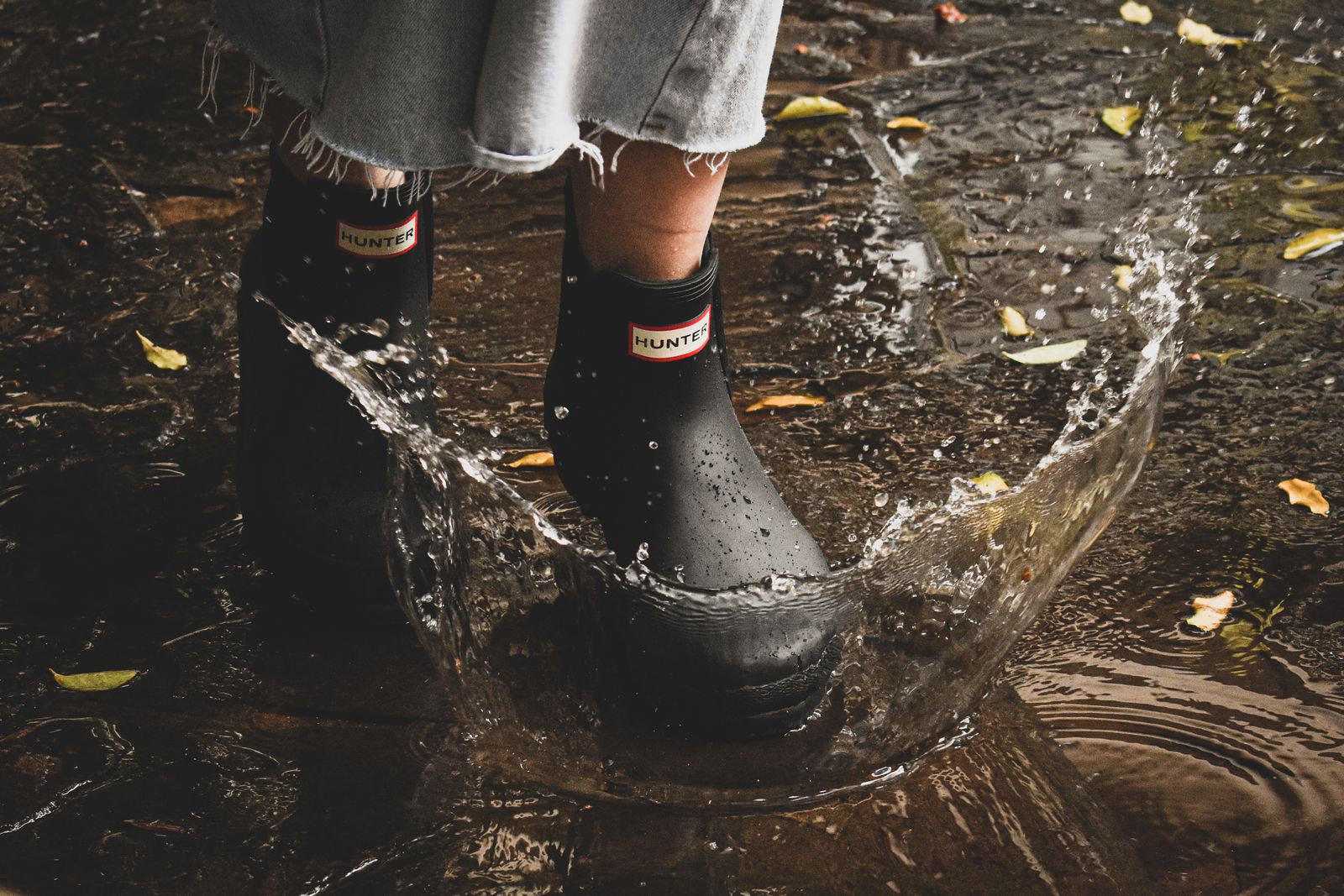
Shoes take the worst of a rainy night and decide the most: whether you arrive dry, whether you walk confidently across a wet marble lobby, and whether the pair itself survives to be worn again. The rules are three. The shoe is closed, so water cannot pour in over the toes. The sole is textured rubber or lugged, never smooth leather, because grip is a tread question. And the material is one that wipes dry, which in practice means leather, faux leather or a purpose-built rain boot, and never suede, satin or fabric. Vogue’s stylists make the same hierarchy in their guide to rainy-day outfit ideas, where the shoe swap, not the dress swap, is what turns a fair-weather look into one that works in the rain.
Grip is a safety rule, not a style preference
Wet pavement, wet tile and wet marble are genuinely hazardous surfaces, and the guidance is consistent across safety authorities. OSHA’s standard on walking and working surfaces is written for workplaces, but its core requirement, that walking surfaces be kept in a condition that prevents slips and that footwear match the surface, is the same physics you meet outside a restaurant. A smooth leather sole on wet stone has almost no grip; a rubber sole with tread channels water away and bites. Wirecutter’s testing of the best rain boots reaches the practical version of the same conclusion: the pairs that performed best combined a waterproof build with a lugged outsole that held on slick ground, and a shaft height matched to the depth of water you actually walk through. Translate that to a night out and the answer is a heeled ankle boot or Chelsea boot in leather with a rubber sole: enough lift to clear puddles, enough tread to trust, and a shape that still belongs with a dress.
What rain does to the shoes you skip
Suede is the obvious casualty, but leather needs honesty too. Heddels’ guide to protecting leather shoes from rain explains the mechanism: water bonds with the oils in the hide, and as it evaporates it carries some of those oils away, which is why repeatedly soaked leather dries stiff, discoloured and eventually cracked, and why salt in road water leaves permanent tide marks. A polished leather boot survives an occasional wet night well if you dry it slowly and condition it afterwards. A delicate heel or a satin pump spends its one soaking all at once. Choose the pair built for it, and leave the precious shoes for a dry forecast. Our roundup of the best places to find vintage boots is a good reminder that a sturdy second pair, bought cheap and kept for wet nights, is a wardrobe tool rather than an extravagance.

The sock and spare-shoe details
Two small decisions finish the shoe system. Wear a sock or a lined boot rather than a bare foot in a wet shoe, because a wet insole against bare skin blisters fast and feels cold all night. And if the evening starts with a long walk and ends somewhere polished, use the city commuter’s solution: travel in the rain boot, carry the heel in the zip-shut bag, and swap at the door. It is the same two-stage thinking as our guide to Friday night drinks after work, where the conversion at the door is the whole technique.
The Coat Is the Outfit Until You Arrive
On a rainy night, the coat is not a layer over the outfit. For every minute you are outside, it is the outfit, and the dress underneath is a reveal that happens once, indoors, on your terms. That reframing makes the decisions simple. The coat must be longer than the dress, so the hem it protects never sticks out below it into the rain. It must close fully, with buttons, a zip or a belt that actually fastens, because an open coat in wind-driven rain protects nothing. And its fabric must be from the survives column: a coated trench cloth, a wool coat in a tight weave, or a leather jacket for shorter walks. Our dedicated guide to how to wear a trench coat covers the trench as a styling piece; here it earns its place as equipment.
Coat length versus dress length
The governing measurement is the gap between the two hems. A coat that ends at the knee over a dress that ends above the knee leaves nothing exposed. A cropped jacket over a midi dress leaves the entire skirt, the most mobile and splash-prone part of the outfit, outside the shelter. If the dress is longer than every coat you own, reverse the build: choose the knee-length dress, or wear the midi with the heeled boot from the shoe system and accept a damp hem as a planned cost, in a fabric that hides it. Who What Wear’s editors return to this proportion in their roundup of rainy-day outfits, where the long coat over the shorter dress is the recurring formula, precisely because it solves the exposed-hem problem while looking like a deliberate silhouette rather than weather gear. The city version of the same build, coat first and outfit second, runs through our guide to what to wear Friday night in London, a city that dresses for this exact problem most of the year.

Inside the coat: the dry core
What you wear under the coat should be chosen as if the coat did not exist, because from the moment you check it, it does not. This is the dry-core principle: the indoor outfit is complete, deliberate and dry, and every wet-weather compromise lives in the layers you remove. A slip dress under a trench is a fine rainy-night outfit. A slip dress that needs the trench to look finished is not, because the trench will be wet, and hanging in a cloakroom. Build the core from the survives fabrics where you can, and let the coat be pure protection. The same discipline is what keeps the looks in our explainer on Friday night outfit mistakes from reading flat: every visible line was chosen, including the line where the weather gear stops and the outfit starts.
Bags, Umbrellas and the Dry-Core Strategy
The last pieces of the system protect the things the coat cannot: your bag’s contents, your hair, and the parts of the outfit above the coat’s collar. They are small, and they are where rainy nights are actually won, because the difference between arriving dry and arriving damp is usually one open-topped tote or one too-small umbrella.
The bag that zips shut
An open tote in the rain is a bucket. It collects water on top of everything inside it, its handles darken, and a suede or pale leather version carries the marks permanently. The rainy-night bag closes: a zip top or a firm flap, in a leather or coated fabric that wipes dry, worn crossbody so both hands stay free for the umbrella and the door. Size it for the night’s real contents, including the small rescue kit below, and nothing more. Glamour’s editors make the closed-bag point in their guide to rainy-day outfit ideas, where the polished rainy looks pair structured, shut-fast bags with the coats, because an open bag undoes the whole arrive-dry effect the moment you set it down on a wet pavement. If your favourite evening clutch is suede or satin, tonight is not its night; carry the leather one and let the favourite stay famous for dry evenings. Scale and structure follow the same logic as any night out, which our mistakes guide covers in its section on a bag at the wrong scale: the bag is part of the silhouette, and in rain it is also part of the shelter.

The umbrella is coverage, not an accessory
An umbrella protects a circle, and the outfit survives if the circle is wider than your shoulders and the bag combined. Wirecutter’s long-running test of the best umbrellas judges umbrellas on exactly the properties a night out needs: a canopy wide enough to keep the carrier dry, a frame that resists inverting in wind, and a build that survives nightly use. A tiny fashion umbrella that flips in the first gust is worse than none, because it fails after you have committed to the route. Choose the sturdy one, and carry it at a slight forward tilt into the rain rather than straight up, which is how shoulders stay inside the circle. Hair strategy follows from the same realism: a low ponytail, a sleek bun or a braid survives the damp walk and the umbrella’s drip line, where a fresh blowout spends the evening fighting humidity. Our explainer on Friday night outfits that photograph well makes the connected point: controlled, deliberate hair reads polished in flash photos, and a rainy night is the strongest argument for it.
Three Rainy-Night Builds, Venue by Venue
The system assembles differently depending on where the night happens, because each venue changes the walk, the floor and the reveal. These three builds use the same rules in different proportions, from pieces the other guides on this site already use, so nothing here needs a special rainy-day wardrobe.
Dinner: the trench, the knee-length dress, the heeled boot
For a restaurant night, wear a dark knee-length dress in a matte knit, a wrap style or a leather or faux-leather fabric, under a belted trench that ends below the dress hem. Heeled ankle boots with a rubber sole handle the walk and the restaurant’s hard floors, and a zip-top leather clutch carries the evening. The dress choice borrows the measurement-first thinking in our how-to on picking a Friday night dress for your body type: the silhouette that flatters you in dry weather flatters you in rain, as long as its fabric is in the survives column and its hem obeys the puddle rule. Arrive, check the trench, and the outfit underneath has not met the weather at all. This is the build for the plans in our guide to what to wear on a Friday night date, where arriving composed matters more than arriving elaborate.

Drinks with the girls: jeans, leather jacket, Chelsea boots
For a bar night with walking between venues, build from the ground up. Cropped dark jeans, cuffed once, with a Chelsea boot the hem meets cleanly. A fitted top in a dark, forgiving fabric, and a leather jacket as the shedding layer, zipped for the walk and open indoors. A crossbody bag that zips shut, and hair in a low ponytail. The build is a close cousin of the looks in our guide to what to wear Friday night with the girls, with every fabric and length swapped for its rain-proof equivalent. An all-black outfit is the natural palette here, because splashes disappear into it, and texture, leather against knit against denim, keeps it from reading flat.
A dressy party: the column dress and the long wool coat
For the dressiest rainy nights, wear a slim midi column dress in a dark, tight-weave fabric, with the heeled boot lifting its hem clear of the ground, under a long wool coat that covers the dress completely. Wool’s vapour handling is why the coat works so hard here: it sheds drizzle at the surface and absorbs vapour without feeling wet, so it protects without the clammy seal of a fully waterproof shell, the balance Patagonia’s waterproof-breathable explainer describes for technical shells. Carry the small leather clutch inside the coat’s shelter, not swinging outside it. For the over-40 version of this build, with its longer lines and covered arms, our listicle of Friday night outfits for women over 40 has the silhouettes; the rain rules change none of them, only their fabrics and hems.

If You Get Caught Anyway: The Five-Minute Rescue
Systems reduce damage; they do not repeal weather. If a downpour catches the outfit anyway, the rescue order matters, because the wrong first move, blasting wet leather or silk with heat, does more harm than the rain did.
Dry slowly, blot, never blast
Blot, do not rub, because rubbing pushes water and pavement grit into the weave. Hang the garment where air moves, away from radiators and hairdryers. The leather guidance is the clearest: Let soaked leather dry slowly at room temperature, with trees or paper inside to hold its shape, and condition it once dry to replace the oils the water carried away. Heat-drying is what cracks it. The fabric version of the same patience: protein fibres such as silk and wool are weakened when wet and damaged by heat and agitation, so a wet silk piece is hung, untouched, until it is fully dry, and only then assessed for spots. Most water marks fade as the piece dries evenly; the ones that remain are a dry-cleaner conversation, not a bathroom-sink experiment.
The rescue kit that lives in the bag
Four small things, carried in the zip-shut bag, cover most rainy-night emergencies. A folded microfibre cloth blots a hem, a shoe and a bag without lint. Tissues handle the drip line at the hairline. A clear lip balm revives a face humidity has flattened faster than powder, which cakes on damp skin. And a spare hair tie converts a ruined blowout into a deliberate low ponytail in ten seconds. It is the same kit logic as our guide to last-minute Friday night outfits: the rescue is decided at home, calmly, not improvised in a venue bathroom. Even a caught-out night then ends as a story rather than a ruined dress, and the pieces themselves survive to be worn again.
Our view
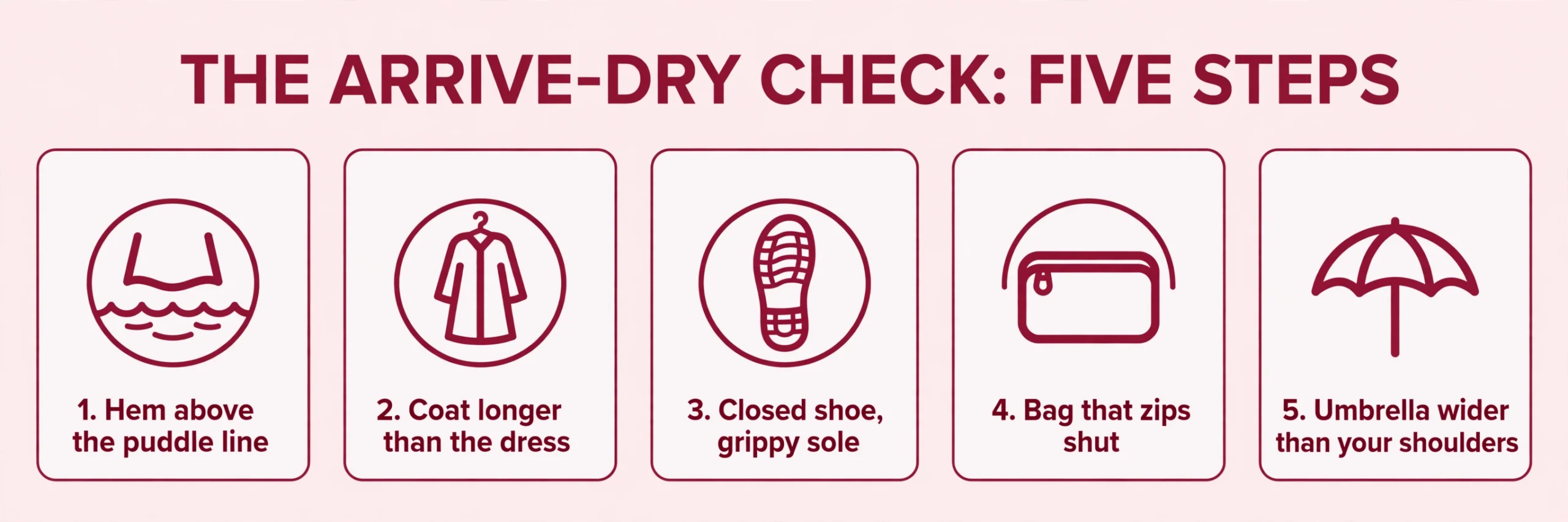
Rain is not a reason to dress down, and it is not a reason to sacrifice the outfit you planned to the walk between the car and the door. In our experience the women who arrive dry are not wearing special clothes. They are wearing ordinary, favourite clothes chosen by five rules: a fabric that sheds or hides water, a hem above the puddle line, a closed shoe with grip, a coat longer than the dress, and a bag that shuts. Decide those five things at the wardrobe, and the weather becomes background. The night stays the point.
— Friday Night Style
Frequently Asked Questions
Can I wear a dress on a rainy night out?
Yes, and a dress is often the easiest rainy-night piece, because it has no waistband to wick water and no trouser hem to drag. Choose a knee-length or shorter style, or a slim midi lifted by a heeled boot, in a fabric that sheds or hides water: a matte knit, a dark print, leather or faux leather. Keep silk, satin and pale chiffon for dry nights, and let a coat longer than the dress do the protecting on the walk.
What shoes should I avoid in the rain?
Avoid suede, satin and fabric uppers, which stain and soak; smooth leather soles, which have almost no grip on wet stone and tile; open sandals and mules, which let water in over the toes and slip on a wet footbed; and very high, narrow stilettos, which are unstable on slick ground. The rainy-night shoe is closed, leather or purpose-built, with a textured rubber sole and a low, stable heel or a heeled boot shaft.
How do I stop my hem getting soaked?
Keep the hem off the ground and out of the splash zone. Shorten the silhouette for the night: knee-length dresses, cropped or cuffed trousers, jeans tucked into boots. If you wear a midi, pair it with a heeled boot so the hem clears standing water, and lift the hem by hand at curbs and puddles rather than letting it trail. A coat longer than the dress keeps the top of the hem dry; the shoe’s lift keeps the bottom of it dry.
Is a trench coat enough, or do I need a waterproof jacket?
For a night out, a trench in a coated, tight-weave fabric is enough for the walks that matter: car to door, door to taxi, a few city blocks. It sheds rain at the surface and still looks like part of the outfit. A fully waterproof technical jacket earns its place only when the night involves long, exposed walks. What matters more than the label is the build: the coat closes fully, covers the dress hem, and is worn shut in the rain rather than open over it.
What if my outfit gets wet anyway?
Blot it, hang it in moving air, and let it dry slowly away from heat. Do not rub the fabric, do not blast leather or silk with a hairdryer, and do not judge the damage while the piece is still damp, because most water marks fade as a garment dries evenly. Condition leather once it is dry, and take silk with remaining spots to a dry cleaner rather than treating it at the sink.
Questions About Rainy Night Outfits?
Tell us the plan, the dress code, and the part of the outfit that is not working — we read every message.
Sources
- Woolmark — Wool Fibre Properties, Facts and Benefits
- TextileTuts — Fabric Care Guide for Every Fabric
- Heddels — Protecting Leather Shoes from Rain, Sleet and Snow
- REI — Rainwear: How It Works
- OSHA — Walking and Working Surfaces
- Who What Wear — Rainy-Day Outfits
- Vogue — Rainy-Day Outfit Ideas
- Glamour — Rainy-Day Outfit Ideas
- Wirecutter — The Best Rain Boots
- Wirecutter — The Best Umbrella
- Patagonia — Waterproof and Breathable Construction
- Columbia — Waterproof Versus Water-Resistant